
Friendship-Based Routing: Decoding Social Pressure for Efficient DTNs
Exploiting Friendship Relations for Efficient Routing in Mobile Social Networks
The paper introduces Friendship-Based Routing, a novel protocol for Mobile Social Networks (MSNs) within the Delay Tolerant Network (DTN) framework. It utilizes a new Social Pressure Metric (SPM) to quantify friendship quality and identifies periodic social communities to optimize opportunistic message forwarding.
TL;DR
In the world of Mobile Social Networks (MSNs), your best "courier" isn't necessarily the person you see most often, but the one you see most predictably. This paper introduces a Friendship-Based Routing algorithm that uses a new math metric called Social Pressure Metric (SPM) to quantify the "intensity" of social bonds. By segmenting friendship communities into time-of-day periods, it achieves massive gains in routing efficiency—up to 450% improvement over classical probabilistic methods.
The "Friendship" Blind Spot in Routing
Routing in Delay Tolerant Networks (DTNs) is notoriously difficult because a stable end-to-end path rarely exists. We rely on "opportunistic" forwarding—giving a message to someone who has a better chance of meeting the destination later.
Previous SOTA methods had a major flaw: they were "socially shallow." They looked at total contact time or simple frequency but ignored regularity and periodicity. If node A meets node B every morning at 9:00 AM for 5 minutes, that is a much more reliable routing link than a random 2-hour meeting that happens once a month.
Methodology: Science of Social Pressure
The authors define friendship through three lenses: Frequency, Longevity, and Regularity.
1. The Social Pressure Metric (SPM)
Instead of just counting meetings, SPM asks: "What is the average remaining time until the next meeting if I generated a message at every possible moment?"
Mathematically, it is the inverse of the link quality. If meetings are frequent and evenly spaced (regular), the SPM stays low, and the link weight stays high.
2. Indirect Friendships (RSPM)
Traditional transitivity assumes if A knows B, and B knows C, then A knows C. But in routing, the order matters. The authors propose Relative SPM (RSPM), which specifically measures the efficiency of the path . It captures the reality that node B might consistently meet C shortly after meeting A, creating a "social pipeline" even if A and C never meet.
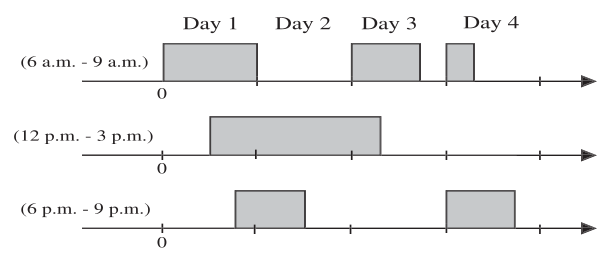 Fig 1: Illustration of how encounter history is partitioned into periodic slices to detect time-dependent friendships.
3. Periodic Communities
Your "friend" at 10:00 AM is likely a coworker. Your "friend" at 8:00 PM is likely a family member. By creating Periodic Friendship Communities, the algorithm ensures messages aren't handed to a "work friend" on a Friday evening when they won't be seen again for 60 hours.
Performance: Efficiency Reimagined
The researchers tested the algorithm against Prophet, SimBet, and Fresh across real-world traces (MIT, Haggle) and synthetic models.
- MIT Trace: Achieved the highest delivery ratio (78%) while maintaining the lowest cost.
- Haggle Trace: Demonstrated a staggering 450% increase in routing efficiency compared to Prophet.
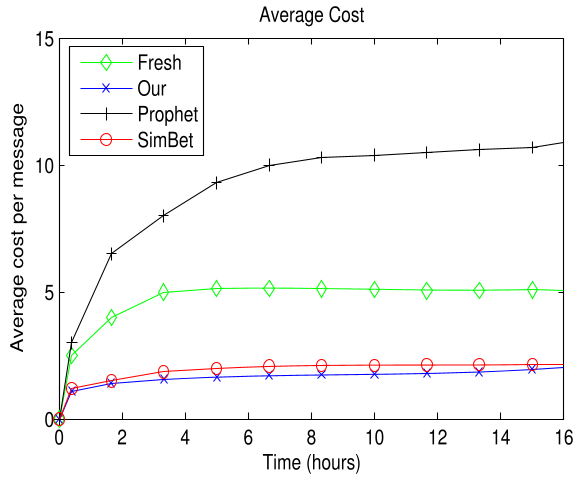 Fig 2: Performance comparison in Haggle traces showing the superior balance between delivery ratio and cost.
What’s impressive is the Ablation-style insight: even with limited buffer space, the algorithm’s focus on "high-quality" friends prevents the network from being flooded with useless replicas, which normally causes packet drops in protocols like Epidemic Routing.
Critical Analysis & Future Outlook
The genius of this work lies in treating human mobility as a non-memoryless process. By acknowledging that future contacts depend on the time passed since the last contact (periodicity), the authors moved past the "Random Walk" myths of early DTN research.
Limitations:
- Storage Overhead: Managing community sets for every 3-hour window might be taxing for low-power IoT devices.
- Threshold Sensitivity: The (friendship threshold) needs to be finely tuned for different environments (e.g., a dense conference vs. a sparse city).
Closing Takeaway: This paper effectively proves that in mobile networks, Social Structure = Physical Topology. Future MSN routing will likely move toward even more granular context-awareness, perhaps integrating activity recognition (GPS/accelerometer) to refine these periodic friendship windows.