
ImSoRec: Beyond Friend Lists—Unlocking Implicit Social Ties for POI Recommendation
Exploiting Implicit Social Relationship for Point-of-Interest Recommendation
The paper introduces ImSoRec (Implicit Social Relationship Enhanced POI Recommendation), a novel POI recommendation model that extracts implicit social connections from spatio-temporal check-in data. By fusing implicit behavior patterns with explicit social networks using Probabilistic Matrix Factorization (PMF), it achieves SOTA performance on Foursquare and Gowalla datasets.
TL;DR
Social networks are vital for POI recommendation, but what if the "friends" list is empty? ImSoRec bridges this gap by extracting implicit social relationships from spatio-temporal check-in history. By analyzing how often and where users "bump into each other" (co-occurrences), this model significantly outperforms traditional social-based recommendation systems, especially in data-sparse environments.
Background: The "Social Gap" in LBSNs
In Location-Based Social Networks (LBSNs) like Foursquare or Yelp, we usually assume users visit places their friends visit. However, two major issues persist:
- Data Sparsity: Many users don't link their Facebook or Twitter friends to these apps.
- Spatial Irrelevance: Your Facebook friend might live 1,000 miles away; their favorite local cafe is useless for your recommendations.
The authors argue that Implicit Social Relationships—people who frequently visit the same niche spots at the same time—are much better indicators of shared taste and spatial commonality.
Methodology: How to Measure an "Implicit" Bond?
The paper breaks this down into three technical challenges: capturing the relation, representing its strength, and integration.
1. Extracting Strength: Diversity & Weighted Frequency
Not all co-occurrences are equal. If you meet someone at a massive airport (high popularity), it means little. If you meet at a small, niche jazz club (low popularity), it suggests a strong shared interest.
- Diversity (): Uses Renyi entropy to measure if users meet across many different locations rather than just one.
- Weighted Frequency (): Uses location entropy to give more weight to co-occurrences in "quiet" or private places.
2. The ImSoRec Model Architecture
The model extends Probabilistic Matrix Factorization (PMF). It creates a dual-influence system:
- Explicit Branch: Models social trust propagation.
- Implicit Branch: Models behavior similarity.
- Adaptive Fusion: A parameter (learned via Beta distribution) lets the model decide for each specific user whether they are more influenced by their real friends or their "behavioral twins."
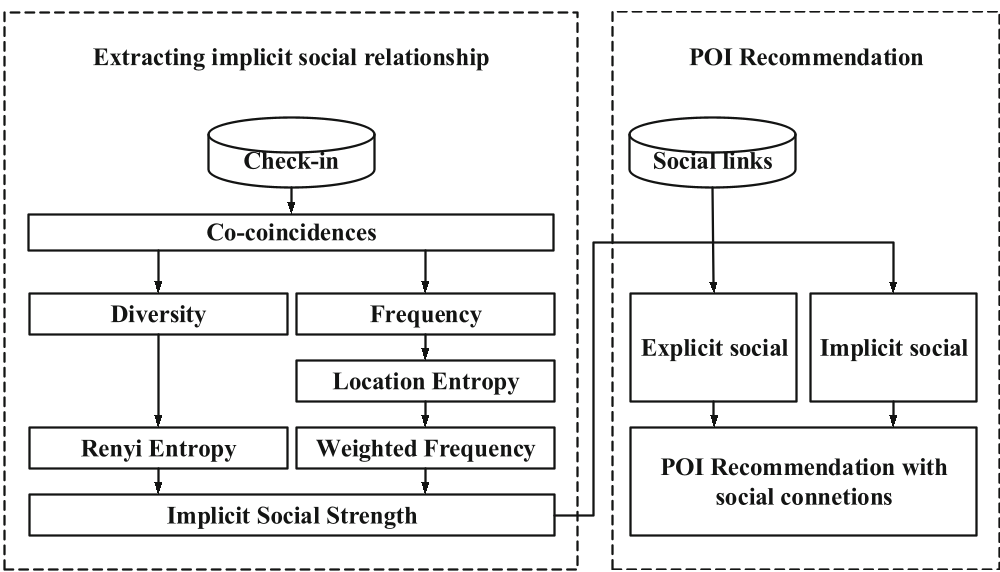 Figure: The ImSoRec framework showing the pipeline from spatio-temporal data to final recommendation.
Experiments & Key Findings
The authors tested ImSoRec against 5 baselines across two major datasets.
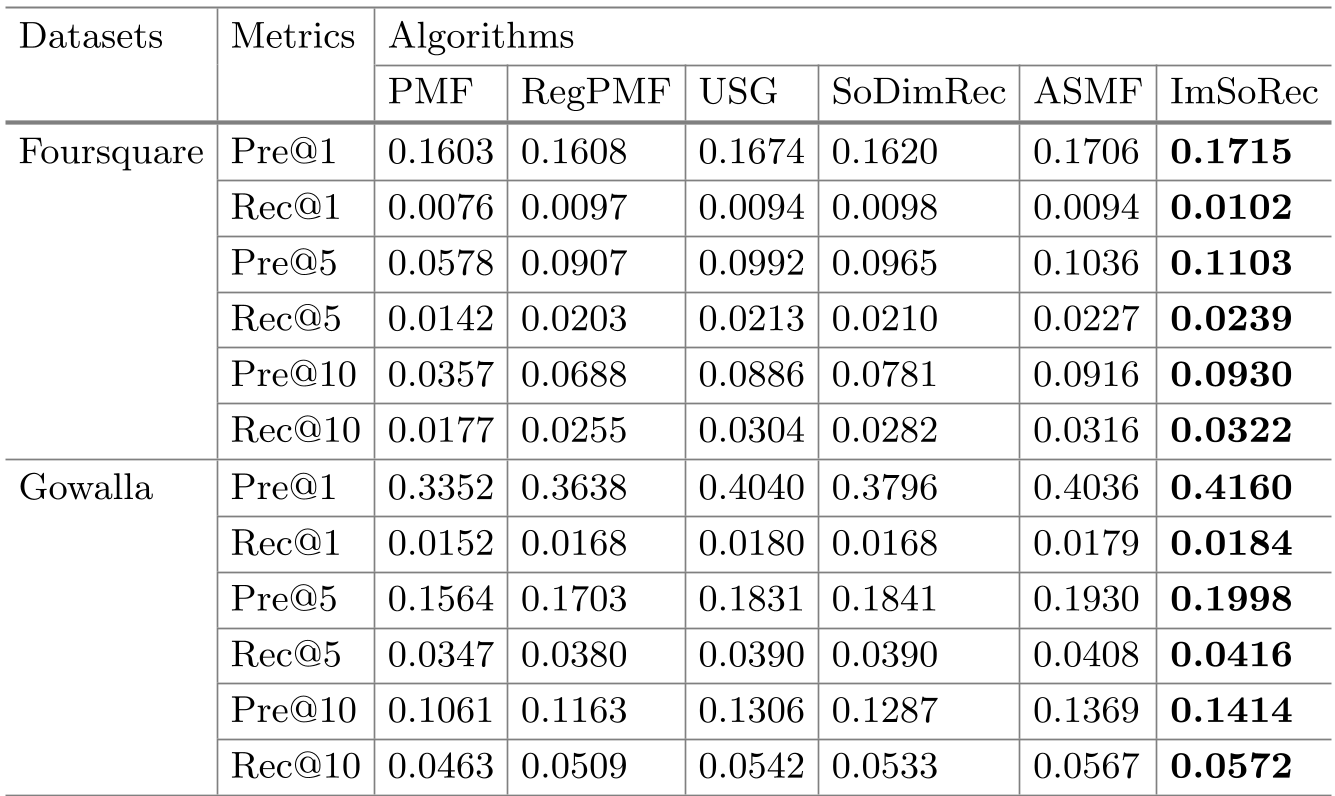 Table: Precision and Recall metrics across different algorithms. ImSoRec consistently leads.
Critical Insight: The Power of Implicit over Explicit In Figure 5 of the paper, the sensitivity analysis of revealed something startling: the model performs best when is small (around 0.2). This means that implicit social relationships have a much higher impact on a user's decision-making process than their explicit friends.
Critical Analysis & Conclusion
Takeaway
ImSoRec proves that "behavior speaks louder than friend lists." By focusing on co-occurrence diversity and location specificity, the model captures the nuances of urban mobility that social graphs miss.
Limitations
- Temporal Granularity: The co-occurrence window is fixed (e.g., 1 hour). In very dense cities, this might capture noise (strangers in a mall) rather than genuine implicit ties.
- Cold Start: While it helps with social sparsity, it still requires some check-in history to establish implicit bonds.
Future Work
The next step for this research line is likely the move toward Graph Neural Networks (GNNs). Instead of static Matrix Factorization, modeling these implicit bonds as dynamic edges in a spatio-temporal graph could further improve the "Social-Aware" recommendation paradigm.