
Exploiting Locality of Interest: A New Blueprint for Global Social Networks
Exploiting locality of interest in online social networks
This paper introduces a distributed architecture for Online Social Networks (OSNs) by leveraging TCP proxies and Regional OSN Caches. By reverse-engineering Facebook's traffic, the authors demonstrate that partitioning OSN state based on "locality of interest" can achieve a 79% reduction in request latency and a 91% reduction in bandwidth consumption.
TL;DR
Online Social Networks (OSNs) are inherently global, yet their infrastructures often remain stubbornly centralized. This paper reveals that Facebook's reliance on U.S. data centers causes massive latency for international users. By introducing TCP Proxies and Regional OSN Caches—functionality that exploits the fact that social interactions are often geographically clustered—the authors reduced user lag by up to 79% and slashed backbone bandwidth usage by 91%.
Contextual Positioning
Published during a period of explosive OSN growth, this study is a seminal "reverse-engineering" work. It treats a proprietary giant (Facebook) as a black box to uncover a fundamental truth: the social graph is not a uniform web, but a collection of dense local clusters that can be partitioned for massive performance gains.
Problem & Motivation: The Transatlantic Lag
The authors identified two fatal flaws in the centralized OSN model:
- Protocol Chatty-ness: Even small updates (like "Likes") require multiple round trips. When these cross high-latency, lossy transatlantic links, the cumulative delay becomes unbearable.
- Bandwidth Waste: If 10,000 users in Sweden view the same local status update, current systems fetch that data from the U.S. 10,000 times, ignoring the inherent "Locality of Interest."
Methodology: The Core Innovation
The researchers proposed a two-tier strategy to decentralize OSN state without the massive cost of building new data centers.
1. TCP Proxies
By placing a proxy server in the user's region, the high packet loss typical of "last-mile" connections is isolated. Retransmissions happen locally and quickly, preventing the entire transatlantic pipe from stalling.
2. Regional OSN Cache
Unlike a standard CDN (which handles static photos), this cache stores dynamic OSN state (wall posts, comments) and the local social graph.
- The 55-Second Rule: The cache persists state for just 55 seconds (matching the polling interval), ensuring consistency remains high while satisfying the majority of "Locality of Interest" requests locally.
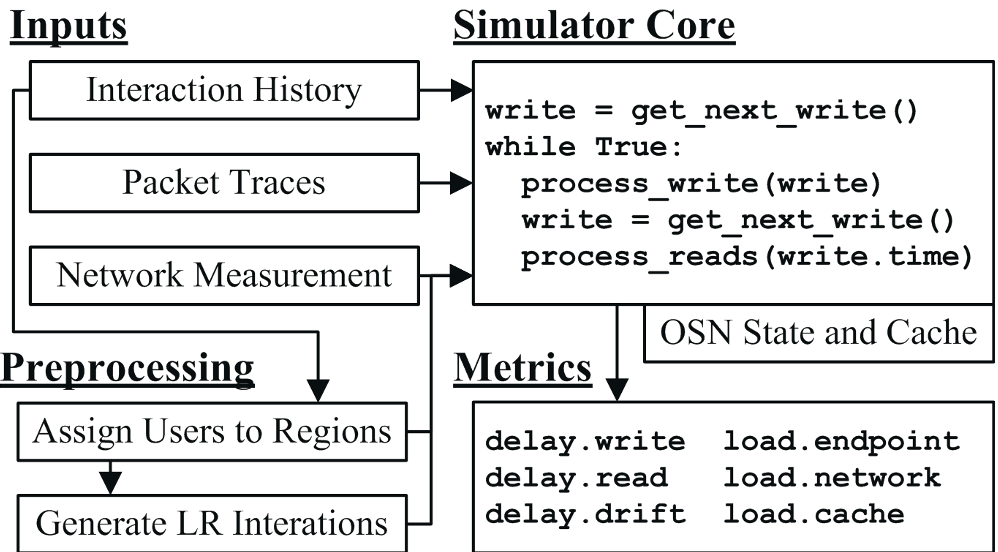 Figure 1: The proposed information flow where the Regional Server (REG) intercepts requests to reduce round-trip time to U.S. data centers.
Experiments & Results
The authors evaluated their model across five distinct geographic regions: Russia, Egypt, Sweden, New York City, and Los Angeles.
Scaling the "Interactive Feel"
In Russia, mean write delay plummeted by over 75%. The reduction in "OSN State Drift"—the time between a post being made and it appearing in a friend's feed—was even more dramatic, turning a sluggish "real-time" experience into a truly instantaneous one.
Bandwidth and Efficiency
The load on the main California data center for Swedish traffic dropped by 91% when regional caches were used.
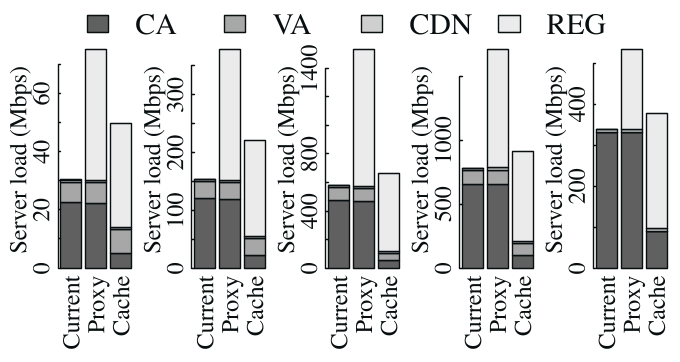 Figure 2: Traffic load comparison showing significant reduction in infrastructure load (VA/CA) when moving from current architectures to Regional OSN Caches.
Critical Analysis & Conclusion
Takeaway
The paper proves that locality matters. Even in a "borderless" digital world, physical proximity between users remains the strongest predictor of interaction. Architecting systems to respect this geographic clustering yields exponential improvements in efficiency.
Limitations & Future Work
- Ad Placement: The study focused on organic content; scaling dynamic ad-insertion to regional edges presents a different consistency challenge.
- Dynamic Popularity: While 55 seconds works for social feeds, viral "global" content (breaking news) might still strain the regional model.
In conclusion, the deployment of regional servers is not just a performance tweak—it is a more cost-effective scaling strategy than wholesale data center replication, offering a path for OSNs to provide a local-first experience on a global scale.