
CG SSL: Uncovering Hidden Social Ties through Community Consistency
Exploit of Online Social Networks with Community-Based Graph Semi-Supervised Learning
The paper introduces a Community-based Graph (CG) Semi-Supervised Learning (SSL) model designed to infer sensitive information in Online Social Networks (OSNs). By integrating "community consistency" into existing graph-based SSL frameworks, the method achieves superior accuracy in predicting hidden user attributes across synthetic and real-world datasets like Facebook and StudiVZ.
TL;DR
Online Social Networks (OSNs) often claim user privacy is protected through profile settings, but the "Community-based Graph (CG) SSL" model proves otherwise. By leveraging public friendship and group membership data, this novel Semi-Supervised Learning approach identifies sensitive information with higher accuracy than ever before, using a new mathematical constraint called Community Consistency.
Background: The Illusion of Privacy
In platforms like Facebook, up to 70% of users have incomplete profiles. While individual attributes might be hidden, their connections—friends, university networks, and hobby groups—are often visible. This paper posits that these connections are not just "noise" but structured "communities" that act as powerful predictors for hidden data.
Problem & Motivation: Beyond Local Links
Previous graph-based SSL models, such as those using Harmonic Functions or Local and Global Consistency (LGC), rely on the assumption that "neighbors in a graph are likely to share the same label." However, social reality is more complex:
- Local Consistency focuses only on direct neighbors.
- Global Consistency looks at the overall structure but misses sub-group dynamics.
- The Missing Link: Users might not be direct friends but belong to the same dense community (e.g., attending the same university or joining the same niche group).
The authors' insight is to formalize this "Community Consistency" to bridge the gap between individual friendships and global network trends.
Methodology: High-Level Intuition
The core of the CG SSL model is an optimization problem that minimizes three types of "disharmony":
- Local Disharmony: Differences between direct friends.
- Fitting Error: Discrepancy between predicted labels and known (labeled) data.
- Community Disharmony: Variance within defined social communities.
Architecture Evolution
As shown in the authors' conceptual map, CG SSL incorporates all previous methodologies while adding a community layer:
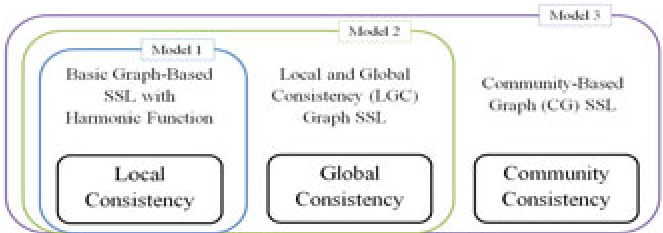
The Objective Function
The model is expressed as:
- : The Laplacian of the friendship graph.
- : The Laplacian of the community matrix (generated via K-means clustering of group/network distances).
- : Control parameters for the influence of labels and communities.
Experiments & Results: Proving the Risk
The researchers tested their model on three specific datasets: a synthetic "TwoMoons" set, and two real-world datasets from StudiVZ and Facebook.
1. Superiority over Supervised Learning
In nearly every test case, the graph-based SSL methods crushed traditional Supervised Learning. This is because SSL "propagates" information through the unlabeled parts of the network, effectively using the silence of some users to learn from the noise of others.
2. The Power of Communities
On the Facebook dataset, when only 1% of data was labeled, CG SSL reached nearly 75% accuracy in predicting sensitive university affiliations, significantly outperforming LGC SSL (~63%) and Basic Graph SSL (~65%).
3. Stability in Predictions
One of the most impressive results was on the TwoMoons dataset. While other SSL models failed to distinguish between classes where local links were ambiguous, the community constraint provided the "tie-breaker" needed to reach 100% accuracy.

Deep Insights & Concluding Thoughts
Takeaway
The success of CG SSL demonstrates that communities are the fundamental units of social identity. Even if you hide your profile, the groups you join and the meta-networks you occupy provide a signature that is mathematically difficult to mask.
Limitations
The model depends heavily on the quality of the "Community Generation" phase. As seen in the StudiVZ experiments, if the clustering of communities is unstable, the final prediction accuracy can fluctuate even as more labeled data is added.
Future Outlook
As Online Social Networks evolve into decentralized formats, the privacy risk remains. This research serves as a warning for platform designers: protecting a user's attributes is useless if you do not also protect the topology of their associations.