
Beyond the Greedy Leap: Maximizing Banking ROI through Global Offer Optimization
Exploiting response models—optimizing cross-sell and up-sell opportunities in banking
The paper proposes an optimization framework for bank cross-sell and up-sell campaigns, utilizing response and profitability models to assign products and channels to customers. It introduces a practical two-stage algorithm (Algorithm P) that uses customer aggregation and Linear Programming (LP) to maximize global ROI while adhering to complex business constraints.
TL;DR
Marketing in banking has long followed the mantra: “Right product, right customer, right time.” However, achieving this at scale is an optimization nightmare. This paper moves beyond simple predictive modeling (who will buy?) to Global Offer Optimization (what combination maximizes bank-wide profit?). By introducing a scalable aggregation-based algorithm, the author demonstrates a 93% ROI increase over traditional methods while managing real-world constraints like call center capacity and strict budgets.
The "Greedy" Trap: Why Predictive Models Aren't Enough
Most banks use Response Models—statistical tools that tell you Customer A has a 5% chance of buying a Mortgage. The standard "Greedy" approach is to rank customers by this probability and work down the list until the budget is gone.
The Motivation for Change:
- Resource Contention: What if Customer A is the best candidate for both a Mortgage and a Credit Card, but the bank only wants to send one offer?
- Capacity Bottlenecks: A branch might only be able to handle 1,000 follow-up calls, even if 10,000 customers are "high probability."
- Hidden Costs: Traditional rules can't tell you how much profit you lost by capping the budget at 1.5M.
Methodology: High-Dimensional Optimization for Millions
The "Ideal Solution" is an Integer Program (IP). With 5 million customers and 10 products, you face 50 million decision variables—a computational wall.
The Two-Stage Scalable Framework
The paper introduces Algorithm P, which sidesteps this complexity:
- Phase 1: Aggregation: Customers are grouped into aggregates based on similar expected profits and costs. This shrinks the problem size.
- Phase 2: Linear Programming: The system solves for the proportion of each aggregate that should receive a specific offer.
- Phase 3: Assignment: The "fractional" results from the LP are turned back into individual customer assignments by solving a simple local assignment problem within each aggregate.
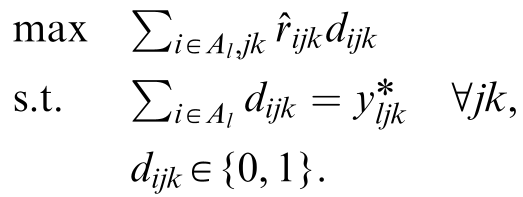 The algorithm uses aggregate centroids to find a near-optimal allocation that respects global constraints.
Real-World Impact: The $3.58 Million Result
The bank tested this on a universe of 2.5 million customers with 11 different products (GICs, Mutual Funds, Credit Cards, etc.) across three channels (Direct Mail, Call Center, Branch).
Key Breakthroughs:
- The Profit Lift: The optimized plan generated 2.65M using the best ad-hoc business rules. That is nearly $1M in "found money" simply through better math.
- Constraint Insight: The model provided "Marginal Values." For instance, the Campaign Cost constraint had a marginal value of *1 we spend on this campaign, we expect $1.53 in additional profit."
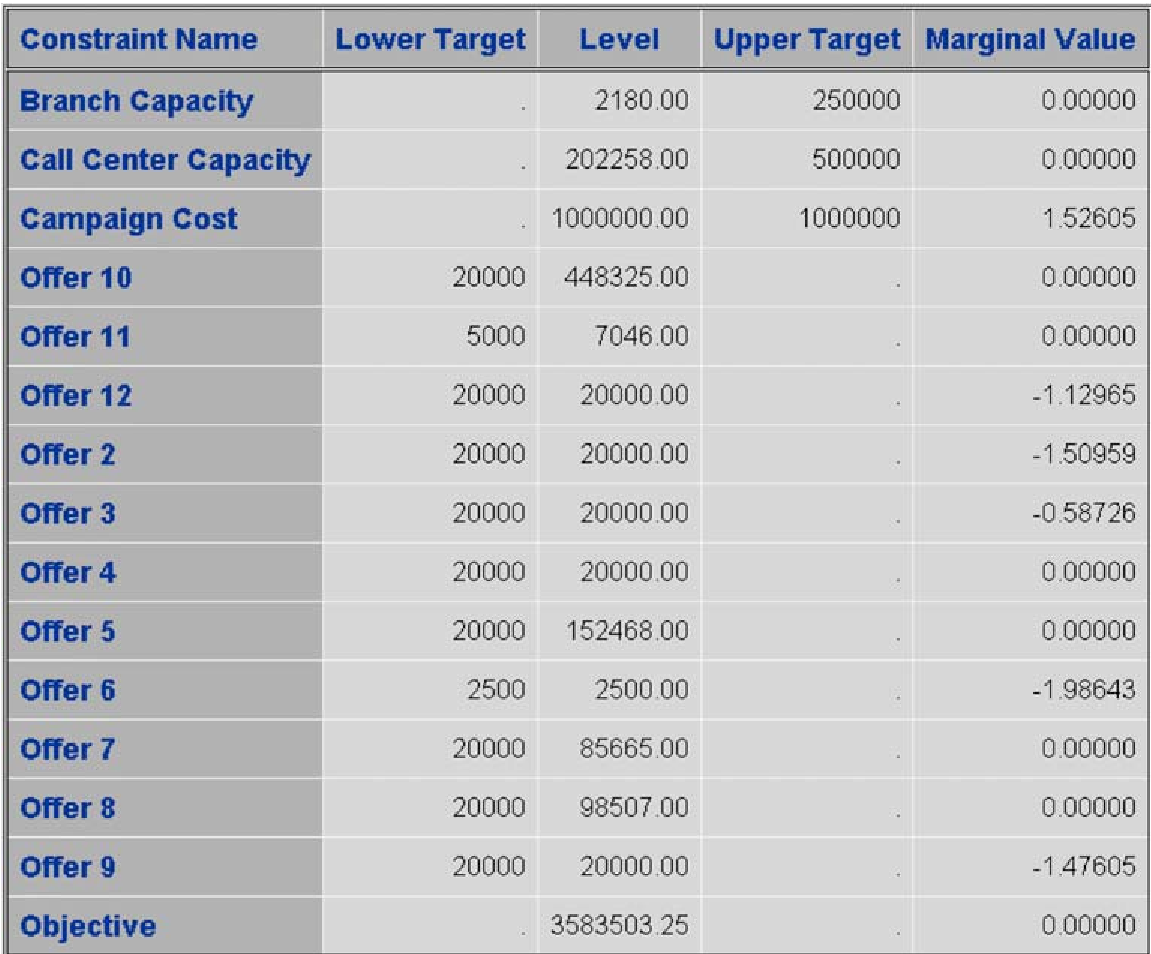 The Constraint Report quantifies the "shadow price" of business rules, showing exactly which constraints limit profit.
Critical Insight: Strategizing Capacity
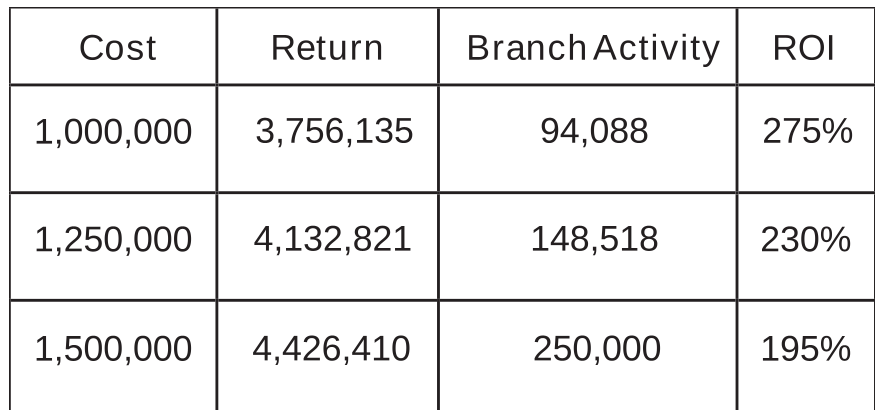
One of the most powerful takeaways is Sensitivity Analysis. By varying the budget in the model, the bank could see when their branch capacity became a bottleneck. As shown below, once the budget reached $1.5M, the branch became fully utilized, and the ROI began to taper. This allows managers to decide when to hire more staff or expand channel operations based on hard ROI data.
Conclusion & Future Outlook
While the paper focuses on banking, the logic applies to any industry with limited resources and multiple offers (e.g., Telecom, E-commerce).
- Limit: The model assumes linear relationships; non-linear costs (like bulk discounts on mail) require more complex solvers.
- Legacy: This work serves as a foundational bridge between "Data Mining" (finding the visitor) and "Operations Research" (finding the profit).
Takeaway for Leaders: Stop asking who the "best" customer for a product is. Start asking what the "best" allocation of your entire marketing budget looks like across your total customer base.