
DeEvA: Bridging Personality and Aesthetics via Evolutionary Crowdsourcing
Exploiting Reverse Correlation for the Generation of Virtual Characters from Personality Traits.
The paper introduces DeEvA, a platform that utilizes Crowdsourcing and Interactive Genetic Algorithms (IGAs) to generate virtual characters based on desired personality traits (e.g., OCEAN model). It bridges the gap between high-level character description and low-level physical attribute modeling through a Reverse Correlation approach.
TL;DR
First impressions of virtual characters are often driven by sub-conscious stereotypes. This paper introduces DeEvA (Depot of Evolving Avatars), a system that uses Interactive Genetic Algorithms (IGA) and the wisdom of the crowd to automatically translate personality traits (like the "Big Five") into 3D physical attributes. By evolving "generations" of characters based on user votes, the system creates a reliable mapping that lets designers generate believable characters by simply describing their personality.
Background: The Designer's Gap
In the traditional character creation workflow, there is a massive cognitive leap between a writer's description ("a dominant, untrustworthy villain") and a modeler's task (adjusting 200+ sliders for chin width, eye distance, and torso V-shape). While tools like MakeHuman have simplified the crafting, they haven't addressed the design logic: Why does a certain jawline make a character look more reliable?
Methodology: Evolution Driven by Human Perception
The core of the DeEvA platform is an Interactive Genetic Algorithm (IGA). Here is the process:
- Genotype to Phenotype: A character's "DNA" is a vector of slider values from the MakeHuman engine.
- The Crowd as a Fitness Function: Instead of a mathematical formula, the "fitness" of an individual is determined by how consistently a crowd of human voters assigns it a specific personality trait.
- Reverse Correlation: By analyzing these votes, the system identifies which physical genes (e.g., eyebrow angle) are statistically responsible for the perceived "Dominance" or "Trustworthiness."
- Retrieval: Once the mapping is trained, a designer can input a personality profile, and the system maximizes the following objective to find the best-matched visual candidate:
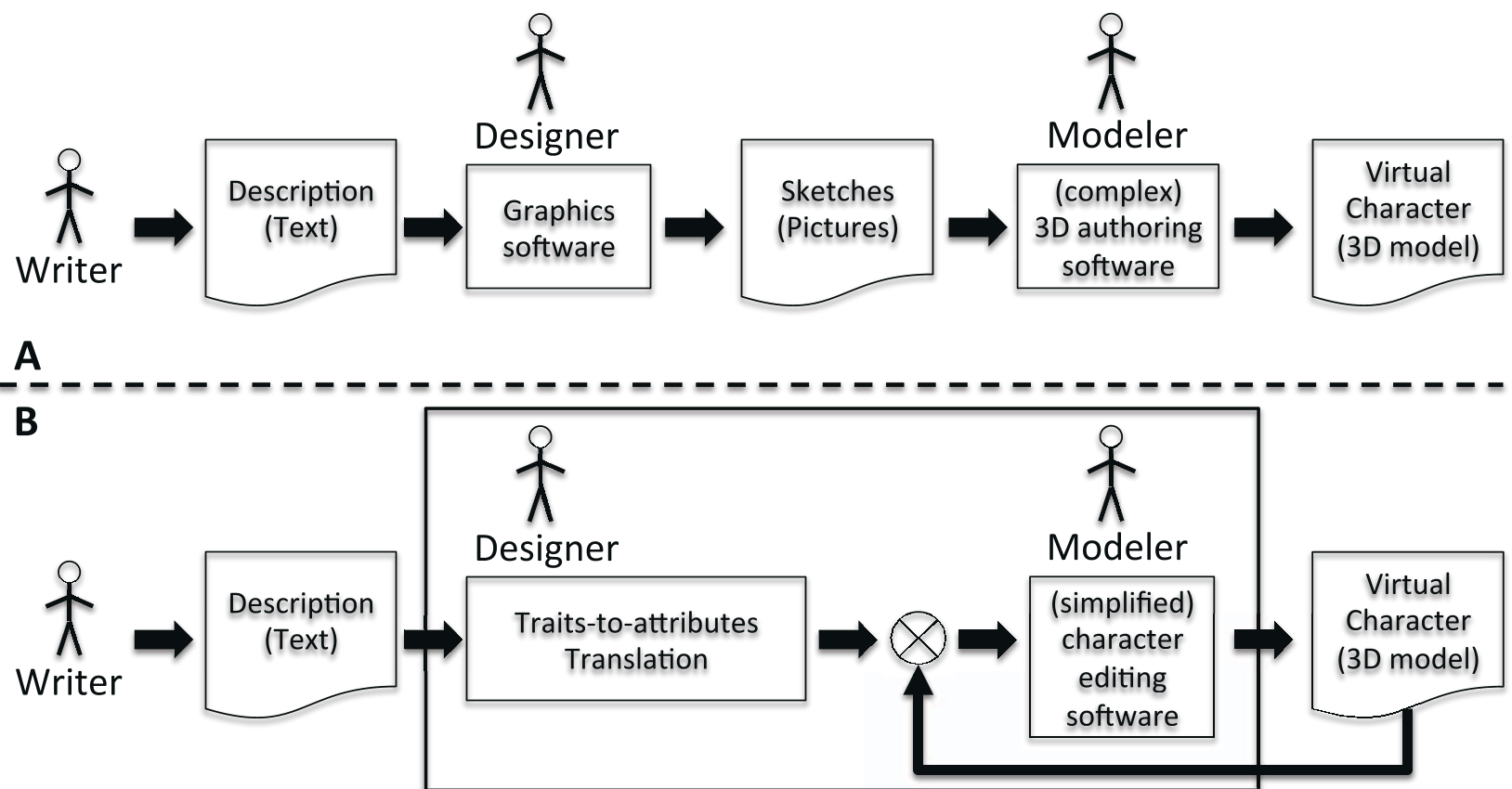 The workflow contrasts traditional manual design (top) with the proposed trait-to-attribute translation (bottom).
Experiments and Insights
The authors validated the system through two main experiments:
1. The Power of "Elite" Selection
By filtering the population to only include "Elite" individuals (those with the highest fitness scores), the researchers found a dramatic increase in predictability. For the Dominance trait, the correlation coefficient () jumped from 0.5627 (random population) to 0.7731 (top 25% elites). This proves the genetic algorithm successfully "purifies" the visual signals for personality.
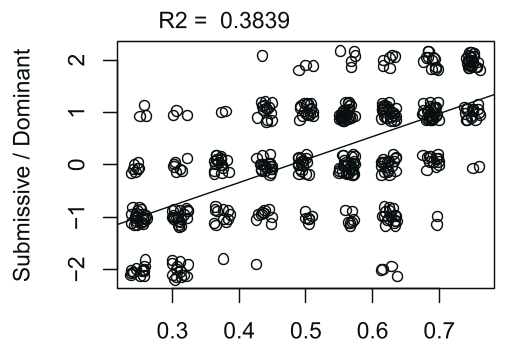 Experimental results showing how Dominance perception correlates more tightly with Age and Gender as the population evolves.
2. Decoding Dominance
What specifically makes an avatar look "Dominant"? Using backward elimination regression, the study identified the most significant predictors:
- Eyebrow angle: (Downward/Angled)
- Neck scale: (Wider necks)
- Torso width: (Broad shoulders)
- Face shape: (Rectangularity)
Interestingly, while previous psych research focused heavily on the face, this study highlights that body proportions (neck and torso) are equally critical for social signaling in 3D avatars.
Critical Analysis & Conclusion
Takeaway
DeEvA moves character authoring from "vertex-space" to "personality-space." It leverages the fact that while individual human judgments are subjective, the aggregate judgment of a crowd is remarkably consistent.
Limitations
- The "Neutral" Bias: Voters tend to gravitate toward the center of scales (Neutral), making it harder to evolve extreme archetypes.
- Dynamic Cues: The study focused on static images. In reality, personality is heavily influenced by animation and posture, which the authors plan to include in future iterations.
Future Work
The fusion of this evolutionary approach with Generative AI (like Stable Diffusion or 3D GANs) could soon allow us to generate high-fidelity 3D NPCs by simply typing: "Generate a shopkeeper who is 70% agreeable but 90% neurotic."
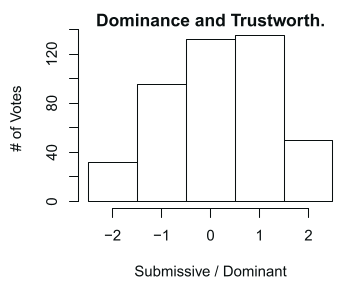 Visual comparison of the evolved 'Most Submissive' (left) vs 'Most Dominant' (right) characters.