
SIARS: Bridging Online Influence and Offline Attendance in EBSN Recommendation
Exploiting social influence for context-aware event recommendation in event-based social networks
The paper introduces SIARS (Social Information Augmented Recommender System), a context-aware framework for Event-based Social Networks (EBSNs). It innovatively integrates the social influence of event hosts and group members with temporal, spatial, and content data to achieve SOTA performance in personalized event recommendation.
TL;DR
Recommending events is significantly harder than recommending movies or products because events are ephemeral—they don't have historical ratings to leverage. This paper presents SIARS, a Social Information Augmented Recommender System that tackles this "cold-start" challenge by mining the social reputation of event hosts (even from other platforms like Twitter) and the interaction history of group members, combined with advanced spatial and topic modeling.
Problem & Motivation: The Transience of Events
Traditional recommender systems rely on Matrix Factorization or Collaborative Filtering. However, in Event-based Social Networks (EBSNs) like Meetup or Eventbrite, these fail for two reasons:
- Strict Cold-Start: New events have zero historical attendees.
- Short Life Cycle: Feedback (ratings/comments) only appears after the event is over, making it useless for recommending the same event to others.
While prior work focused on "where" and "when," they missed "who." The authors argue that a host’s reputation and the "social ties" within a group are the missing links to predicting whether a user will show up offline.
Methodology: The Five Pillars of SIARS
SIARS operates as a fusion model, aggregating scores from five specialized sub-models:
1. Host-Aware Model (The Social Lever)
This is the paper's most unique contribution. Since a new event has no history, the authors look at the Host. They calculate host influence via:
- External Influence: Number of followers on Twitter (modeled via CDF).
- Reputation: Average ratings of all past events hosted by that individual.
- Consistency: Similarity between the new event’s content and the host’s previous successful events.
- Optimization: They use a modified AdaBPR (Adaptive Boosting Personalized Ranking) to intelligently weight these heterogeneous social signals.
2. Member-Aware Model
"It takes two to tango." Research shows users often attend events if their past co-attendees are going. This model calculates the Jaccard similarity between a user and other members of the group hosting the event.
3. Contextual Refinements (Content, Time, Location)
- Content: Instead of simple keyword matching, they use Latent Dirichlet Allocation (LDA) to map events to a user's latent interest topics.
- Location: They don't just look at distance; they integrate Location Popularity, realizing that certain venues (like a famous park or tech hub) act as "gravity centers" for events.
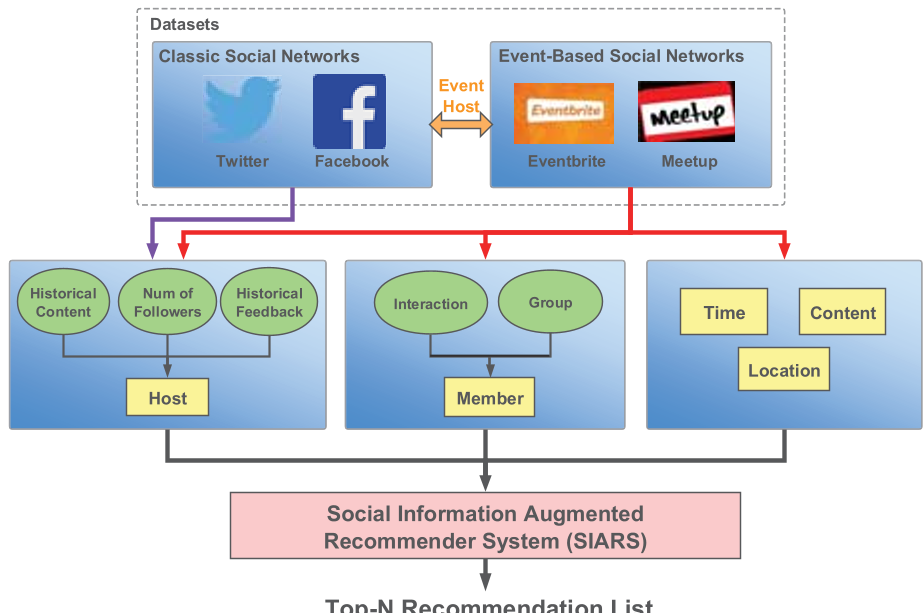 Figure 1: High-level overview of the SIARS framework showing the integration of EBSN data and external social networks.
Experiments & Results
The authors tested SIARS against standard baselines (Most Popular - MP) and SOTA methods (BPR, MCLRE) using real-world data from Phoenix, Chicago, San Jose, and New York.
Key Findings:
- Accuracy Boost: SIARS consistently outperformed the MCLRE baseline. Even though MCLRE was already strong, the addition of social influence provided a clear edge in Precision and Recall.
- Ablation Study: The authors removed features one by one to see what mattered most.
- Location & Content were the heavy hitters—removing them caused the steepest drop in performance.
- Social Influence (Host/Member) proved more influential than Time, justifying the paper’s core hypothesis.
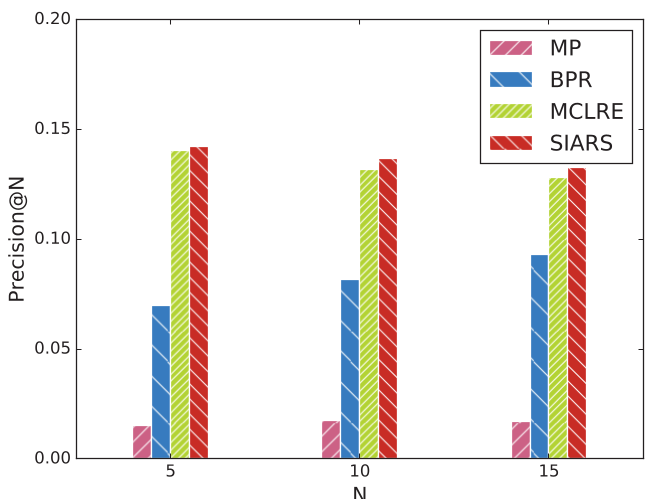 Figure 2: Performance comparison on Precision@N, demonstrating SIARS's superiority over MCLRE and BPR.
Critical Analysis & Conclusion
Takeaway
The success of SIARS confirms that in "offline-centric" social networks, the identity of the organizer acts as a proxy for event quality. By bridging the gap between a host's online persona (Twitter) and their offline output (Meetup), SIARS effectively solves the item cold-start problem.
Limitations & Future Work
While robust, the model relies on users linking their Twitter accounts to Meetup, which may not always be available (data sparsity). Future iterations could benefit from using Graph Neural Networks (GNNs) to model the complex, multi-modal relationships between Users, Hosts, and Groups as a single graph, rather than a linear fusion of separate models.
Final Thought: If you are building a recommendation engine for transient items (events, flash sales, or news), prioritizing the Source/Host reputation and Spatial Popularity will likely yield better results than traditional collaborative filtering.