
Scaling Crisis Response: A Distributed Big Data Approach to Social and Mobile Intelligence
Exploiting Social Networking and Mobile Data for Crisis Detection and Management
The paper introduces a scalable, open-source distributed platform designed for real-time crisis detection and management. By integrating spatio-textual data from social networks (Facebook, Twitter, Foursquare) and mobile GPS traces, the system achieves sub-second query latency for personalized emergency insights using a hybrid HBase/PostgreSQL architecture.
TL;DR
In the wake of natural disasters or social unrest, the "digital footprint" left on social media and mobile devices is a goldmine for first responders. This paper presents a high-performance, distributed backend that fuses GPS traces with social networking data to detect crises in real-time. By leveraging a hybrid HBase/PostgreSQL architecture and distributed machine learning, the system identifies emerging hotspots and tracks user safety with sub-second responsiveness even under heavy load.
Problem & Motivation: The Data Deluge in Emergencies
When a crisis strikes—be it an earthquake in Lesvos or a flood in the Philippines—social media activity spikes instantly (e.g., 20k tweets/day during Hurricane Sandy). Existing crisis management tools struggle with the 3Vs of Big Data:
- Volume: Millions of status updates and GPS pings.
- Velocity: The need for immediate detection (seconds matter).
- Variety: Mixing unstructured text with structured geospatial coordinates.
The authors' core insight is that crisis management isn't just about "what" is happening, but "who" it is happening to. They recognized a gap in personalized crisis intelligence: shifting the focus from global alerts to social-graph-aware insights (e.g., "Which of my friends are currently near the protest?").
Methodology: The Hybrid Distributed Engine
To solve the conflicting needs of high-speed ingestion and complex querying, the platform employs a modular layered architecture.
1. The Storage Strategy (HBase + PostgreSQL)
The system avoids the "one size fits all" database trap:
- Apache HBase: Used for high-volume, primitive data like GPS traces and social friend activities. It utilizes data replication (denormalization) to avoid costly joins during emergencies, allowing the system to trade cheap disk space for retrieval speed.
- PostgreSQL: Used for structured, lower-frequency data like the "Emergency POI" repository and user "Blogs" (semantic trajectories).
2. Core Processing Modules
- Event Detection: Implements a distributed version of DBSCAN clustering. By analyzing the density of GPS traces, the system "discovers" new emergency locations (like a spontaneous protest site) without manual input.
- Sentiment Analysis: A Naive Bayes classifier trained on 500k Tripadvisor reviews (achieving 94% accuracy) classifies social posts as positive or negative, providing a "vibe check" of the affected area.
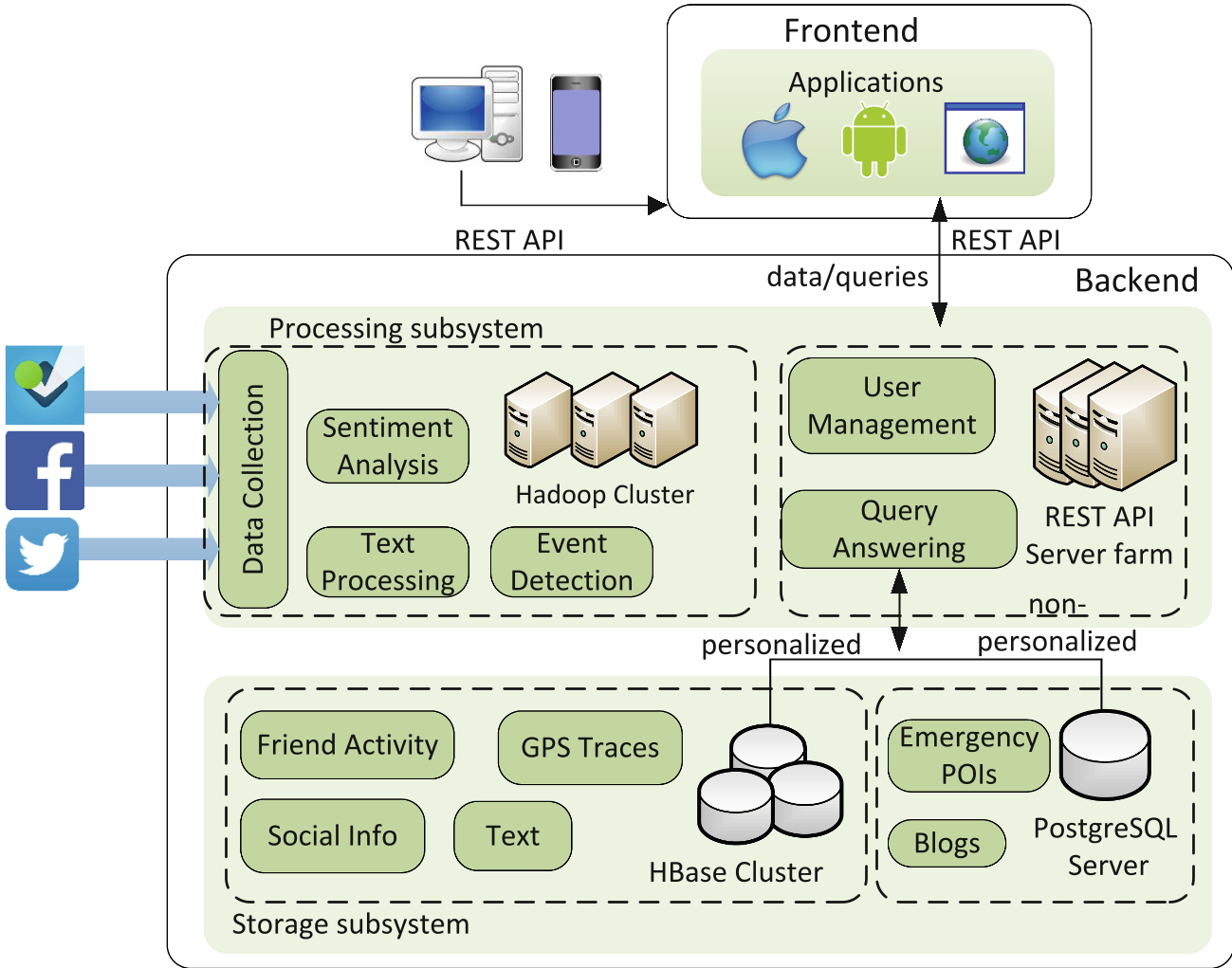 Figure 1: The layered architecture showing the interplay between the Hadoop/HBase backend and the REST API frontend.
Experiments & Results: Performance at Scale
The true test of an emergency system is its behavior under stress. The researchers simulated 150k users and measured query latency across different cluster sizes.
Performance Gains
The evaluation showed that HBase coprocessors are the "secret sauce." Instead of moving data to the server, the computation is moved to the data nodes.
- Linear Scalability: Doubling the cluster size from 8 to 16 nodes consistently reduced latency, maintaining responses under 1 second even when a user had 10,000 friends to check.
- Concurrency Resistance: While 4-node clusters choked under multiple simultaneous queries, the 16-node setup showed a flat performance curve, proving it could handle a surge of users during a real disaster.
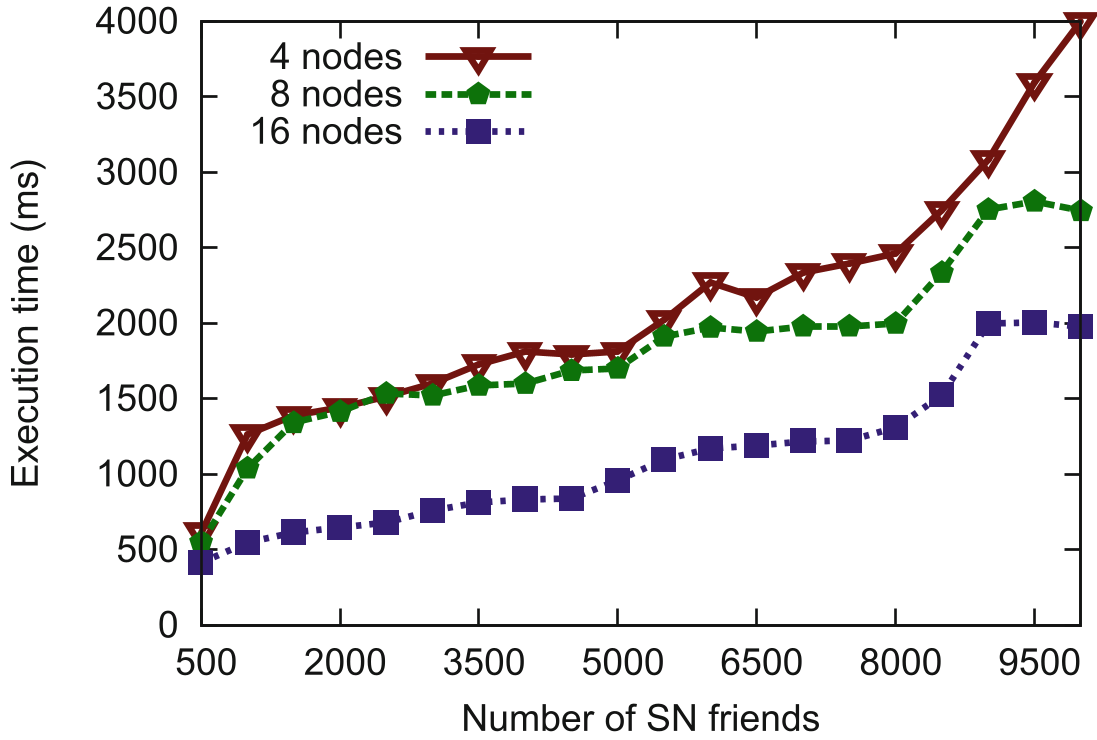 Figure 2: Execution time vs. number of social connections. Note the linear efficiency provided by the 16-node configuration.
Critical Analysis & Conclusion
Takeaway
The platform's success lies in its personalized query mechanism. By utilizing HBase regions and coprocessors, it solves the "Social Graph Discovery" problem in real-time—a task that typically crashes traditional SQL-based crisis tools.
Limitations & Future Work
While the architecture is robust, the Sentiment Analysis module relies on Tripadvisor data. While effective, emergency language (slang, panic-induced shorthand) differs significantly from hotel reviews. Future iterations could benefit from Domain-Specific Language Models (like CrisisBERT) to improve detection accuracy. Furthermore, moving from batch-oriented Hadoop to a streaming framework like Apache Flink could further reduce the "detection lag" from minutes to milliseconds.
Overall, this work provides a blueprint for the next generation of public safety infrastructure, where social networks act as a massive, distributed sensor network for humanity.