
Exploiting Social Networks for Healthcare: Turning Digital Bonds into Lifelines
Exploiting social networks for healthcare
The paper proposes a participatory sensing framework to identify and quantify the strength of social bonds within Online Social Networks (OSNs) to support healthcare and assistive living. Utilizing metrics based on interaction frequency, regularity, and extent, the authors develop a weighted graph model to identify key contacts for emergency response and information dissemination.
TL;DR
This research pioneers the use of Participatory Sensing and Online Social Networks (OSNs) to enhance healthcare and assistive living. By moving beyond simple "Friend/Follower" binary connections, the authors propose a mathematical framework to measure the strength of social bonds. This allows for the creation of intelligent systems that can automatically notify the most relevant close contacts during a medical emergency, even if the person in need cannot act themselves.
Background & Positioning
In 2013, when this work was published, OSNs like Facebook and Twitter were exploding. While many researchers viewed these platforms through the lens of marketing or "influence maximization," Litou and Kalogeraki positioned their work at the intersection of Pervasive Computing and Public Safety. They identified that the social graph is not just a commercial asset but a critical piece of infrastructure for "ad-hoc community" medical response.
The Problem: The "Equality" Fallacy in Social Graphs
Most prior work in social networks focused on influence (the probability that user A will retweet user B). However, for healthcare, influence is less important than intimacy and reliability.
The authors argue that:
- Prior Work Limitations: Existing metrics often required private data (like profile details) that are frequently hidden by privacy settings.
- Contextual Blindness: Standard graphs don't distinguish between a "Broadcaster" (followed by thousands) and a "Caregiver" (who communicates regularly with a few).
- Emergency Latency: In life-or-death scenarios (e.g., a blind person lost in a city), finding the strongest connection in the immediate geographical vicinity is paramount.
Methodology: Quantifying the Human Bond
The core contribution is a composite metric that calculates the "weight" () of a relationship between two nodes (users). The authors move away from static models toward a behavior-based approach using three pillars:
1. The Three Pillars of Social Strength
- Frequency (): Measures how often user talks to relative to their total sociability.
- Regularity (): Uses the log of time lapses. Even if communication isn't constant, if it happens every Monday at 9 AM, the bond is likely significant.
- Extent (): The sheer volume or duration of the interaction.
2. The Final Metric Equation
The overall metric is a weighted sum of these factors, which is then normalized to ensure that "loners" and "social butterflies" can be compared on the same scale:

Experiments: Real-World Validation in Dublin
To test the feasibility, the authors analyzed a massive dataset of over half a million tweets from Dublin. By filtering for GPS-tagged data and "@" mentions, they constructed a real-world social topology.
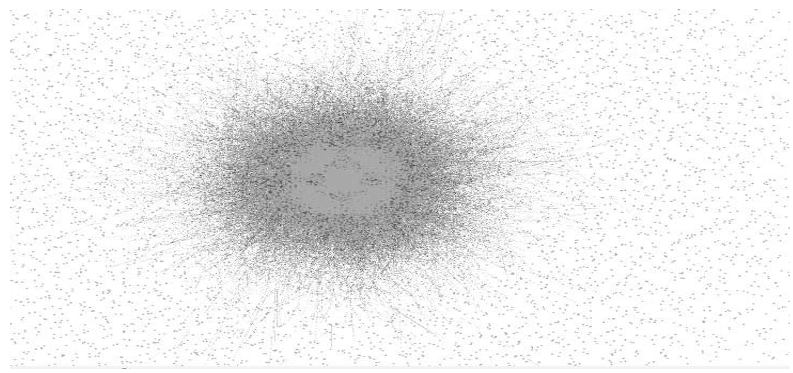 Figure 1: Social interactions mapped across the city of Dublin, showing the clusters of potential first-responders.
The study demonstrates that these "Participatory Sensing" systems—where users' phones serve as both sensors and communication hubs—can identify "S1" nodes (individuals directly at the scene) and indirectly related nodes who have the skills or the relationship to assist.
Critical Insight & Conclusion
Why this matters
The paper's true value lies in the automation of empathy. In an assistive environment, a person with special needs might not be able to call for help. A system that "knows" who your inner circle is, based on your daily digital interactions, can trigger an emergency protocol that alerts the right people—those most likely to respond—rather than just broadcasting to everyone.
Limitations & Future Outlook
While the 2013 context utilized Twitter (a largely public dataset), modern applications would face stricter GDPR and privacy constraints. However, the logic remains sound: as we move toward "Smart Cities," the ability to map social bonds to physical locations will be the backbone of next-generation emergency response systems.
Takeaway
Social networks are more than just digital lounges; they are dynamic datasets of human reliability. By weighting edges based on communication patterns, we can transform an OSN into a robust healthcare support system.