
Forecasting Unrest: A Cloud-Based Forensic Framework for Social Media Analysis
Exploiting Social Networks for the Prediction of Social and Civil Unrest: A Cloud Based Framework
This paper proposes a novel theoretical framework designed for predicting social and civil unrest by analyzing social network data (Twitter, Facebook) using digital forensics principles integrated with Cloud technology. The authors demonstrate the framework's feasibility through a multi-agent cloud-based implementation that monitors sentiment and identifies potential flashpoints.
TL;DR
Social media has transformed from a communication tool into an organizational engine for civil unrest. This paper introduces a specialized cloud-based framework that applies Digital Forensics to the chaotic stream of social networks. By utilizing "Social Snapshots" and multi-agent cloud architectures, the system can monitor, analyze sentiment, and predict potential outbreaks of instability.
Contextual Positioning
In the landscape of social network analysis (SNA), most tools are either purely academic or restricted to marketing. This work bridges the gap between Digital Forensics and Predictive Analytics, positioning itself as a strategic tool for law enforcement agencies to manage events like the "BlackBerry Riots" or the "Arab Spring" using scalable cloud infrastructure.
The Challenge: Why Social Media is a Forensic Nightmare
Analyzing social media for predictive policing is fraught with technical hurdles:
- Volatilty: Data changes in milliseconds; by the time an investigator looks at a tweet, the user may have deleted it or moved to a new platform.
- Noise: High volumes of unstructured data, abbreviations ("u" for "you"), and numerical substitutions ("8" for "ate") break standard NLP tools.
- Scale: Processing millions of worldwide users requires more than local server power; it demands the elastic scalability of the Cloud.
Methodology: The Three-Phase Loop
The authors reject the traditional linear forensic model in favor of a dynamic loop across three phases:
1. Pre-Investigation (The Sentry)
Continuous keyword monitoring acts as a trigger. For example, if names of government officials or specific locations starts trending alongside aggressive language, the system flags the event.
2. Investigation (The Engine)
This phase utilizes several sophisticated sub-processes:
- Social Snapshots: Instead of trying to capture a continuous "river" of data, the system takes specific snapshots of the feed at targeted intervals to preserve evidence for analysis.
- Big Data Analysis: Using Hadoop and NoSQL databases to handle the volume, coupled with Automated Semantic Role Labeling to understand "who" is doing "what" to "whom."
- Prediction: Comparisons are made against historical datasets of "peaceful" vs. "unrest" periods to forecast outcomes.
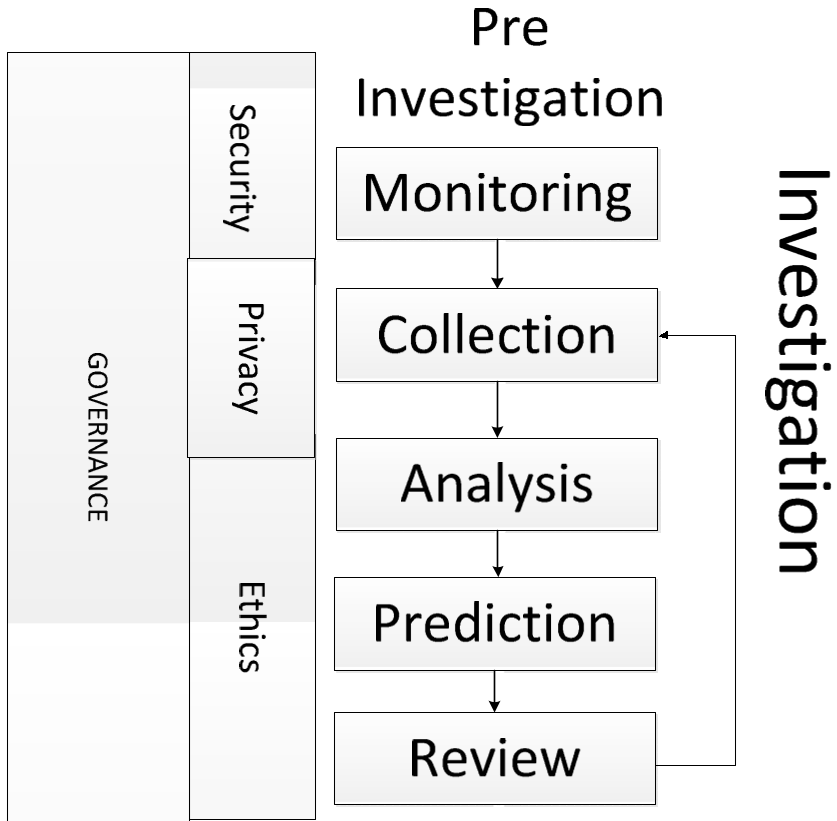
3. Governance
Critical for legal admissibility, this phase addresses the ethical handling of excess data, privacy of non-involved citizens, and the management of unstructured "Big Data" storage.
Experimental Results: The Woolwich Case Study
To prove the framework, the authors monitored the "Woolwich" incident in the UK. The system used a multi-agent cloud architecture to scale its monitoring power as the hashtag gained momentum.
- Data Extraction: The system extracted dates and locations linked to the unrest.
- Sentiment Visualization: It mapped the rate of posts against their sentiment (positive vs. negative) in a time series, providing a clear visual indicator of escalating tension.
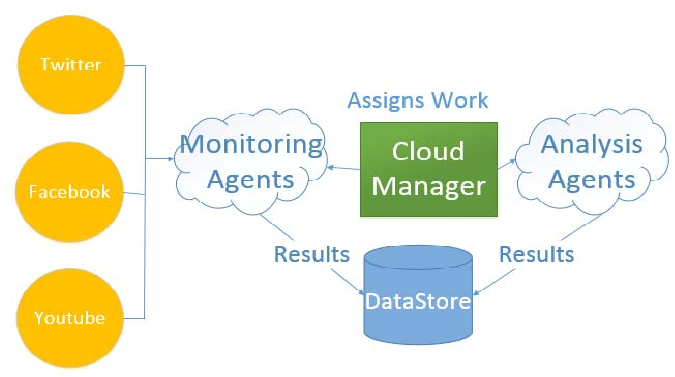 Fig. 1: The Multi-Agent Cloud Architecture for Sentiment Analysis.
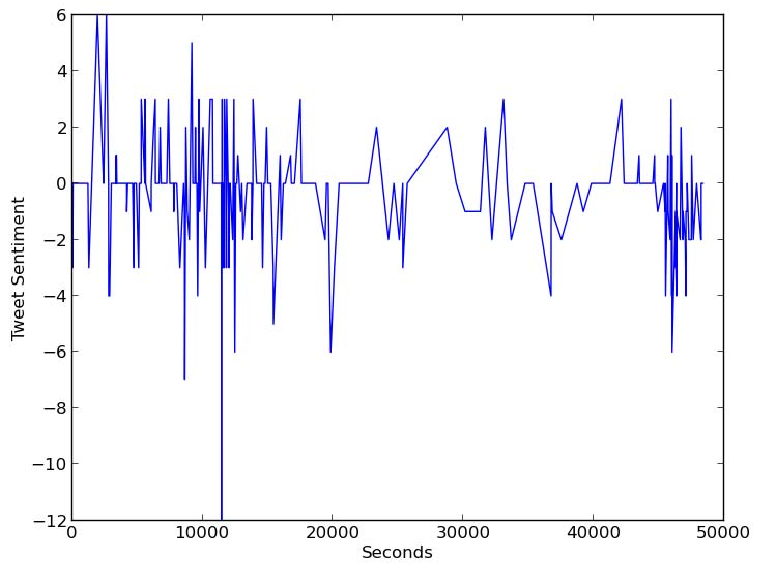 Fig. 2: Time-series analysis showing the correlation between post rate and sentiment.
Critical Insight & Conclusion
The true value of this work lies in its hybridization. By treating social media data not just as "text" but as forensic evidence, the framework provides a structured pathway for law enforcement to move from reactive response to proactive management.
Limitations: The paper acknowledges that "text speak" and abbreviations remain a challenge, requiring a constantly updated database of slang. Furthermore, as protesters shift to encrypted messaging (like Telegram or Signal), the effectiveness of monitoring public feeds like Twitter may diminish, necessitating further research into cross-platform signal detection.