
Socially-Powered Security: Rethinking Threshold Signing via Trust Networks
Exploiting social networks for threshold signing: attack-resilience vs. availability
The paper proposes a novel framework for Threshold Signing by leveraging the inherent trust relationships in Social Networks to protect private keys. It introduces a two-tier secret sharing method and evaluates the system through two key metrics: attack-resilience and availability, achieving a balanced trade-off between security and service uptime.
TL;DR
This seminal work explores a decentralised approach to protecting digital signature keys: Social Network-based Threshold Signing. By splitting cryptographic keys among a user's trusted circle of friends, the system eliminates reliance on centralized authorities. The paper introduces a dual-metric framework—Attack-resilience and Availability—to solve the "Why" and "How" of deploying threshold cryptography in the real-world P2P environment.
Problem & Motivation: The Fragility of Private Keys
In the digital age, your identity is only as secure as your private key. The fundamental problem is that average users' computers are frequently compromised. Traditional solutions, like TPMs or password protection, often fail against memory disclosure attacks or lack widespread adoption.
Threshold cryptography (splitting a key into n shares where k are needed to sign) is the theoretical answer. However, the authors argue that the "missing link" has been the deployment model. If you distribute shares to random servers, whom do you trust? This paper posits that Social Networks provide the perfect, pre-existing substrate of "Strong Mutual Trust" to host these shares without service fees or transit problems.
Methodology: The Two-Tier Architecture
The core contribution is a two-tier secret sharing scheme designed to prevent a user's own computer from becoming a zero-day vulnerability.
- Tier 1: The private key is split into two primary shares. The user keeps one.
- Tier 2: The second share is further split among the user's friends using a threshold .
- The Logic: To sign a message, the user must be online AND a specific ratio () of their friends must also be online to contribute their shares.
Remainder Graphs: Modeling a Smart Attacker
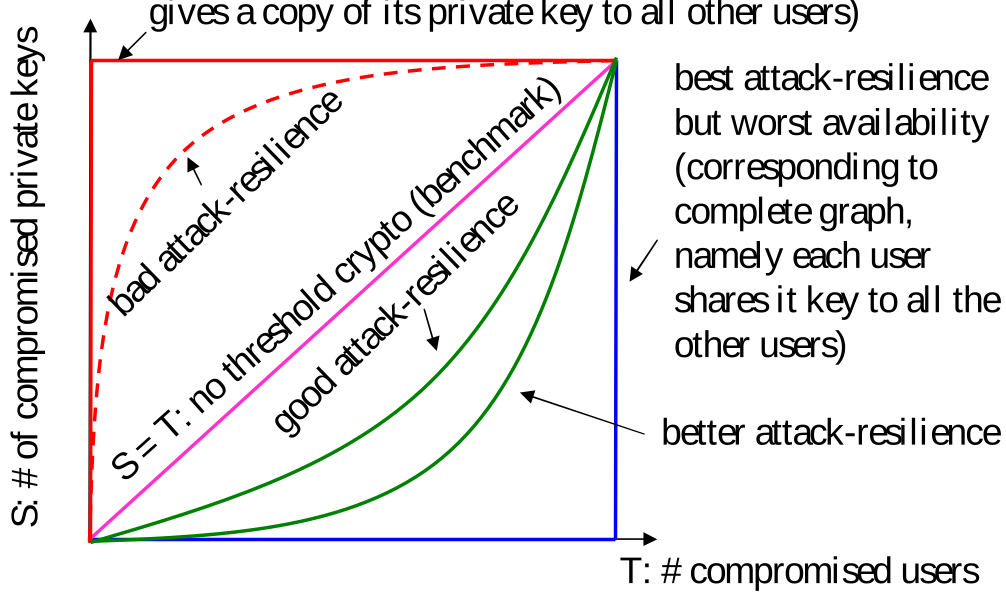
To test this, the authors don't just simulate random failures. They define an adaptive adversary that understands the network topology. The "Remainder Graph" heuristic identifies the most damaging nodes to compromise—those whose removal triggers a cascade of compromised keys.
Experiments & Results: The Price of Availability
The researchers tested three topologies: Regular, Random, and Power-law (Scale-free) graphs.
- The Topology Winner: Regular graphs (where everyone has the same number of friends) are the most resilient to attacks. In Power-law graphs, compromising a few "hubs" leads to catastrophic key loss.
- The Threshold Sweet Spot: The parameter is the "knob" for security. As increases, security goes up, but availability (the chance your friends are online when you need to sign) plummets.
- Quantifiable Success: The paper provides a mathematical proof for availability regardless of node uptime distribution (Exponential, Pareto, or Normal).
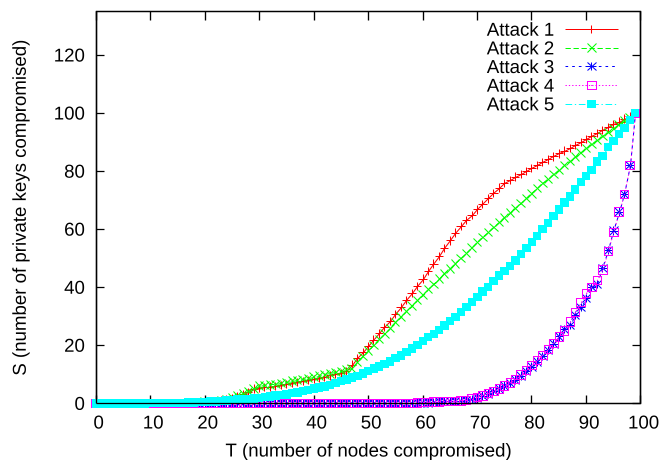 Figure: Analysis showing how different attack strategies (A1-A5) impact the number of compromised keys. Strategy A1 (Remainder Graph-based) proves to be the most lethal.
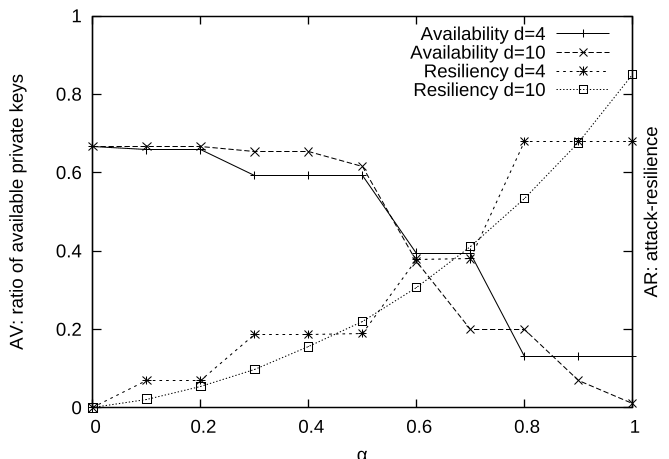 Figure: The critical compromise between Attack-resilience (AR) and Availability (AV). The intersection point suggests optimal system configuration.
Critical Insight & Conclusion
The genius of this paper lies in its realization that Security is a Social Problem. By mapping cryptographic shares to human trust, it creates a system that is naturally "Attack-resilient."
Takeaway for Modern Devs:
If you are building decentralized identity (DID) or recovery systems today, this 2008 paper provides the mathematical foundation for Social Recovery. The key takeaway: is your target range for balancing "I can't sign my transaction because my friends are asleep" with "An attacker stole my key."
Limitations:
- Dynamic Networks: The model assumes a relatively static trust graph. In modern mobile contexts, social edges rotate frequently.
- Collusion: While the paper assumes friends are "trusted," it does not fully model the game-theoretic incentives for friends to collude against a specific user.
In conclusion, the work remains a cornerstone for understanding how distributed systems can inherit the robustness of the social structures they serve.