
Beyond Hyperlinks: Exploiting the Social Graph for Precision Search
Exploiting social relations for query expansion and result ranking
This paper introduces a unified graph framework for social search that models the complex interplay between Users, Documents, and Tags. By leveraging explicit social relations and tag similarities, the authors develop a multi-faceted scoring function that significantly enhances document ranking in online communities like Flickr and del.icio.us.
TL;DR
In the era of social media, "relevance" is no longer a global constant. This paper presents a framework that transforms social networks into a unified graph of users, tags, and documents. By prioritizing content from a user's social circle (friends) and utilizing tag similarities, the researchers demonstrate that social context can significantly improve search precision over traditional content-only methods.
Background: The Social Search Gap
Traditional search engines were built for the "Consumer Web," where authority is derived from hyperlinks (PageRank). However, in platforms like Flickr or del.icio.us, the "Social Web" thrives on user-generated annotations and relationships. The authors argue that existing algorithms ignore the most valuable asset of these platforms: the specific social context of the person searching.
The Unified Graph Model
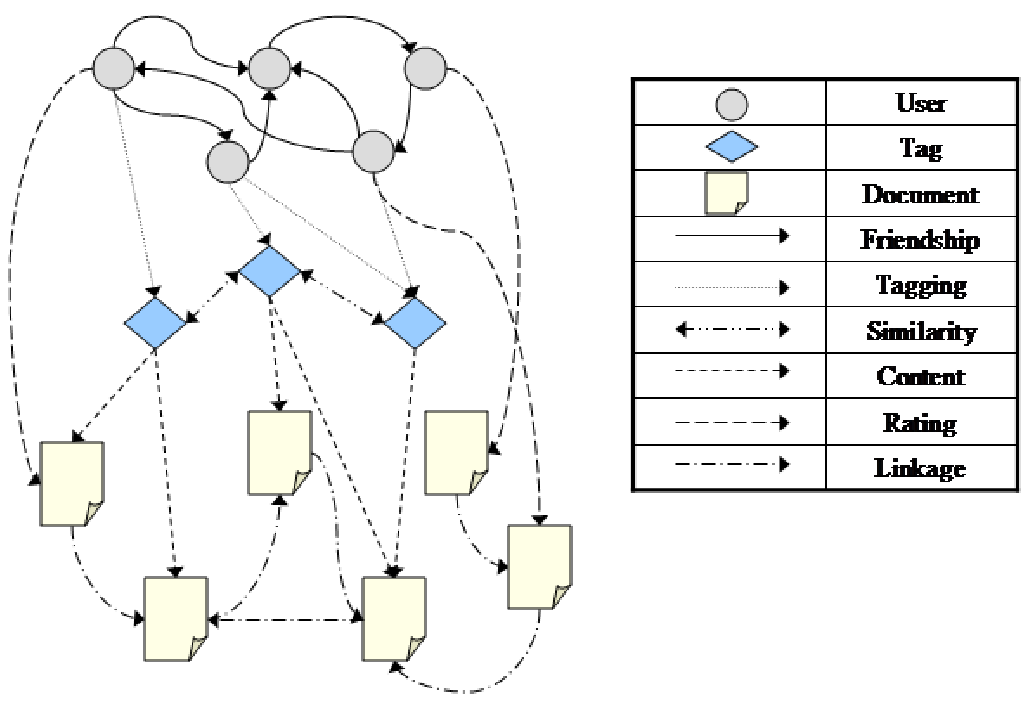
The authors propose that every social platform can be broken down into three fundamental nodes:
- Users: The producers and annotators.
- Documents: The content (photos, bookmarks).
- Tags: The bridge between users and content.
Unlike prior work that treated tags merely as attributes, this model treats Tags as first-class nodes. This allows for "Semantic Expansion"—finding content not just with the exact query word, but with synonymous or related tags used by the community.
Methodology: The Social Scoring Function
The core of the paper is the Social Score (SOS). This isn't just a simple keyword match. The ranking of a document for a user is a weighted sum that considers:
- Friendship Distance: Documents from direct or close indirect friends get a boost ().
- User Authority (UserRank): A PageRank-style score calculated specifically on the user-to-user friendship graph.
- Tag Similarity: Using the Dice coefficient to expand queries to related topics.
- Personalized BM25: A modification of the classic BM25 ranking that accounts for how often a specific user uses a specific tag.
Experiments and Hard Truths
The researchers crawled del.icio.us and Flickr to test their theories. They used a "fictitious initiator" approach for manual relevance assessment—asking human judges to evaluate results through the eyes of a specific social media user.
Key Findings:
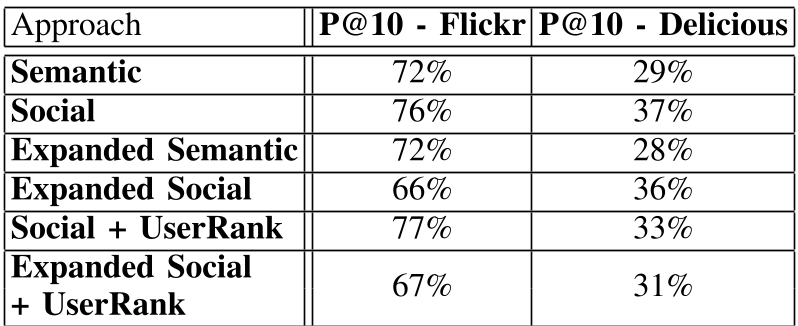
- Social Wins: In both datasets, incorporating the social graph (Social Search) outperformed purely semantic search. On del.icio.us, precision jumped from 29% to 37%.
- The Expansion Trap: Interestingly, automated tag expansion (Expanded Social Search) often decreased precision. The Dice coefficient was sometimes too "loose," bringing in irrelevant tags that caused topic drift.
- Authority vs. Proximity: Global UserRank (popularity) had negligible impact. What mattered was not how important a user was globally, but how close they were to the searcher.
Critical Insight & Conclusion
This work highlights a fundamental shift in Information Retrieval: Social Proximity > Global Authority. While a celebrity's bookmark might be "authoritative" in a PageRank sense, your friend's bookmark is likely more "relevant" to your specific needs.
Limitations & Future Work
The study noted that tag expansion is a double-edged sword. Future iterations would likely benefit from modern NLP (like BERT embeddings) to handle tag similarity more gracefully than the Dice coefficient. Furthermore, the "UserRank" failure suggests we need Topic-Sensitive UserRank—where authority is calculated based on specific expertise (e.g., a "Cooking Expert" vs. a "Tech Expert").
The takeaway for developers and researchers is clear: to build the next generation of search, you must index the people as much as the data.