
ComPAS: Leveraging Social DNA for Efficient Data Replication in Ad-hoc Networks
Exploiting Social Relationship to Enable Efficient Replica Allocation in Ad-hoc Social Networks
This paper introduces ComPAS (Community-Partition Aware replica allocation method), a social-aware data replication strategy for Ad-hoc Social Networks (ASNETs). It leverages social relationships and Reference Point Group Mobility (RPGM) models to optimize data availability and access efficiency in decentralized, mobile environments.
TL;DR
In the unpredictable world of Ad-hoc Social Networks (ASNETs), node mobility often tears communities apart, leaving data inaccessible. This paper proposes ComPAS, a replication method that doesn't just treat nodes as random moving points, but as social entities. By exploiting "social relationships" and group mobility patterns, ComPAS ensures that data replicas are placed exactly where they are most likely to be needed after a network partition, reducing read costs and relocation overhead significantly.
The "Broken Link" Problem: Why Traditional MANETs Fail
In a Mobile Ad-hoc Network (MANET), we assume nodes move. When they move too far, the network partitions. If the data you need is in "Community A" and you are now isolated in "Community B," that data is effectively lost to you.
Prior works often used random replication or simple greedy approaches. These are inefficient because:
- Resource Constraints: You can't store everything everywhere.
- Social Blindness: They ignore the fact that humans move in groups (friends, colleagues) and access data related to their social circle.
- High Relocation Cost: Moving replicas every time a node twitches creates massive network traffic.
Methodology: The Logic of Social Proximity
The core insight of ComPAS is simple yet powerful: Store replicas where the "neighbors" of the data owner live.
1. The Social Graph & RPGM
The authors utilize the Reference Point Group Mobility (RPGM) model. This recognizes that nodes don't move randomly; they follow leaders or move as clusters. By building a social graph, the system identifies which nodes are "socially close."
2. Location Histograms
ComPAS calculates a "Location Histogram" , which identifies how many neighbors of user are located in community .
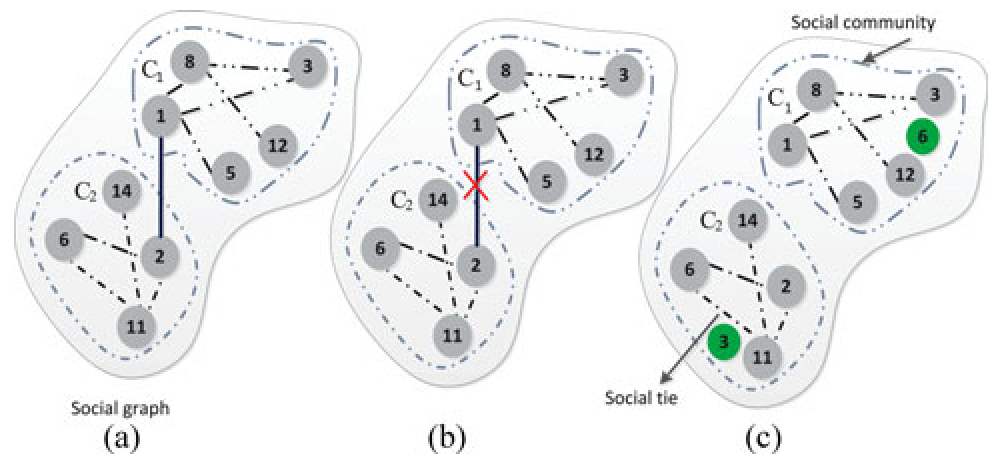 The ASNET middleware layer integrating social properties into data management.
3. Mathematical Optimization
The goal is to maximize Read Cost Reduction (RCR). The paper formulates this by comparing the cost of jumping across communities to find data versus finding it locally. Where is the social adjacency. If and are friends, the system prioritizes placing 's data in 's community.
Experimental Showdown: ComPAS vs. SOTA
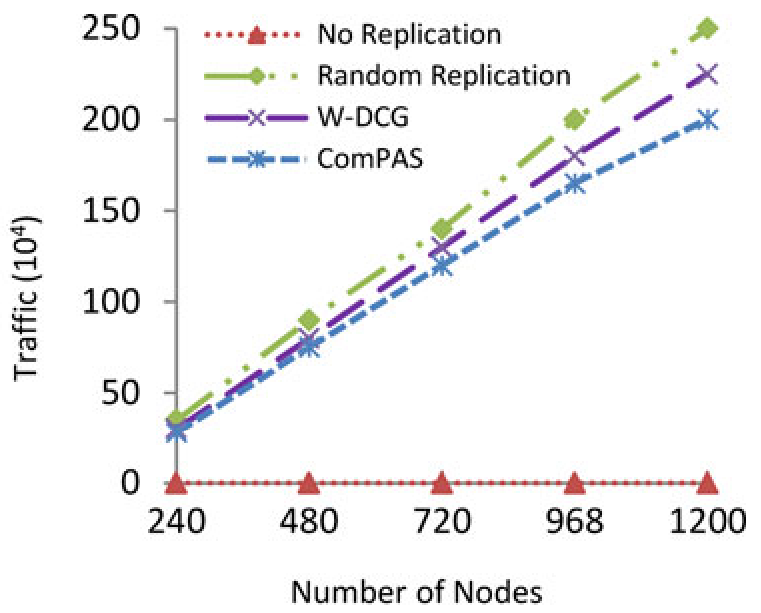
The researchers compared ComPAS against W-DCG (a weighted dynamic group method) and random replication using a 1,200-node synthetic graph.
Key Result 1: Read Cost Efficiency
As the number of storage spaces increases, the read cost for ComPAS remains consistently lower than its competitors. This proves that "smart placement" beats "more replicas."
Key Result 2: Lower Relocation Overhead
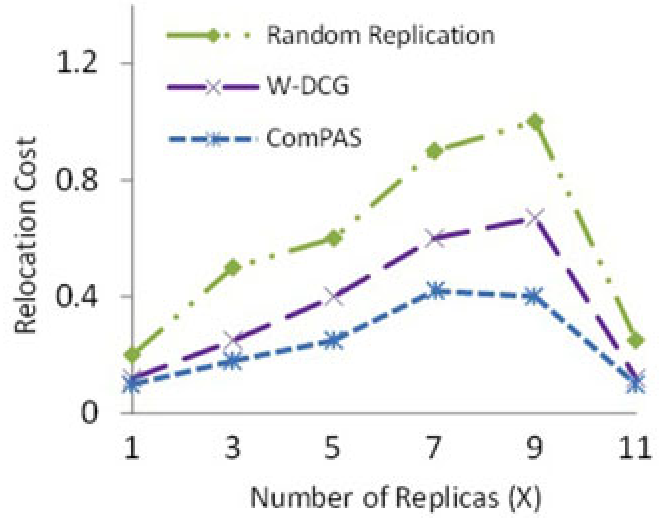
One of the most impressive feats of ComPAS is keeping the Relocation Cost low. Because replicas are placed based on stable social patterns rather than transient physical positions, they don't need to be moved as often. The relocation cost for ComPAS rarely exceeded 0.6, even in complex scenarios.
Critical Insight: Why it Works
ComPAS succeeds because it treats social ties as a predictor of future connectivity. In a world of high mobility, physical distance is a "noise" variable, but social connection is a "signal." By aligning the data architecture with the human architecture, the network becomes inherently more resilient to partitioning.
Conclusion & Future Outlook
ComPAS is a significant step toward "Socially-Aware Middleware." While the current work focuses on read/write efficiency, the authors hint at future extensions involving reliability management (detecting selfish/malicious nodes) and cloud integration. For developers building peer-to-peer apps or edge computing solutions, the takeaway is clear: understanding who uses the data is just as important as knowing where the node is.