
SSRS: Securing Mobile Social Networks through the Lens of Human Relationships
Exploiting social relationship for secure routing in mobile social networks
This paper introduces SSRS (Social-based Secure Routing Strategy), a novel framework for Mobile Social Networks (MSNs) that integrates social relationship evaluation and trustworthy behavior tracking. It leverages human social stability to optimize message forwarding while effectively isolating selfish and malicious nodes.
TL;DR
Mobile Social Networks (MSNs) are often plagued by "free-riders" and malicious actors who disrupt message delivery to save energy or sabotage the network. This paper presents SSRS (Social-based Secure Routing Strategy), a protocol that doesn't just look at who you meet, but how reliable you are. By combining social feature similarity with a robust trust-reward mechanism, SSRS maintains high delivery ratios even when a significant portion of the network turns hostile.
Problem & Motivation: The Trust Deficit in DTNs
Mobile Social Networks are a paradigm of Delay Tolerant Networks (DTNs) where messages are moved via "store-carry-forward" logic. Most current SOTA methods (like Bubble Rap) follow a simple intuition: give the message to someone more popular.
However, the authors identify a critical flaw: Popularity Integrity.
- Packet Dropping: Malicious nodes can claim to be popular to attract packets and then drop them.
- Trust Boosting: Attackers can collude to artificially inflate each other's reputation.
- Defamation: Malicious nodes can lie about well-behaving nodes to isolate them.
Methodology: Quantifying Friendship and Trust
The core of the SSRS strategy rests on two mathematical pillars: SRM and TBM.
1. Social Relationship Evaluation (SRM)
Instead of just counting contact frequency, SRM looks at shared social features (Nationality, Job, etc.). If two nodes share weighted features and meet frequently, they have high "Social Strength."
2. Trustworthy Behavior Evaluation (TBM)
Trust isn't just direct; it's social. Node A evaluates Node B's trust using its own observations plus recommendations from its "Familiar Set" (close friends).
This formula ensures that recommendations from closer friends carry more weight, making "Sybil" or collusion attacks much harder to execute.
3. Community and Centrality
The paper introduces Local Community Centrality (LCC). Using Information Entropy, LCC identifies nodes that are not just "popular" in a general sense, but are reliably central within their specific social clusters.
Note: The architecture involves DistriCommuDect for group formation and LCC for identifying relay leaders.
Message Forwarding & Protection
The forwarding logic is elegant:
- If you meet the destination's friend: Pass the packet.
- If you're in the same community: Give it to someone with higher LCC.
- The Security Twist: Before any transfer, the Protection Algorithm checks the TBM. If a node's trust is below a dynamic threshold , it is "punished" by having its SRM and LCC scores slashed, eventually isolating it from the network.
Experiments: Proving the Gains
The authors tested SSRS against Epidemic, IRONMAN, and Bubble Rap using the INFOCOM 2006 trace (85 users, 4 days of movement).
Key Findings:
- Resilience: As the number of misbehaving nodes increases, the delivery ratio of Bubble Rap and Epidemic plummets. SSRS remains stable because it actively "detects" and avoids these nodes.
- Accuracy: SSRS achieved higher misbehavior detection accuracy than IRONMAN because it leverages social context rather than just raw forwarding counts.
- Latency: By selecting reliable, central nodes, SSRS avoids the "dead ends" created by malicious nodes, keeping average delivery time low.
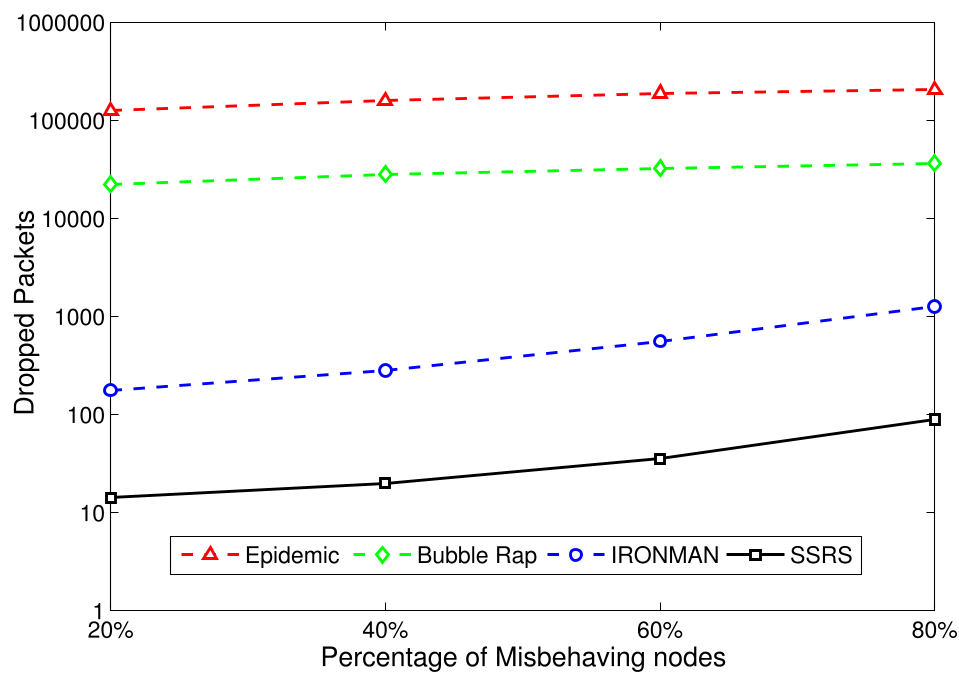 Fig 1: Delivery ratio comparison showing SSRS's superiority as the network environment becomes more hostile.
Critical Insight & Conclusion
The brilliance of SSRS lies in its use of Social Stability. Human relationships change much slower than wireless links. By anchoring trust in these stable social features and using entropy to measure local influence, the authors create a routing protocol that is "human-aware."
Limitations: The current model assumes users are willing to share social features openly. In a real-world deployment, Privacy-Preserving Computation (like Homomorphic Encryption) would be necessary to calculate SRM without exposing personal data.
Takeaway: Secure routing in decentralized networks is a social problem as much as a technical one. SSRS provides a blueprint for how future P2P systems can leverage "social capital" to enforce security.