
SpamHunter: Leveraging Distributed Correlations for Scalable Social Spam Detection
Exploiting the Spam Correlations in Scalable Online Social Spam Detection
This paper introduces SpamHunter, a distributed and scalable system designed for real-time social spam detection. By leveraging a DHT-based hierarchical functional tree and exploiting cross-platform spam correlations, it achieves a high 95% F1 score in identifying malicious content across large-scale distributed data sources.
TL;DR
Social spam is no longer a localized problem; it is a coordinated, cross-platform phenomenon. SpamHunter addresses this by moving away from isolated detection algorithms toward a distributed system architecture. Using DHT-based functional trees, it enables distributed servers to share "spam correlations," achieving a 95% F1 score with minimal latency and high scalability.
Problem & Motivation: The Isolated Island Problem
Most current spam filters act like isolated islands. They process local data streams excellently but are blind to the fact that the same spammer might be hitting a different server with nearly identical content. This lack of a global view makes them slow to react to new, emerging spam campaigns.
The authors observed that spammers manipulate hundreds of accounts across different platforms to spread similar posts. To catch these, we need two things:
- System Scalability: The ability to handle millions of logs from thousands of servers.
- Correlation Awareness: A mechanism for distributed servers to "talk" to each other and share intelligence about new spam signatures in real-time.
Methodology: The DHT Hierarchical Functional Tree
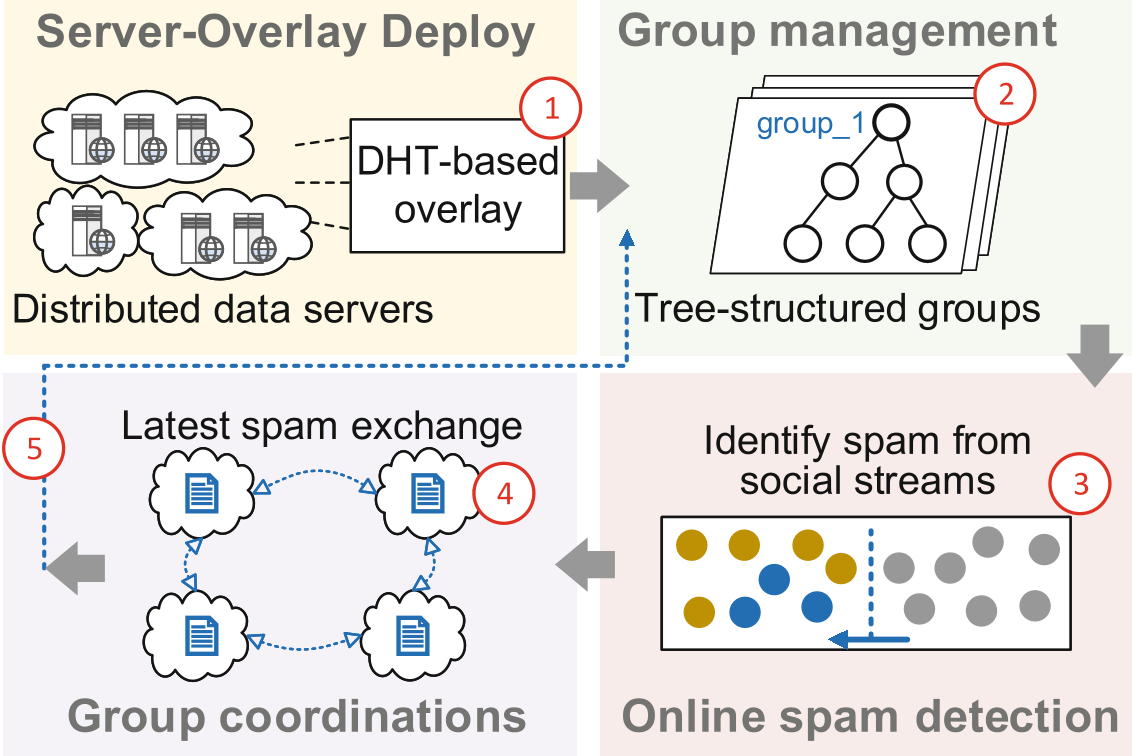
SpamHunter is built on top of the Pastry Ovelay, a peer-to-peer DHT (Distributed Hash Table) network. The core innovation lies in its hierarchical management:
1. Group & Tree Management
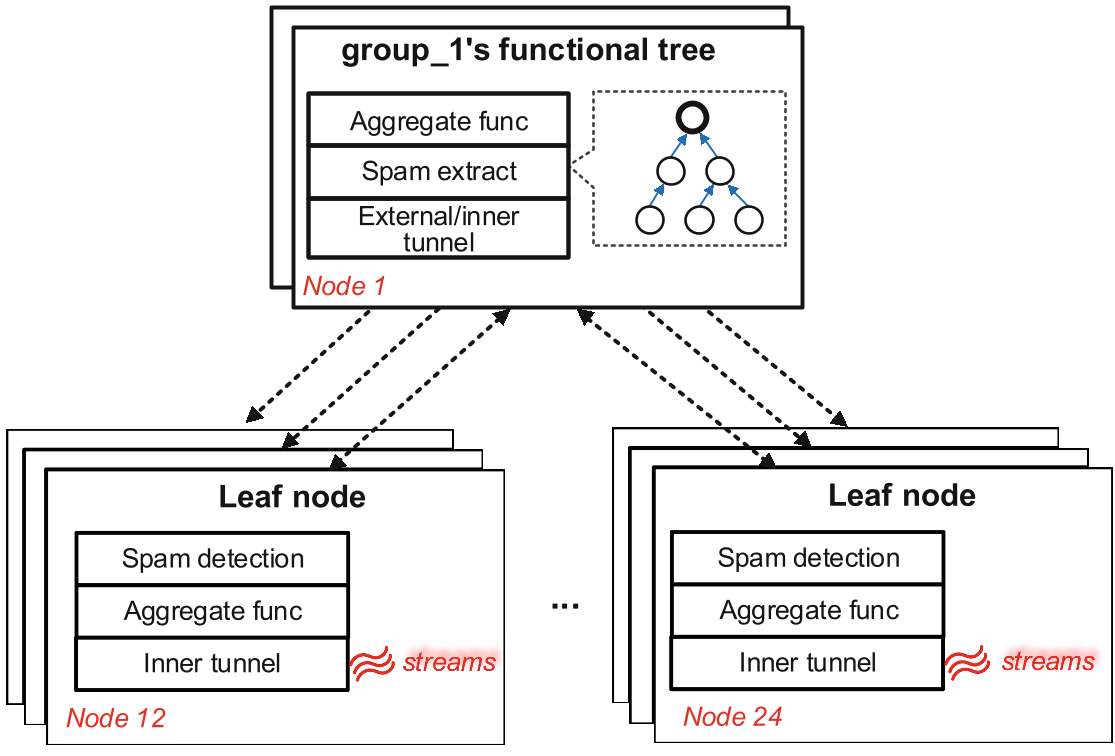
Servers are grouped (by topic, location, or tag). Each group forms a functional tree.
- The Root: Acts as the brain, training models and aggregating results.
- Leaf Nodes: The "boots on the ground" that collect raw social logs (via APIs like Twitter), normalize them, and run local detection.
2. Exploiting Correlations via Anycast
The system doesn't just work within groups. Roots of different groups use Anycast and a Diffusion Group communication protocol to share updated models. When Group A finds a new type of spam, it "infects" other groups with this knowledge, ensuring that the entire network becomes immune to the new spam pattern almost instantly.
Experiments & Results: Efficiency at Scale
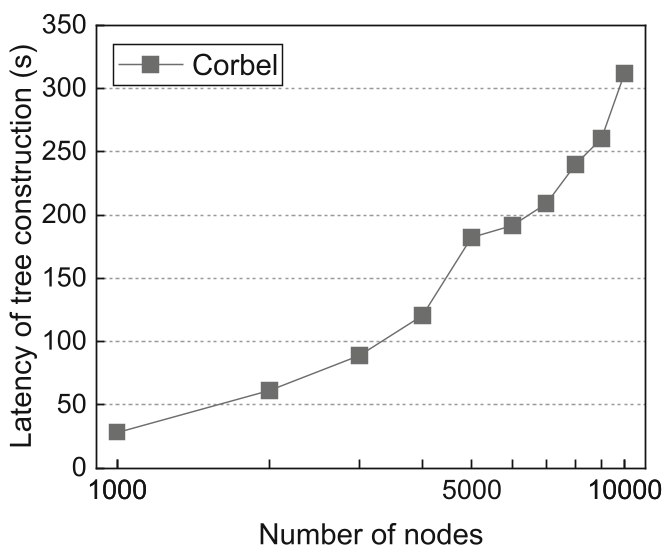
The authors tested SpamHunter on a massive scale (up to 10,000 nodes).
Detection Performance
Using the Random Forest (RF) algorithm within the SpamHunter framework yielded the best results, proving that the system architecture effectively supports high-performance classifiers.
| Model | F1 Score | Precision | Recall |
|---|---|---|---|
| Random Forest (RF) | 0.951 | 0.951 | 0.951 |
| SVM | 0.942 | 0.945 | 0.944 |
| Logistic Regression | 0.859 | 0.866 | 0.855 |
System Latency
The beauty of the DHT approach is that communication hops only increase logarithmically with the number of nodes. Even with 10,000 nodes, the average hops remain between 2 and 3, keeping the detection latency in the range of milliseconds.
Critical Insight & Conclusion
SpamHunter proves that network topology matters as much as the machine learning model. By structuring the detection system as a P2P overlay, the authors solved the "outdated spam" problem—where a model becomes useless because it wasn't updated with the latest cross-platform trends.
Limitations: While highly scalable, the current system relies on a "Root" node for aggregation within groups, which could become a single point of failure or a bottleneck if the group size becomes excessively large. Future iterations might benefit from fully decentralized aggregation via gossip protocols.
Final Takeaway: For modern cybersecurity, "detecting locally" is no longer enough. We must "communicate globally" to stay ahead of coordinated malicious actors.