
STIF: Decoding Social Bonds Through Fine-Grained Spatiotemporal Patterns
Exploiting Spatiotemporal Features to Infer Friendship in Location-Based Social Networks
The paper introduces STIF (Spatiotemporal Features to Infer Friendship), a unified framework for predicting social ties in Location-Based Social Networks (LBSNs). It leverages fine-grained temporal profiles, weekday vs. weekend behavior, and a novel location-time popularity metric to achieve state-of-the-art results on Gowalla and Brightkite datasets.
TL;DR
Can your morning coffee routine at 7 AM reveal who your friends are? The STIF (Spatiotemporal Features to Infer Friendship) framework says yes. By analyzing not just where you check in, but when and with what regularity—specifically distinguishing between weekdays and weekends—this model outperforms previous SOTA methods in predicting social ties within Location-Based Social Networks (LBSNs) like Gowalla and Brightkite.
Problem & Motivation: The "Rush Hour" Fallacy
Most existing friendship inference models rely on the Homophily Principle: friends tend to visit the same places. However, many models fall into the trap of treating all co-occurrences equally.
The authors identify three fatal flaws in prior work:
- Coarse Temporal Analysis: Many models ignore the specific hour-by-hour lifestyle of a user.
- Temporal Smearing: They fail to distinguish between the rigid structure of a weekday and the flexible nature of a weekend.
- Static Location Weighting: Standard "Location Entropy" measures how popular a place is in general, but it ignores when it is popular. Meeting at a train station at 5 PM is likely a coincidence; meeting there at 2 AM is likely a social plan.
Methodology: The STIF Framework
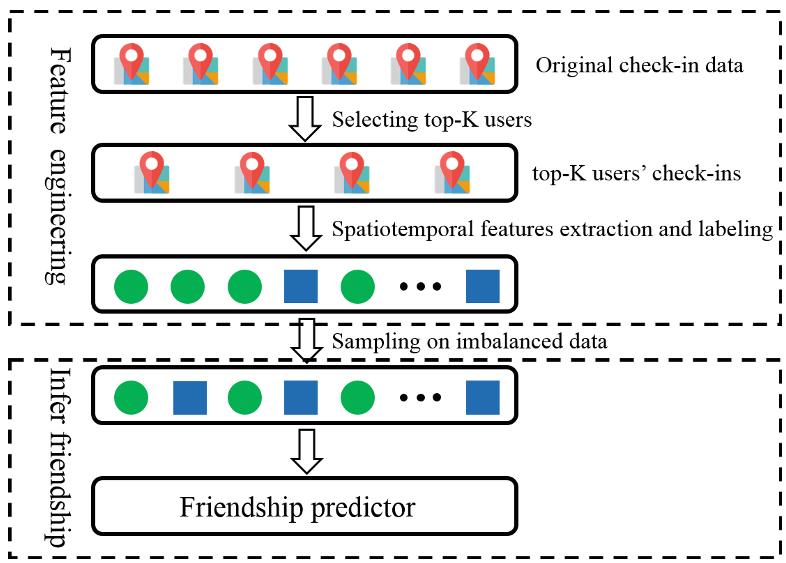
The STIF framework processes active user data through a multi-dimensional feature extraction pipeline, addressing the data imbalance problem using SMOTE before feeding features into classifiers like Random Forest.
1. Fine-Grained Temporal Lifestyles
Instead of broad categories, STIF divides a day into 24-hour bins and a week into 7 days. It calculates hour_sim and day_sim using Cosine Similarity to capture users with synchronized biological clocks or work schedules.
2. Weekday vs. Weekend Dynamics
People have different "anchors" on weekends. STIF calculates the distance between "weekday-home" and "weekend-home" locations separately, recognizing that social trajectories shift significantly when work constraints are removed.
3. Fine-Grained Location Weighting
This is the "secret sauce." The authors propose a new metric:

This formula factors in:
- Location Time Popularity: Is the place empty or crowded at this specific time?
- Stay Time: How long did the two users remain in proximity?
Experiments: Breaking the SOTA
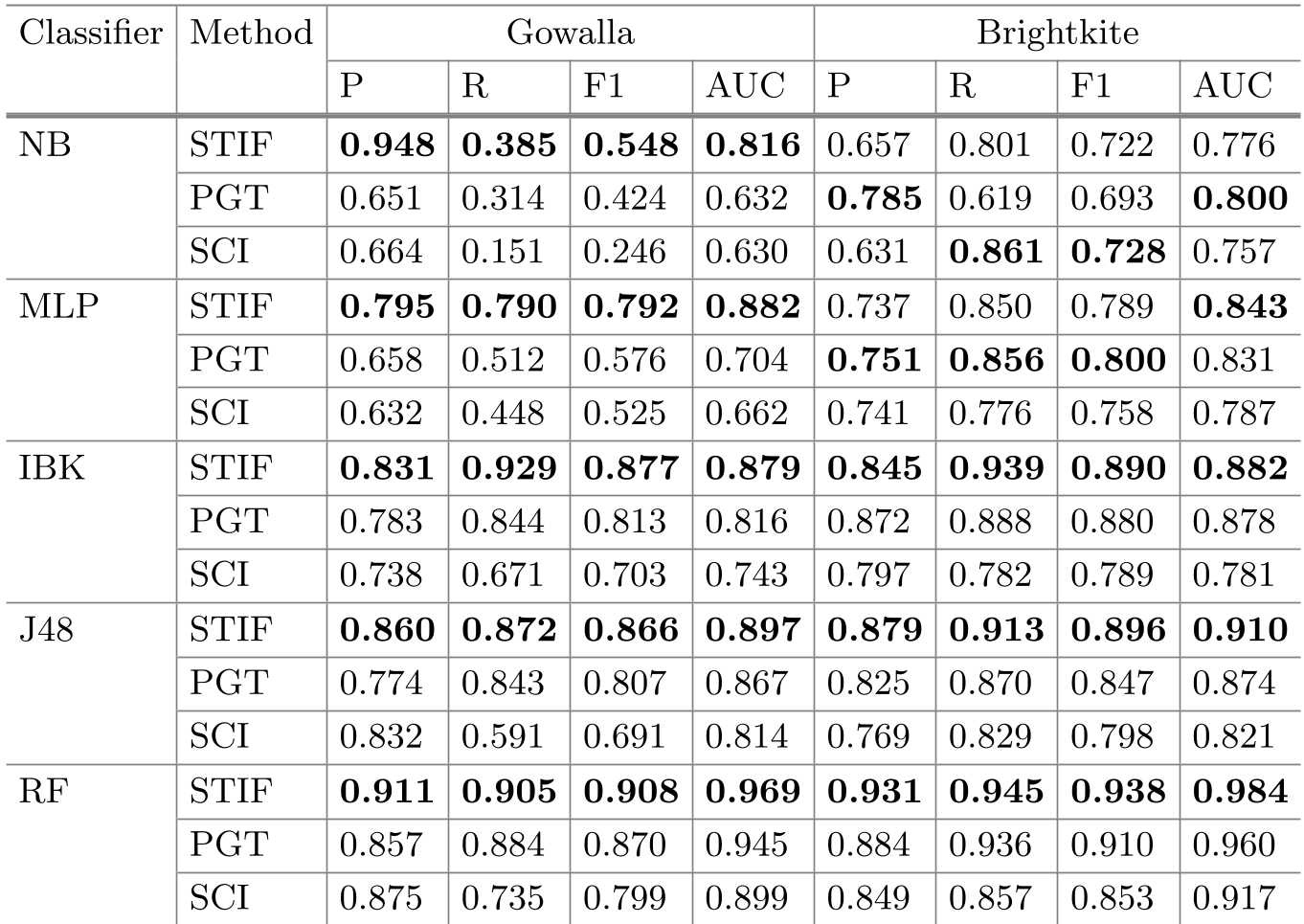
The researchers tested STIF on two massive datasets: Gowalla (6.4M check-ins) and Brightkite (4.4M check-ins).
Key Metrics:
- F1-Score: Reached 0.908 (Gowalla) and 0.938 (Brightkite) using Random Forest.
- Superiority: STIF outperformed the SCI method by 30.2% in some configurations.
- AUC Performance: The framework showed a robust ability to distinguish friends from strangers, even in imbalanced datasets.
Critical Insight & Future Work
The success of STIF proves that context is everything in spatiotemporal data. While previous models looked at "where," STIF looks at "where, when, and how busy it was."
Limitations: The model currently relies on handcrafted features and classical machine learning. Outlook: The authors suggest that moving toward Topic Models or Deep Learning could further uncover latent lifestyle patterns (e.g., distinguishing between "night owls" and "fitness enthusiasts") to enhance the precision of social recommendations.
Final Takeaway: To understand human connections, we must look at the specific rhythm of their lives. STIF provides the mathematical heartbeat for that observation.