
Beyond Keywords: Leveraging Social DNA for Precision Focused Crawling
Exploiting Tags and Social Profiles to Improve Focused Crawling
The paper introduces a novel profile-based focused crawling system designed for social media-sharing platforms like Flickr and YouTube. By integrating personal and social user profiles as ranking criteria, the system predicts link relevance before content retrieval, significantly outperforming standard Breadth-First Search (BFS) and Online Page Importance Computation (OPIC) algorithms.
TL;DR
Researchers from the University of Louisville have developed a focused crawler that "thinks" social. Instead of just scanning text, it analyzes user profiles and social circles to predict if a link is worth following. Tested on Flickr, it crushes traditional Breadth-First and OPIC strategies by using social identity as a navigator.
The Social Media Data Gap
In the traditional Web of content, crawlers relied on the "Relevance Hypothesis": pages that link to each other usually share topics. However, in the modern Social Web (Flickr, YouTube, Instagram), content is often transient, and the "Detail Pages" containing the actual assets (images/videos) are hidden behind "List Pages."
The current bottleneck? Retrieving the full content of every image page just to check if it matches a topic is computationally expensive and slow. Prior works ignored a goldmine: User Metadata.
Methodology: The Personal and Social Dual-Rank
The brilliance of this work lies in how it defines a user's digital footprint. The crawler segments a user's profile into two distinct intelligence layers:
1. The Personal Profile
This captures the user's explicit interests. By extracting terms from "collections," "sets," and "tags" then comparing them to the target topic using Cosine Similarity, the crawler assigns a Rank_personal.
2. The Social Profile
Recognizing that "birds of a feather flock together," the system analyzes the user's contacts. If your friends upload photos of "Flowers," you likely do too. The Rank_social is the average personal rank of all your social connections.
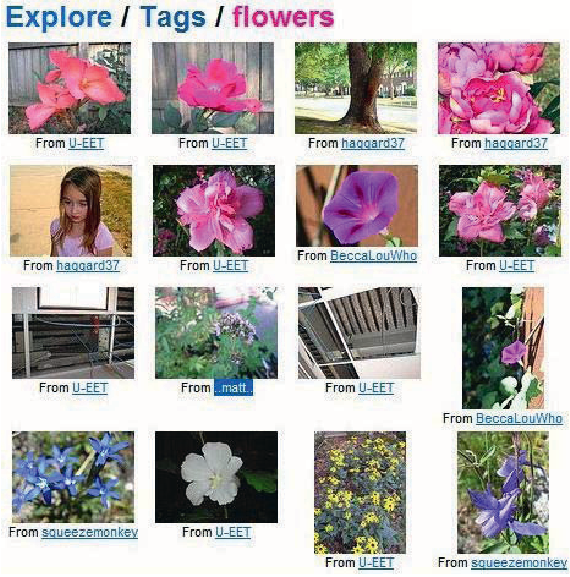
The Bayesian Synthesis
The crawler uses a weighted combination ( and ) of these two ranks to calculate the probability —the likelihood that a specific link leads to a topic-relevant page. This allows the crawler to prioritize its queue without ever having to "open" the detail page first.
Experimental Battleground: Flickr
The authors tested their system using two distinct topics: "Flowers" (general) and "NYC" (geographically specific).
Key Result: Harvest Ratio
The "Harvest Ratio" (relevant pages / total pages crawled) is the industry standard for efficiency.
- BFS (Breadth-First): Quickly dilutes, picking up noise and irrelevant data.
- OPIC: Better than BFS but ignores the semantic value of the "user" context.
- Profile-Based Crawler: Maintained a consistently higher harvest ratio, proving that social signals are more predictive than link density alone.
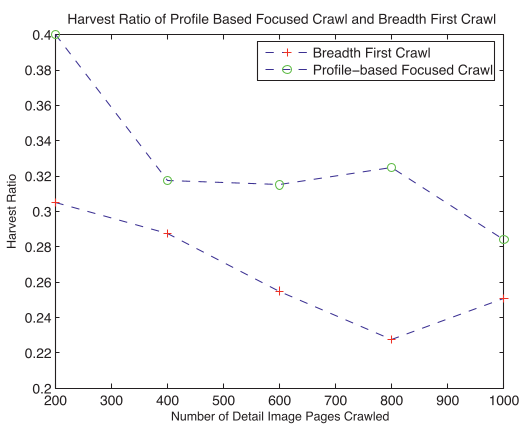 Fig 1. Harvest Ratio for "Flowers" - The profile-based method displays significantly higher precision than standard BFS.
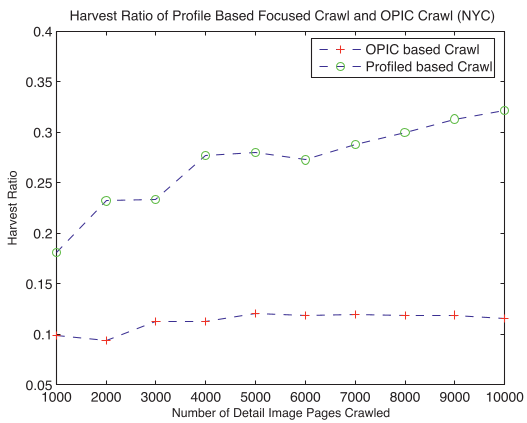 Fig 2. Results for "NYC" show sustained crawling efficiency as more profiles are analyzed.
Critical Insight & Future Outlook
This paper effectively shifts the focus of crawling from "Content-Centric" to "User-Centric." By treating the User Hub as a source of truth, the crawler avoids the "black box" of social media databases.
Limitations: The system relies on the availability of public profile pages. As platforms become more restrictive with "walled gardens" and privacy settings, the crawler's ability to aggregate Rank_social may be hindered.
The Future: Integrating this with Active Learning—where the crawler learns which users are "Subject Matter Experts" in real-time—could further revolutionize how vertical search engines index the social web.