
Modernizing the CI Genome: Lessons from 10 EU-Horizon 2020 Projects
Exploratory Analysis of Collective Intelligence Projects Developed Within the EU-Horizon 2020 Framework
This paper presents an exploratory analysis of 10 modern Collective Intelligence (CI) platforms developed under the EU-Horizon 2020 framework. It evaluates the "CI Genome" model's ability to describe contemporary initiatives and proposes three new "genes"—Beneficiaries, Knowledge/Social Cause, and Collaboration-based Contests—to modernize the framework.
TL;DR
Collective Intelligence (CI) has evolved significantly since the early days of Wikipedia. This paper audits the classic CI Genome Model (Who, Why, What, How) against 10 modern European projects. The authors discover that the old model is no longer sufficient and propose new "genes"—Beneficiaries, Social Cause, and Collaboration-based Contests—to capture how humans collaborate today.
Perspective: The Map is No Longer the Territory
In 2009, Malone et al. mapped the "Genome" of CI, providing a framework to understand how crowds solve problems. However, that map was drawn in the era of early open-source software and prediction markets. Modern CI projects, especially those funded by the EU, focus on social innovation, crisis management, and environmental sustainability.
The authors argue that the original model's simplicity—while elegant—misses the complexity of modern platforms where the person contributing is often not the person benefiting, and where the "contest" isn't a solo sport.
Methodology: Active Participation
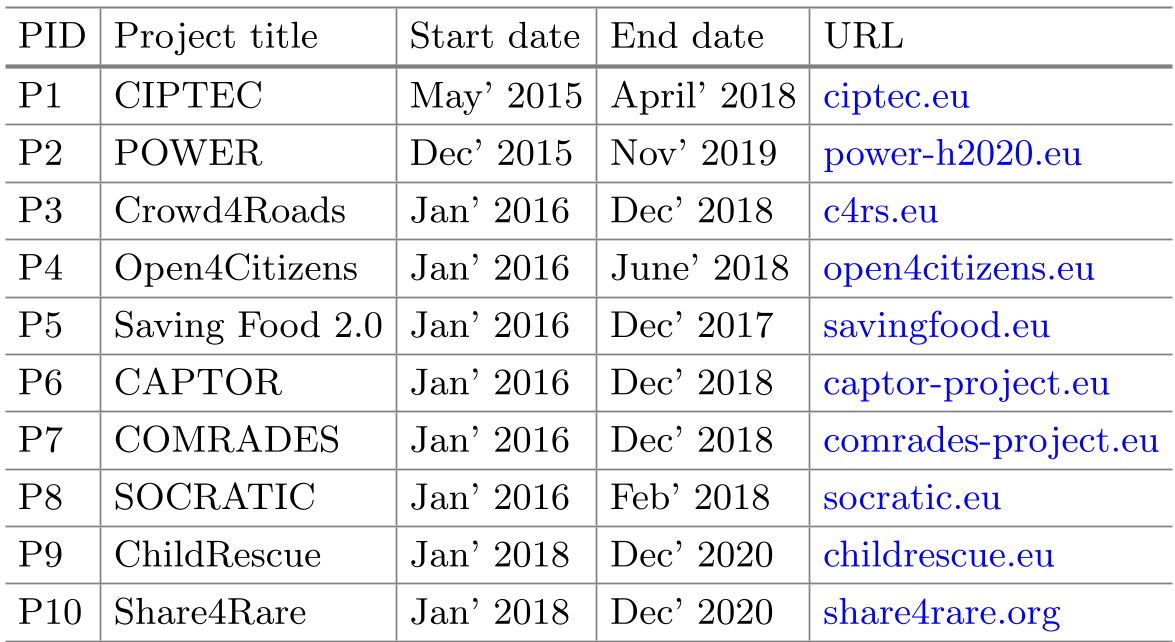
To test the model, the research team didn't just read papers; they became part of the crowd. They spent a month registering for and participating in 10 diverse projects across Europe, ranging from road quality sensing (Crowd4Roads) to food waste reduction (Saving Food 2.0).
Project Overview
| Project | Domain | Core Mission |
|---|---|---|
| CIPTEC | Transport | Urban public transport innovation |
| CAPTOR | Environment | Monitoring ozone pollution levels |
| ChildRescue | Social Safety | Reducing the time to find missing children |
| Share4Rare | Healthcare | Knowledge sharing for rare diseases |
Identifying the "Missing Genes"
By mapping these projects into the "Who/Why/What/How" framework, the authors identified three critical gaps:
1. The Beneficiaries (New "Who" Gene)
The original model only recognized Hierarchy (the controllers) and Crowd (the contributors). The authors observed a third group: Beneficiaries. In projects like Saving Food 2.0, the "vulnerable groups" receive the food but do not necessarily participate in the creation or decision process. Recognizing them is vital for analyzing the value-flow of a CI system.
2. Social Cause & Knowledge (New "Why" Genes)
While the old model used "Love" as a catch-all for intrinsic motivation, the authors found it too vague. Modern users are driven by a specific Social Cause (e.g., finding a missing child) or the thirst for specialized Knowledge. These are distinct psychological drivers that require different engagement strategies than simple "passion."
3. Collaboration-based Contests (New "How" Gene)
The original genome defined a Contest as an independent-create activity (like a solo designer submitting a logo). However, projects like Open4Citizens use Hackathons, where people form teams. This creates a hybrid "Collaboration-based Contest"—a dependent creation process where the end result is still judged competitively.

Critical Insight & Future Outlook
This work highlights a shift in CI from Utility (making a better encyclopedia) to Impact (solving societal crises).
Takeaway for Builders: If you are building a CI platform today:
- Define your Beneficiaries: Who gains value if the crowd succeeds?
- Beyond Gamification: Don't just use "Glory" or "Money." Leverage the "Social Cause" gene for higher-quality engagement.
- Enable Team Play: Move away from solo submissions; foster the "Collaboration-based Contest" to harness diverse team expertise.
Limitations: The study is exploratory and focuses on EU-funded projects, which are inherently socially oriented. A broader look at modern commercial CI (like Uber or Airbnb's data initiatives) might reveal even more genes related to the "Gig Economy."
Conclusion
The CI Genome is not a static document; it is an evolving map. By adding these three new components, we transition from a model of "crowdsourcing" to a more sophisticated model of "collective social action."