
Decoding the Village Network: How Question Phrasing Reshapes Social Maps in Rural India
An exploratory comparison of name generator content: Data from rural India
This study evaluates 12 different "name generators" (survey probes) used to map sociocentric networks in 75 villages in rural India. By analyzing over 80,000 ties, it demonstrates how the phrasing of social interaction questions fundamentally alters the captured network's density, homophily, and status hierarchy, achieving a 89% network recovery using a optimized subset of questions.
TL;DR
The "name generator"—the simple survey question "Who do you talk to?"—is the bedrock of social network analysis. However, a landmark study of 75 Indian villages reveals that the content of these questions acts as a lens, drastically distorting our view of social structure. By moving from general "talk to" probes to functionally specific questions about borrowing rice or seeking advice, researchers can uncover hidden hierarchies and gendered pockets that general surveys miss entirely.
Background: The Problem with General Probes
For decades, sociologists have relied on the "Important Matters" probe. The assumption was that a single deep relationship likely covers multiple social functions. This paper challenges that "Western-centric" simplicity. In a rigid, collective, and hierarchical society like rural Karnataka, India, social life is fragmented. A person you borrow 50 Rupees from is rarely the same person you take a sick child to the hospital with or go to a temple with.
Methodology: The 12-Lens Experiment
The researchers utilized an massive sociocentric dataset—where virtually everyone in a community is interviewed—encompassing 16,984 individuals across 75 villages. They tested 12 distinct name generators across several domains:
- Interactive: Who do you talk to? Who visits your home?
- Exchange: Who would you borrow/lend rice or money from?
- Affective/Role: Who are your relatives? Who do you seek advice from?
Identifying Conceptual Clusters
Through a hierarchical clustering algorithm, they discovered that these 12 questions were not redundant but formed 7 distinct functional "islands."
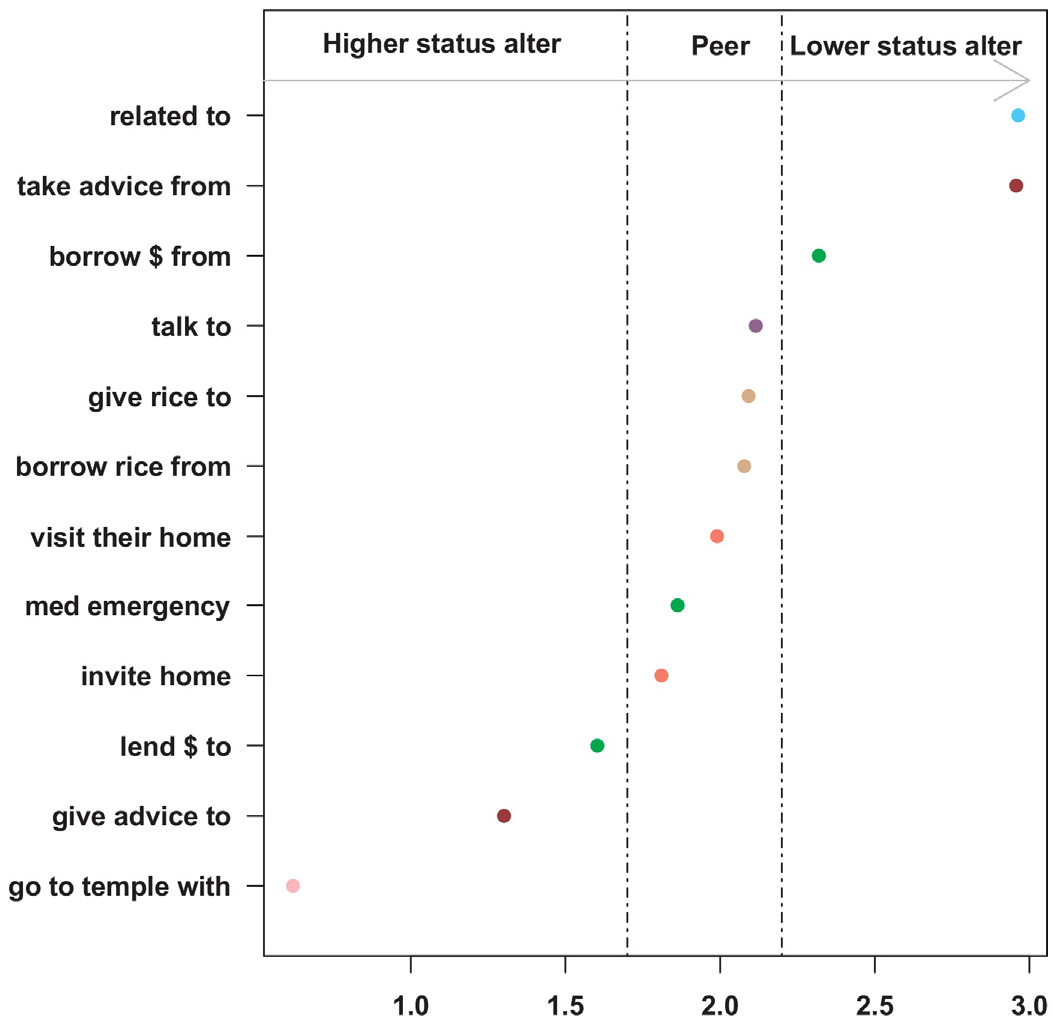 Fig 1. Correlation matrix showing how specific questions cluster together (e.g., domestic interaction vs. financial exchange).
Key Insights: Homophily and the "Status Quest"
1. The Power of Homophily
"Birds of a feather flock together" is a global truth, but in rural India, the "feathers" are defined by gender, caste, and religion. Gender homophily was the most potent predictor of a tie. Interestingly, behavioral traits (like owning a latrine) were much less homophilic than demographic traits.
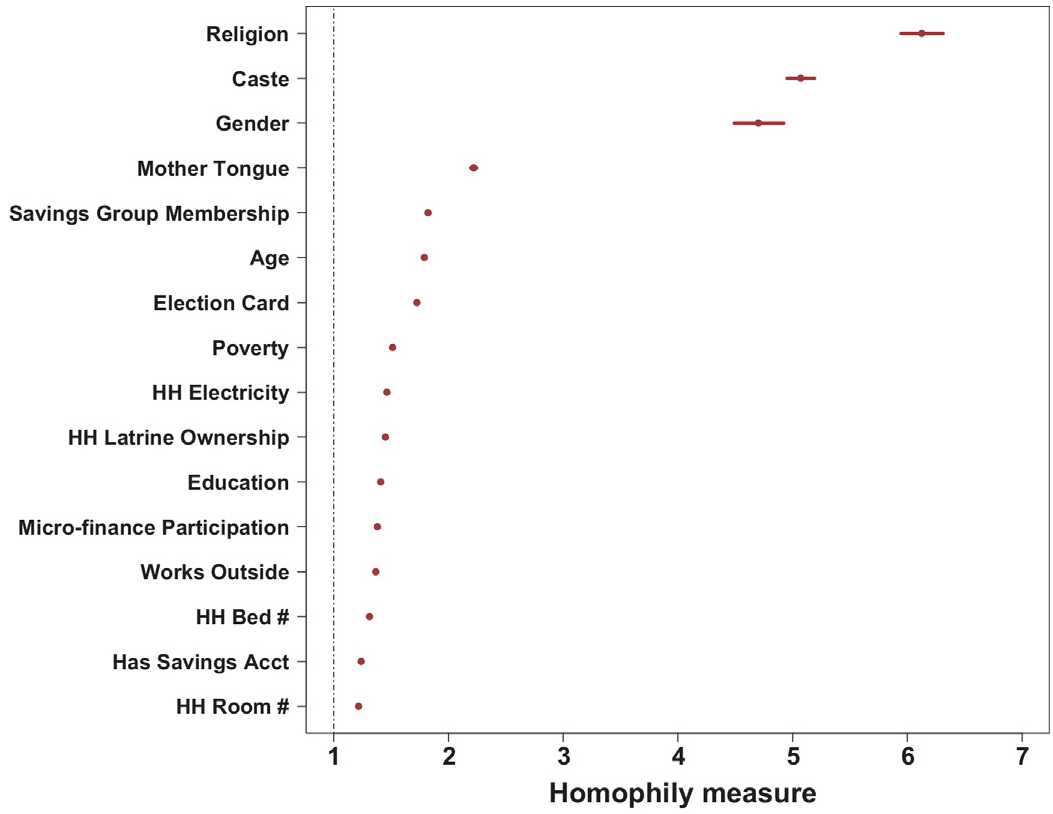 Fig 2. Odds Ratios for naming similar alters. Demographic traits (Gender, Caste, Religion) show massive homophily effects compared to behavioral traits.
2. Peer vs. Hierarchical Networks
The study highlights a fascinating "Status Bias." When asked "who do you talk to," people nominate peers. But when asked "who do you take advice from," participants consistently "nominate up"—choosing alters with higher social standing, more education, and higher network centrality (in-degree).
- Equal Ties: Talking, visiting homes, borrowing rice.
- Hierarchical Ties: Taking advice, help during emergencies, borrowing money.
Optimization: Doing More with Less
One of the paper's most practical contributions is the "Reduced Network." By strategically picking just one question from each of the seven functional clusters, the researchers could reconstruct 89% of the total network while asking 42% fewer questions. This proves that we don't need more questions; we need diverse questions.
Critical Analysis & Conclusion
This work exposes a critical blind spot in global network science: Context remains king.
- The "Temple" Outlier: The "Who do you go to temple with?" question stood completely alone. In many cases, it was the only probe that elicited names of female alters by male respondents. This identifies a "cultural-specific" tie that standard Western surveys would never think to ask.
- Limitations: The study is cross-sectional, meaning it can't prove how behaviors spread over these ties, only that the ties exist. Furthermore, it lacks "affective" (purely emotional) questions, a common trade-off in large-scale rural surveys.
The Takeaway: For anyone deploying social interventions—whether for microfinance or public health—relying on a single name generator is a recipe for bias. To map the true gravity of social influence, one must ask about the rice and the advice.