
Beyond Keywords: Leveraging Social Authority for Precise Literature Retrieval
An Exploratory Study on Using Social Information Networks for Flexible Literature Access
This paper proposes a social-network-based information retrieval model for scientific literature that integrates co-authorship and citation relationships to weight document relevance. By combining traditional topical similarity with author centrality measures like PageRank and Closeness, the method significantly improves retrieval precision, specifically measured by Mean Reciprocal Rank (MRR).
TL;DR
Information retrieval in academic contexts often suffers from "authority blindness"—where a paper might match a query's keywords but lack the scholarly weight of a seminal work. This paper introduces a retrieval model that transforms a bibliography into a social network of authors. By combining traditional text matching with SNA (Social Network Analysis) centralities (like PageRank and Closeness), the authors achieve up to a 61% improvement in ranking precision for scholarly search.
The "Popularity" vs. "Authority" Dilemma
In the realm of scientific literature, relevance isn't just about what is said, but who said it and who acknowledged it. Traditional IR models like TF*IDF focus on the "what." This leads to two major issues:
- Impersonal results: The system ignores the contextual influence of the research community.
- Domination by noise: A popular resource for a general topic might bury a highly authoritative paper in a niche specialized field.
The authors argue that the "Social Usage" of information—who writes with whom and who cites whom—provides fertile ground for identifying truly relevant documents.
Methodology: Mapping the Academic Social Graph
The core innovation lies in treating a bibliographic database as a Social Content Graph.
1. Network Construction
The researchers define a graph where nodes are authors. They define two types of edges:
- Co-authorship (Direct/Undirected): If Author A and Author B wrote a paper together.
- Citation (Indirect/Directed): If Author A cites Author B's work.
2. The Integrated Ranking Model
Instead of relying only on text similarity, the paper proposes a linear combination model:
Where is the topical similarity and is the sum of the Centrality Measures of the paper's authors.
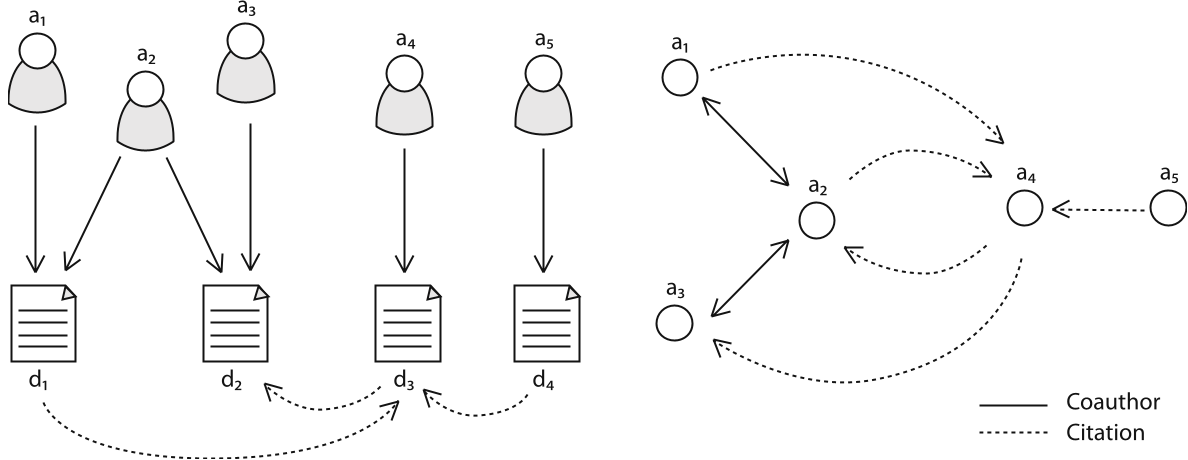 Fig 1: A sample social graph showing authors (nodes) and their publication/citation interconnections.
The study tests five centrality measures: Degree, Closeness, Betweenness, PageRank, and HITS.
Insights from Experiments
The authors tested their model against two assumptions of relevance: "Most Cited" (representing authority) and "Most Downloaded" (representing current popularity/freshness).
Key Findings:
- PageRank and HITS are the champions for finding "Most Cited" (authoritative) documents.
- Closeness Centrality performs best for "Most Downloaded" papers. The authors' intuition here is brilliant: recent, high-interest topics often come from tight-knit research clusters where authors have high reachability (Closeness) within their specific niche.
- Optimal Balance: The best results were found when was around 0.7, meaning 70% weight on text and 30% on social authority.
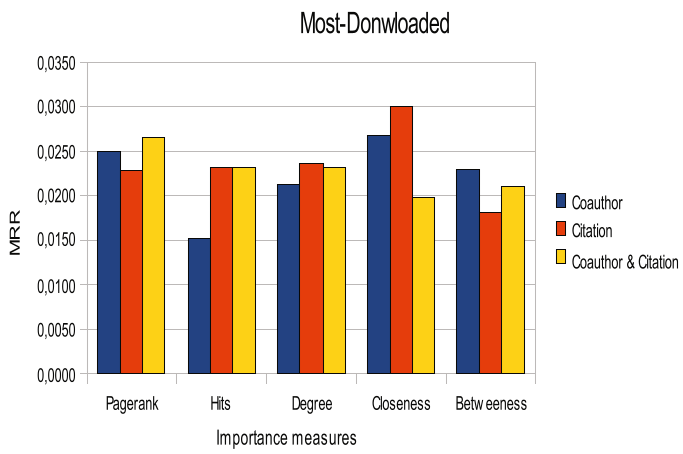 Fig 2: Comparison of different centrality measures. Note how PageRank excels in the "Most Cited" scenario.
The Power of Citation Links
One of the most significant conclusions is that the Citation Network provides much stronger signals for relevance than the Co-author Network. When both are combined, the improvement compared to text-only search is a massive 27% in MRR.
Critical Perspective
While the paper proves that social context is a game-changer for literature access, it has a few limitations:
- Computational Complexity: Calculating Betweenness or Closeness for a global-scale network (like all of Google Scholar) is prohibitively expensive.
- The "Cold Start" for New Authors: Brilliant new researchers might be penalized by the model simply because they haven't yet built a dense network of citations.
Conclusion
This work shifts the paradigm of literature search from "document matching" to "actor evaluation." By treating authors as nodes in a social network, we can filter the noise of the academic explosion and find the work that truly matters to the community. For future search engine developers, the message is clear: the social graph is just as important as the content itself.