
Navigating the Digital Front Door: A Framework for Social Media Adoption in Government
An exploratory study of social media adoption in government
This paper presents an exploratory study by the Center for Technology in Government (CTG) on the adoption of Social Media (SM) in the public sector. It identifies key value drivers and implementation barriers, culminating in a practical "Social Media Policy Guide" featuring eight essential policy elements for government agencies.
TL;DR
As government agencies transition from traditional communication to interactive "Government 2.0," they often hit a wall of legal and resource-related anxiety. This exploratory study from CTG (SUNY Albany) breaks down the perceived values (from cost savings to citizen engagement) and the systemic bottlenecks of social media adoption. Most importantly, it provides a rigorous 8-element framework for crafting social media policies that balance innovation with institutional security.
Background: The Web 2.0 Dilemma in Public Administration
In the early 2010s, social media moved from a novelty to a strategic necessity. However, for government agencies, "just hitting post" isn't an option. They operate within a complex web of public record laws, accessibility requirements (Section 508), and strict security protocols. This paper positions itself as a bridge between the "Wild West" of social media and the structured world of electronic governance (e-Gov).
Problem & Motivation: Why Is Change So Hard?
The authors identify a fundamental tension: while Social Media (SM) tools offer instantaneous information sharing and a "human face" for agencies, they introduce risks that don't exist in the private sector.
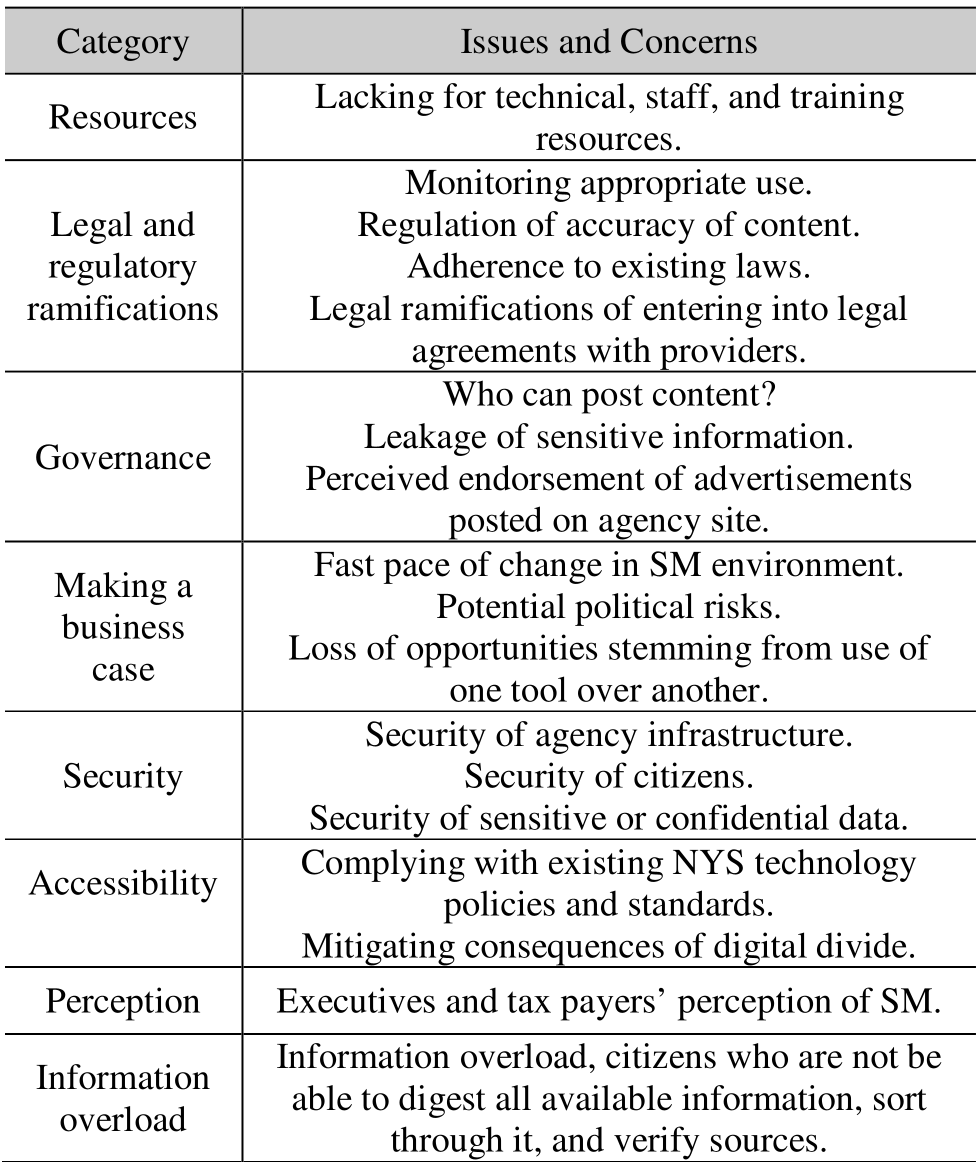
- Resource Scarcity: Unlike corporations, agencies often lack the dedicated staff or training budgets to manage 24/7 engagement.
- Governance Vacuum: Who speaks for the state? The risk of "leaked sensitive info" or "perceived endorsement" of third-party ads creates a paralysis of action.
Methodology: From Practitioner Pain to Policy Framework
The research didn't happen in a vacuum. It was grounded in direct dialogue with government professionals through workshops and interviews.
1. The Value Proposition
The study categorized the rewards of SM into four pillars, which remain highly relevant today:
- Citizen Engagement: Reaching younger demographics and enhancing accessibility.
- Service Delivery: Real-time public safety alerts and information dissemination.
- Workplace Desirability: Competing for young talent who expect modern digital tools.
- Cost Savings: Reducing travel and traditional communication overheads.
2. The Bottlenecks
The researchers mapped out eight critical "concern categories," with Resources and Security topping the list.
The Core Contribution: The Social Media Policy Guide
The "shiny object" of this research is the Social Media Policy Guide. Instead of reinventing the wheel, the authors analyzed 26 existing policies to find the "DNA" of a successful implementation.
They proposed a 4-Step Workflow for agencies:
- Define Goals: What is the specific objective (e.g., transparency vs. service delivery)?
- Multi-functional Teams: You cannot build a policy with just IT; you need Legal, HR, and Communications at the table.
- Audit Existing Rules: How does SM interact with current Records Management or Ethics laws?
- Conflict Resolution: Proactively addressing where new digital speed hits old regulatory friction.

Deep Insight & Conclusion
This paper serves as a foundational text for Digital Governance. Its primary insight is that the "social" in social media is a management challenge, not just a technical one.
Key Takeaways:
- Policy as an Enabler: Rather than being a restrictive document, a well-defined SM policy actually provides employees with the "permission to innovate" within safe boundaries.
- The Digital Divide: The authors early-on identified that moving services to SM risk-excludes those without digital access—a concern that remains a top priority in modern "Equity in Tech" initiatives.
Limitations & Future Outlook: While the study focused on New York State, the framework is globally applicable. However, as the study is "exploratory," it primarily looks at perceptions. Future work (at the time) was needed to measure the actual ROI of these engagements—a task that continues today as governments grapple with the transition from simple social media to AI-integrated citizen portals.