
Beyond the Gail Model: Machine Learning for Personalized Breast Cancer Prediction in Cuban Women
Exploring Breast Cancer Prediction for Cuban Women
This study evaluates the effectiveness of the Gail model (BCRAT) for predicting breast cancer risk in native Cuban women and proposes Machine Learning (ML) alternatives. The research demonstrates that while the Gail model provides a baseline, multiple ML algorithms—including Naive Bayes and Random Forest—achieve significantly higher sensitivity and accuracy on the same clinical datasets.
TL;DR
Early detection is the cornerstone of reducing breast cancer mortality, yet traditional risk models like the Gail model—designed primarily for U.S. populations—falter when applied to native Latin American women. This study proves that Machine Learning (ML) models can bridge this gap, elevating prediction accuracy from 86.7% to over 98% and, crucially, identifying nearly 100% of positive cancer cases that traditional tools missed.
The "One Size Fits All" Problem in Oncology
Risk estimation tools are vital for deciding who needs intensive screening or preventative therapy. However, the Gail Model (BCRAT) was built on an inductive bias favoring white, North American demographics.
The authors argue that Latin American women have distinct ancestral European components and environmental exposures that shift the risk profile. For instance, while the frequency of breast cancer peaks between 51-63 years in the U.S., it hits much earlier (age 40-54) in regions like Mexico and Cuba. When a model built for one region is used in another, it often produces False Negatives, telling high-risk women they are "safe."
Methodology: Testing the Traditional vs. The Computational
The researchers utilized a dataset from the Medical Informatics Center in Havana, Cuba, comprising 1,159 diagnosed patients and 404 healthy controls.
The Baseline: The Gail Model
The study tested the latest BCRAT (version 2.0) which includes a "Hispanic" adaptation. They tested two scenarios:
- Treating all subjects as generic "Hispanic American" (GE1).
- Differentiating between U.S.-born and foreign-born status (GE2).
The Challenger: Machine Learning
Using RapidMiner, the team trained several models:
- Probabilistic: Naive Bayes (NB)
- Tree-based: Random Forest (RF), Decision Tree (DT), Gradient Boosted Trees (GBT)
- Neural: Deep Learning (DL)
- Statistical: Logistic Regression (LR), Generalized Linear Models (GLM)
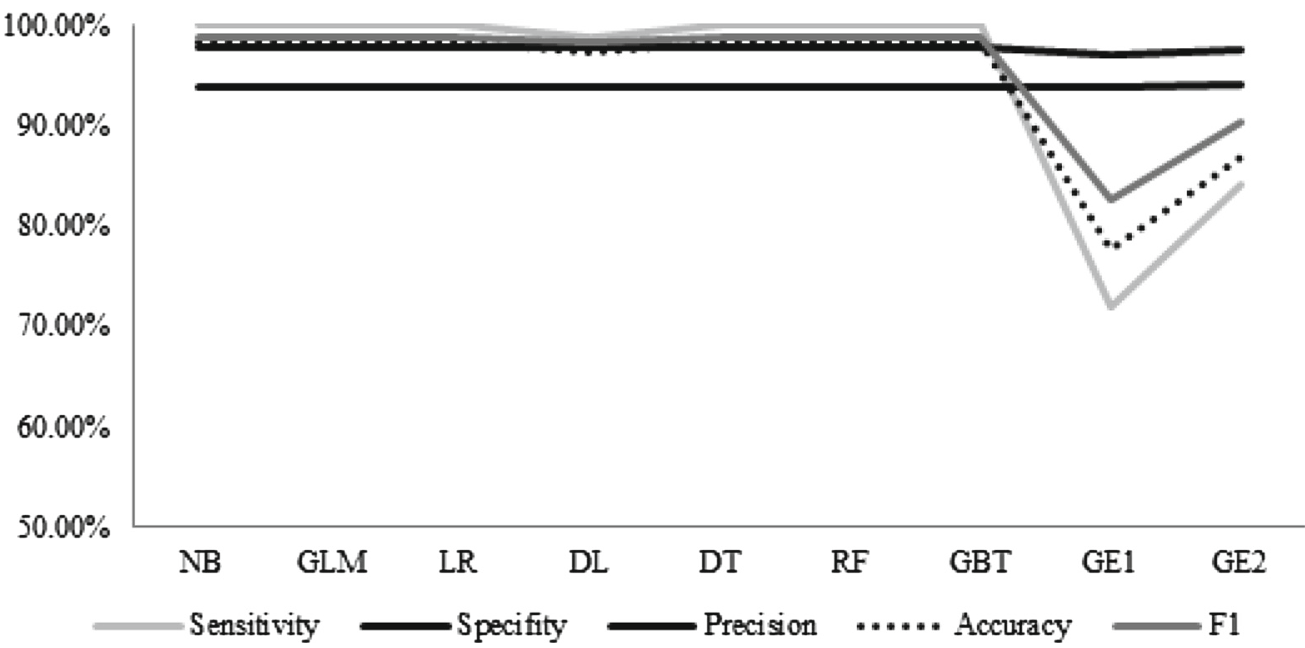 Fig 1: Superiority of ML across Sensitivity, Accuracy, and F1 scores.
Results: Why ML Wins
The disparity in results was stark. The Gail model struggled with Sensitivity—the ability to correctly identify women who actually have cancer.
| Metric | Gail Model (Best) | Machine Learning (Most) |
|---|---|---|
| Sensitivity | 84.21% | 100% |
| Accuracy | 86.76% | 98.4% |
| F1 Score | 90.41% | 98.9% |
While the Gail model missed 183 positive cases (False Negatives), algorithms like Naive Bayes and Random Forest achieved perfect sensitivity on this dataset. This suggests that the relationship between standard risk factors (age at menarche, number of biopsies, etc.) and actual cancer risk is non-linear and complex—patterns that ML captures better than traditional regression.
Critical Insight & Conclusion
The study’s most significant takeaway isn't just that "ML is better," but that population-specific data is non-negotiable. The Gail model’s failure in the Cuban context highlights a "validation gap."
Future Outlook: While these results are promising, the authors acknowledge the need for larger, more diverse datasets. The next frontier involves multidisciplinary schemes—combining these high-performing ML models with genetic markers and imaging data to create a truly global, yet locally-sensitive, early warning system.
Takeaway for Practitioners
If you are developing diagnostic AI, beware of Geographic Drift. A model trained in a Western clinical setting provides only a baseline; localized fine-tuning using Machine Learning is essential for equitable healthcare outcomes in Global South populations.