
Exploring Ideation: How "Network Slack" Drives Scientific Breakthroughs
Exploring Ideation: Knowledge Development in Science through the Lens of Semantic and Social Networks
This paper explores "ideation"—the emergence of new scientific knowledge topics—by analyzing the co-evolution of social (co-authorship) and semantic (title keyword) networks. Focusing on the Semantic Web sub-field of Computer Science from 2006–2010, it identifies how specific network structural properties like "slack" facilitate the transition from technical to application-oriented research clusters.
TL;DR
"Ideation"—the birth and consolidation of new ideas—isn't just a result of individual genius; it is a structural byproduct of how we interact. By analyzing five years of Semantic Web conferences, this study reveals that scientific fields thrive when their social networks have "slack." Paradoxically, a network that is too tight can stifle innovation, while a relatively loose, shifting structure allows a field to pivot from pure technology to real-world applications.
Contextualizing the Study
In the world of academic research, being "hot" is everything. New topics bring funding, prestige, and career advancement. However, we often treat the birth of these topics as a "black box." This paper positions itself at the intersection of Social Network Analysis (SNA) and Semantic Network Analysis, moving away from a static view of science to a dynamic one. It asks a fundamental question: What kind of social environment allows a new "Idea" to take root and become the new consensus?
The Problem: The Consensus Paradox
The authors highlight a critical tension in innovation studies:
- Density Benefits: Close-knit, dense networks build trust, which is essential for transferring complex, risky new knowledge.
- Density Risks: Too much density leads to "lock-in," where everyone thinks alike (homogeneity), and the field stops questioning the status quo.
The challenge is finding the "Goldilocks zone"—enough consensus to validate an idea, but enough "slack" to let new ones emerge.
Methodology: Mapping Minds and Meanings
The researchers tracked 92 "active scientists" in the Semantic Web community from 2006 to 2010. They built two types of networks:
- Social Networks: Ties formed by co-authoring papers.
- Semantic Networks: Ties formed by keywords (topics) appearing together in paper titles.
By calculating Density (how many people know each other), Transitivity (the "friend-of-a-friend" effect), and Degree Centrality (who the "stars" are), they could see the field's skeleton and its vocabulary changing simultaneously.
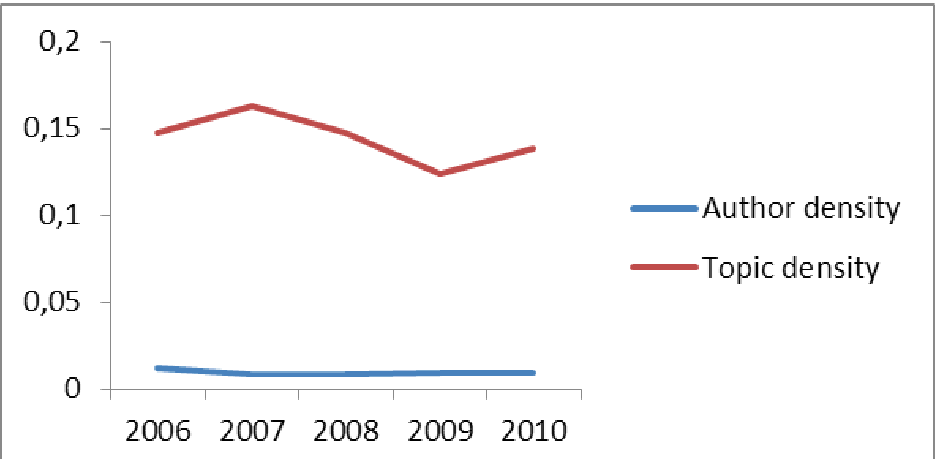 Figure 1: Comparison of network density showing how social structures remain relatively sparse compared to the semantic overlap.
Key Insights: The 2008 Pivot
The data revealed 2008 as a "pivotal year." Before 2008, the Semantic Web field was obsessed with technical infrastructure—terms like OWL, Ontology, and RDF dominated.
However, the social network stayed relatively sparse and transitive. This "slack" allowed a new cluster to form. By 2010, the conversation had shifted toward applications: Linked Data, Querying, and Knowledge.
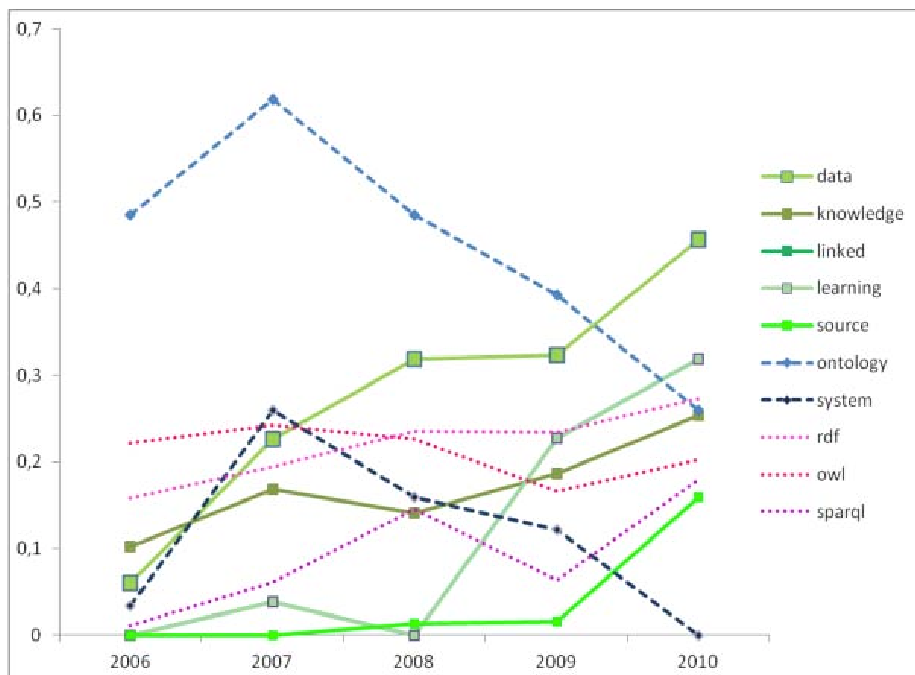 Figure 2: This graph illustrates the "Creative Destruction" in the field—technical terms like "Ontology" declining while "Linked Data" and "Knowledge" surge.
Why was this effective?
- Temporal Consensus: The field doesn't cling to one topic forever. It reaches a temporary agreement, builds on it, and then the social "slack" allows the next wave of ideas to break the previous consensus.
- Distribution of Power: The shifting degree centrality of authors suggests that different experts lead the field during different conceptual phases.
Critical Analysis & Conclusion
This paper provides a vital roadmap for R&D leaders and academic organizers. It suggests that if you want a "hot" topic to emerge, you shouldn't force everyone into a single, dense working group. Instead, foster a network that allows for leeway and short-term collaboration between different clusters.
Limitations: As an exploratory study, it doesn't prove causality. We don't yet know if a "slack" network causes new ideas, or if the emergence of exciting new ideas naturally pulls a network apart into a looser structure.
Future Outlook: The next frontier is automating this analysis. Imagine a tool that monitors your industry's publication and social data in real-time to alert you when a field is entering a "pivotal year"—allowing you to pivot your R&D strategy before the rest of the market catches on.