
ARIM: Decoding True Social Influence Through Action-Reaction Dynamics
Exploring Interactions in Social Networks for Influence Discovery
The paper proposes ARIM (Action-Reaction Influence Model), a flexible and platform-independent framework for measuring user influence. It moves beyond simple network topology by quantifying influence through proactive "Actions" (posts) and reactive "Reactions" (likes, comments, shares), achieving a more granular social scoring on real-world Facebook and Pinterest datasets.
TL;DR
In the era of "influencer marketing," vanity metrics like follower counts are increasingly deceptive. This paper introduces the ARIM (Action-Reaction Influence Model), a generic framework that calculates influence by analyzing the intensity, spread, and frequency of user reactions. By penalizing "spammy" posting behavior and rewarding high-engagement combinations (like a comment paired with a share), ARIM provides a truer map of social power than traditional graph-based models.
Background Positioning: Moving Beyond the "Follow" Graph
Most legacy influence models (like PageRank) treat a social network as a static graph. If User A follows User B, User B is assumed influential. However, ARIM shifts the focus to actual behavior. It differentiates between the Subject of Influence (the creator) and the Object of Influence (the reactor), positing that influence only exists if a proactive Action triggers a reactive Reaction.
The Problem: The Reach vs. Resonance Gap
Existing SOTA methods for Influence Maximization often focus on "how many people might see this." The authors argue this is a flawed premise. A user might have a massive "friend" list on Facebook, but if their posts garner zero comments or shares, their actual influence is null. The challenge lies in:
- Heterogeneity of Reactions: A "wordless nod" (like) is fundamentally different from the effort of a comment.
- Quality vs. Quantity: Information fatigue means that posting 100 times a day often diminishes the value of each post.
Methodology: The ARIM Framework
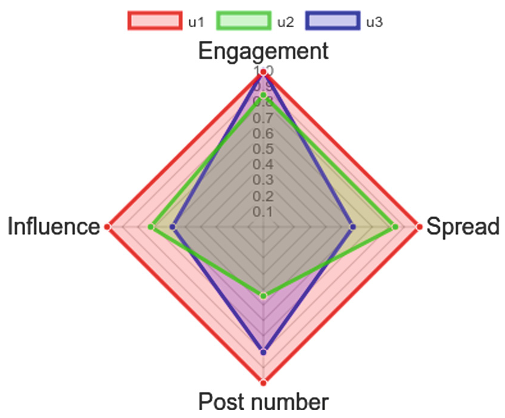
The core of ARIM is built on three pillars: Intensity, Spread, and Engagement.
1. Reaction Intensity (The Non-Linear Core)
The model recognizes that if a user likes, comments, and shares a single post, the influence is exponentially higher than the sum of those parts.

The authors use a weighted formula that includes the multiplication of reaction sets to boost the score of concurrent reactions:
2. Spread vs. Engagement
- Spread: The raw number of distinct audience members reached per action.
- Engagement: The average strength of those reactions.
This distinction allows the model to identify "Broadcasters" (High Spread, Low Engagement) vs. "Community Leaders" (Low Spread, High Engagement).
3. The Time Penalty (ActionFreq)
To reward quality over spam, the model includes a penalty for high-frequency posting: As the number of actions increases, this multiplier decreases, forcing influencers to make every post count.
Experimental Insights
The authors validated ARIM on massive datasets from Facebook and Pinterest.
(Note: Tables in the paper show the scale: 104M comments on Facebook and 37M shares on Pinterest).
Case Study: Pinterest Re-ranking
The Pinterest experiment was particularly revealing. By increasing the weight of "Shares" (repins) relative to "Likes," the rankings shifted significantly.
- User 820 jumped from 8th to 4th place because while they had fewer "likes," their content was shared much more frequently.
- The "Top 3" Stability: The top 3 users remained stable across weight changes, primarily because they dominated in Spread—their content was so ubiquitous that it outperformed specialized engagement.
Critical Analysis & Future Outlook
Takeaway: ARIM is a pragmatic, "single-platform" model. Unlike "all-encompassing" metrics like the Klout score (which are often "black boxes"), ARIM is transparent and adaptable.
Limitations:
- Sentiment Neglect: Currently, a "Hate Comment" and a "Supportive Comment" are treated equally. Future iterations would benefit from Natural Language Processing (NLP) to weigh the sentiment of the reaction.
- Zero-Reaction Actions: The current frequency penalty might be too harsh on users who post frequently but high-quality content (e.g., news bots vs. humans).
Future Work: The authors aim to explore "Potential Influencers"—users who aren't at the top yet but show a high derivative in their engagement growth over time. For advertisers, finding these "rising stars" is the ultimate goal.