
Swarm Intelligence in the Social Web: Decoding Learning Patterns via Ant Colony Optimization
Exploring Learning Pattern in Social Network
This paper explores unsupervised learning patterns in social networks, focusing on two primary collective behaviors: coloring (differentiation) and consensus (agreement). It proposes a decision-making framework leveraging Ant Colony Optimization (ACO) to model how information propagates and how natural agents reach collective decisions in networked settings.
TL;DR
Social networks are more than just platforms for interaction; they are complex, decentralized learning environments. This paper investigates how users reach consensus (agreement) or coloring (differentiation) using a framework inspired by Ant Colony Optimization (ACO). By treating social influence as a "pheromone trail," the authors propose a recursive model to automate decision-making and predict public opinion trends.
Problem & Motivation: The Chaos of Social Influence
Traditional machine learning assumes structured, often stationary, data distributions. However, social networks are inherently chaotic. The authors point out several critical anomalies:
- Uncertainty: The basis of social information is stochastic and unsupervised.
- Scale: Social states () are massive, requiring algorithms that scale polynomially to remain viable.
- NP-Completeness: Solving for the global optimum in social influence—such as picking the perfect nodes to start a marketing campaign—is computationally "hard" (NP-Complete).
The research is driven by a powerful intuition: Humans in a social network behave remarkably like ants foraging for food. We follow "trails" left by others (likes, shares, tweets) and update our "beliefs" based on the strength of these digital pheromones.
Methodology: From Ants to Algorithms
The core of the paper’s contribution is the adaptation of the Ant Colony Optimization (ACO) metaphor to social decision-making.
The Recursive Learning Model
To quantify how a user (agent) updates their preference for a particular path or choice, the authors introduce a recursive utility function:
Where:
- : The utility (belief strength) of a choice at time .
- : A decreasing scalar representing the learning rate.
- : The pheromone strength (popularity/social proof) of that choice.
Architecture of Decision Making
The authors propose a "Three-Tier Architecture" involving State Space, Initial Distribution, and Agent Strategy Classes. This allows the social network to be viewed as a generative model that produces "trajectories" of behavior—such as a viral trend or a market herd.
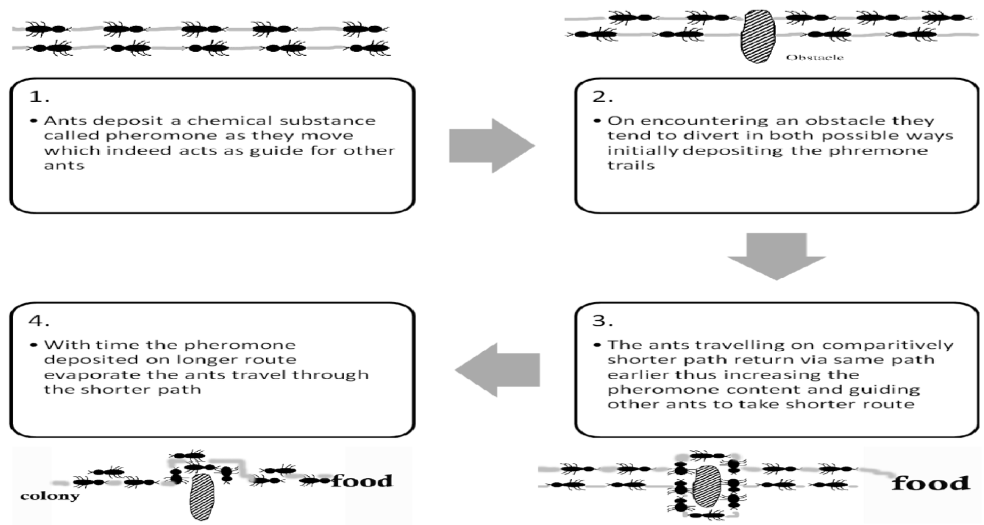 Figure 1: The schematic of how artificial ants (agents) navigate a graph to find optimized social paths.
Experiments & Use Case Flow
The paper validates the theory through a Use Case Approach, focusing on how participants in an online group establish collective belief. The process follows a specific lifecycle:
- Monitoring: Staying involved in the network.
- Referencing: Peer-to-peer influence.
- Refining: Improving individual beliefs based on collective feedback.
- Convergence: Reaching a final decision or consensus.
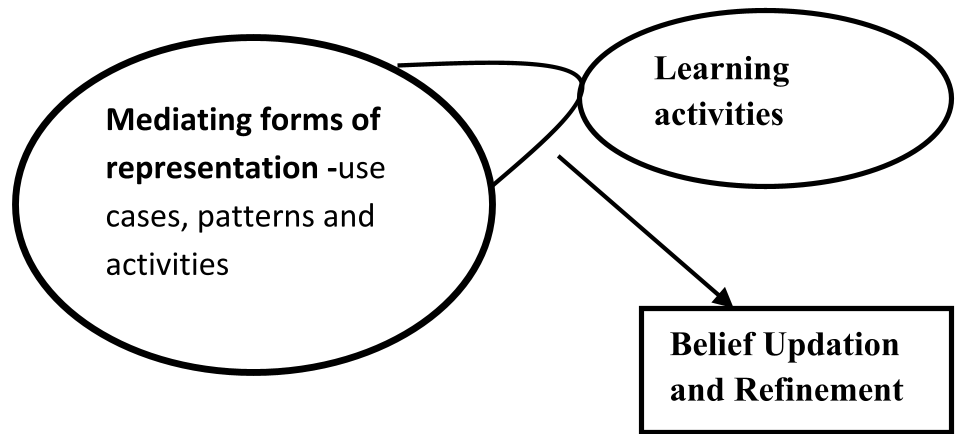 Figure 2: The feedback loop between mediation, learning, and belief updation.
The study suggests that in highly clustered networks (like "cliques"), the throughput of information and the speed of consensus are significantly higher than in random networks. This explains why echo chambers form so rapidly on platforms like Facebook.
Critical Analysis & Conclusion
Takeaway
This work demonstrates that social learning is not just a psychological phenomenon but a computational one. By using stochastic recursive equations, we can model the "pheromone" of popularity to predict which products will succeed or how misinformation will spread.
Limitations
While the ACO model is elegant, the paper is primarily theoretical and conceptual. The authors acknowledge that while the logic holds for small-scale simulations, validating it against real-world Big Data (like a full Facebook event log) remains a challenge for future work. Furthermore, the model assumes "natural agents" (humans) act with a degree of rationality similar to ants, which may ignore the complexities of human emotion and contrarian behavior.
Future Outlook
As we move toward 2026, the integration of Swarm Intelligence into Social CRM and automated opinion mining will likely become standard. This paper provides the mathematical breadcrumbs to get us there.