
Beyond the Poker Face: How Personal Memories Unlock Automated Emotion Recognition
8365_Exploring Personal Memories and Video Content as Context for Facial Behavior in Predictions of Video-Induced Emotions.
This paper introduces a multimodal approach to predict video-induced emotions by integrating facial behavior with personal memories and video content. Using a decision-level fusion strategy (stacked generalization), the authors demonstrate that self-reported memory descriptions significantly enhance the predictive accuracy of the Pleasure-Arousal-Dominance (PAD) dimensions.
TL;DR
Can a computer tell how you feel if you aren't making a face? This paper explores a critical missing link in Affective Computing: Personal Memories. By combining facial tracking with the "internal context" of triggered memories and video content, researchers achieved a significant breakthrough in predicting emotional states (Pleasure and Dominance) that facial analysis alone completely missed.
The "Context" Crisis in Emotion AI
For decades, the "holy grail" of affective computing was reading faces. However, recent psychological evidence suggests that in the real world—especially when watching a video alone—humans don't always "wear" their emotions. This results in the poker face problem, where traditional models like OpenFace struggle to find meaningful patterns.
The authors argue that humans interpret emotions through perspective-taking. If we see someone crying while watching a wedding video, we assume joy/nostalgia because of the context. This paper seeks to give machines that same contextual lens by looking at what the viewer is watching and, more importantly, what it reminds them of.
Methodology: Fusing Behavior with Mind-State
The researchers collected a unique dataset of 932 responses where viewers watched music videos, recorded their faces, and wrote down triggered memories.
The Multimodal Pipeline
- Behavioral Branch (The "What"): Using OpenFace 2.0 to extract Action Units (facial muscles), Gaze direction, and Head Pose.
- Environmental Branch (The "Stimulus"): Analyzing the video using DeepSentiBank (to find "Adjective-Noun Pairs" like creepy forest) and VGG16 features.
- Cognitive Branch (The "Memory"): Processing free-text descriptions using NLP techniques, including Word2Vec, GloVe, and affective lexicons (e.g., VADER).
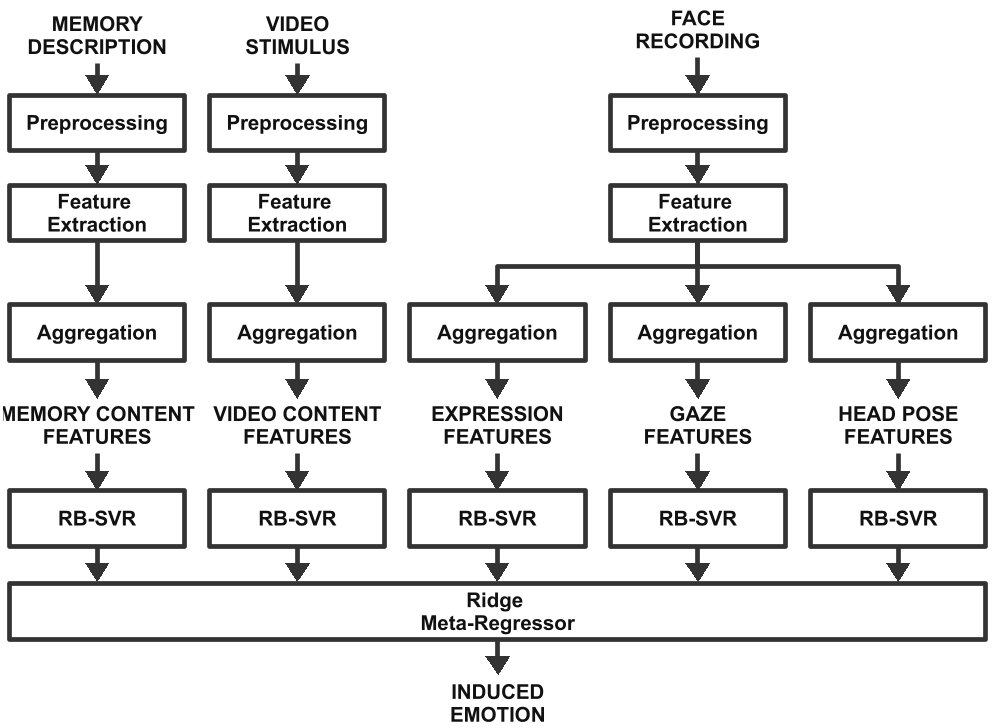 Figure 1: The two-stage pipeline: Feature extraction followed by decision-level fusion via Ridge Regression stacking.
Key Findings: Memories Outperform Faces
The results were striking. For the Pleasure dimension, the "Memory Content" modality was actually the strongest individual predictor, outperforming both facial expressions and video content.
Complementary Effects
- Pleasure & Dominance: Context (Video + Memory) provided massive gains.
- Arousal: Only Facial Expressions remained a reliable predictor, suggesting that bodily excitement is still best captured by physical cues rather than cognitive descriptions.
- The Overlap: Statistical analysis showed that Video and Memory content provide some overlapping information (they are correlated), but they are both highly complementary to facial behavior.
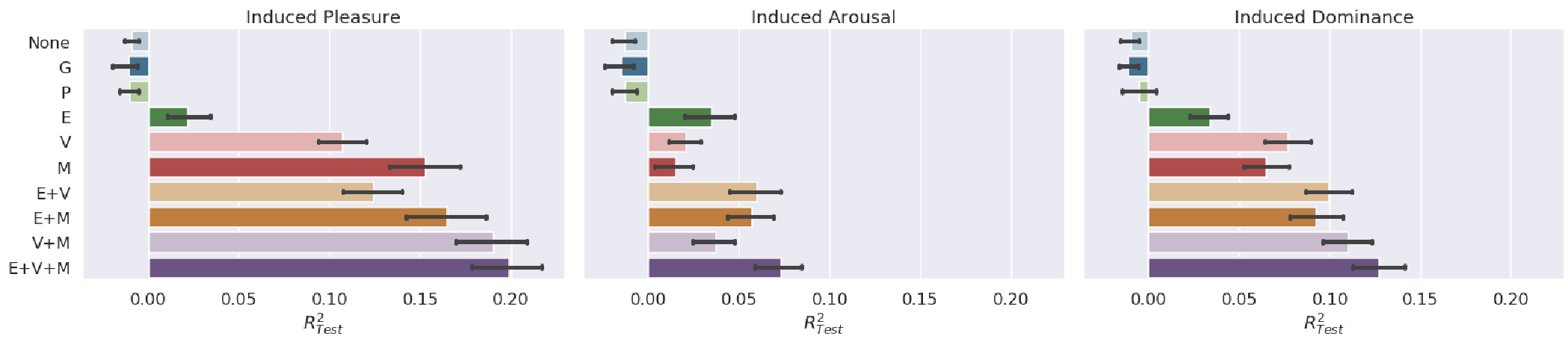 Figure 2: R² performance across the PAD dimensions. Notice how the 'E+V+M' fusion (far right) consistently hits the highest marks.
Critical Insight: The Limitation of Expressivity
Why did the face perform so poorly? The authors suggest a provocative theory: functional sociality. We express emotions to communicate with others. When watching a video alone in a room, there is no "social need" to smile or frown. This makes "internal context" (memories) not just a "nice-to-have" feature, but a requirement for any AI that wants to understand private consumption of media.
Future Outlook
This work opens a new door for personalized AI. Imagine a recommendation system that doesn't just suggest a video because "others liked it," but because it understands the specific autobiographical nostalgia it triggers in you.
The next challenge? Mining this data without asking. Instead of making users write essays about their memories (as in this study), future research will likely look at mining social media comments or past user history to "infer" these memories automatically.
Conclusion
By moving beyond the surface of the skin and into the history of the mind, Dudzik et al. have charted a course for a more empathetic, context-aware generation of Artificial Intelligence.