
IIRL: Deciphering the Hidden Semantics of Social Links through Dual Embeddings
On Exploring Semantic Meanings of Links for Embedding Social Networks
The paper proposes IIRL (Interest and Identity Representation Learning), a social network embedding framework that disentangles node representations into "Identity" (structure-based) and "Interest" (content-based) components. By inferring the semantic meaning of each link, it achieves SOTA performance in social network analysis tasks.
TL;DR
Standard network embeddings assume all "lines" in a graph are the same. IIRL (Interest and Identity Representation Learning) argues that a link between you and a classmate (Identity/Structure) is fundamentally different from a link between you and a stranger who likes the same movie (Interest/Content). By learning two separate vectors for every node and inferring which "reason" dominates each link, IIRL reaches new SOTA heights in link prediction and classification.
Problem & Motivation: The Semantic Blindness of Embeddings
Most graph algorithms are "blind" to the why behind a connection. If Node A connects to Node B, they are pulled together in the latent space.
The Danger of Single Representations: Imagine Node 1 and Node 4 connect because they went to the same school. Node 4 and Node 5 connect because they both post about "Star Wars." A single-vector model might mistakenly place Node 1 and Node 5 close together, suggesting they might become friends, even though they share neither classmates nor interests.
The authors identify two primary link types:
- Structure-close (Identity): Driven by topological proximity (friends of friends).
- Content-close (Interest): Driven by similar user-generated content (e.g., Tweets).
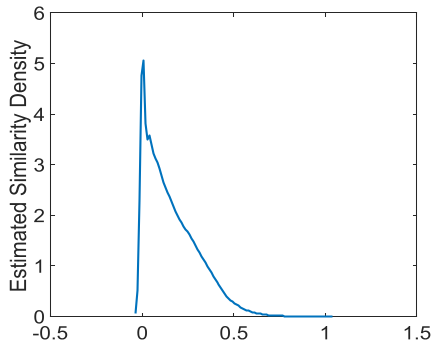 Figure 1: Distinguishing between topological closeness and content-driven similarity.
Methodology: The Dual-Space Architecture
IIRL doesn't just double the vector size; it restructures the optimization objective.
1. Dual Representations ( and )
Each node is assigned:
- : Identity representation.
- : Interest representation.
2. Responsibility Weights ()
The total probability of a link existing between and is a weighted sum: Where . The model learns which is larger during training. If users share common friends but zero keyword overlaps, the model boosts .
3. Content Regularization
To ensure the "Interest" vector actually reflects interests, the model includes a term to reconstruct the node's attribute matrix from via a projection matrix : .
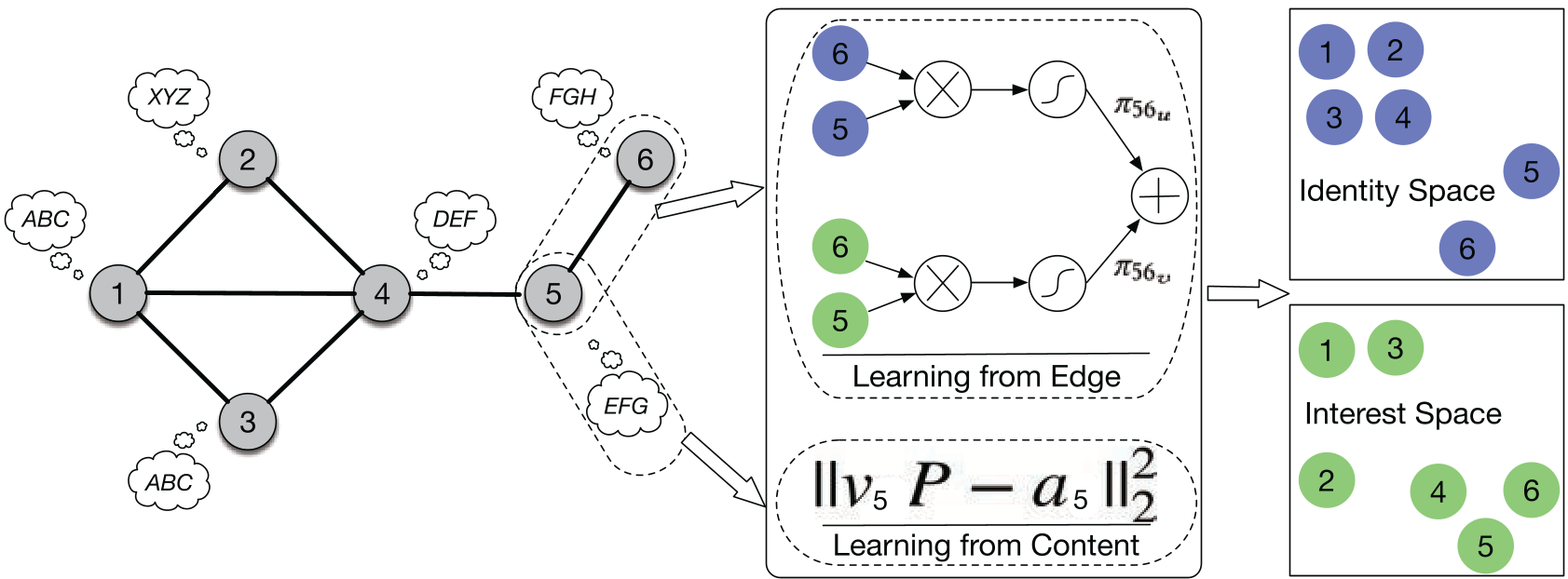 Figure 3: Workflow of link type inference and joint embedding of structure and content.
Experiments & Results: Clearer Clusters, Better Predictions
The researchers tested IIRL on DBLP (Academic), Twitter, BlogCatalog, and Flickr.
Superior Visualization
In the DBLP dataset, IIRL manages to better separate research fields (Data Mining, DB, ML, IR). While structure-only models like DeepWalk struggle with cross-field citations, IIRL’s interest vectors successfully isolate researchers by their topic focus.
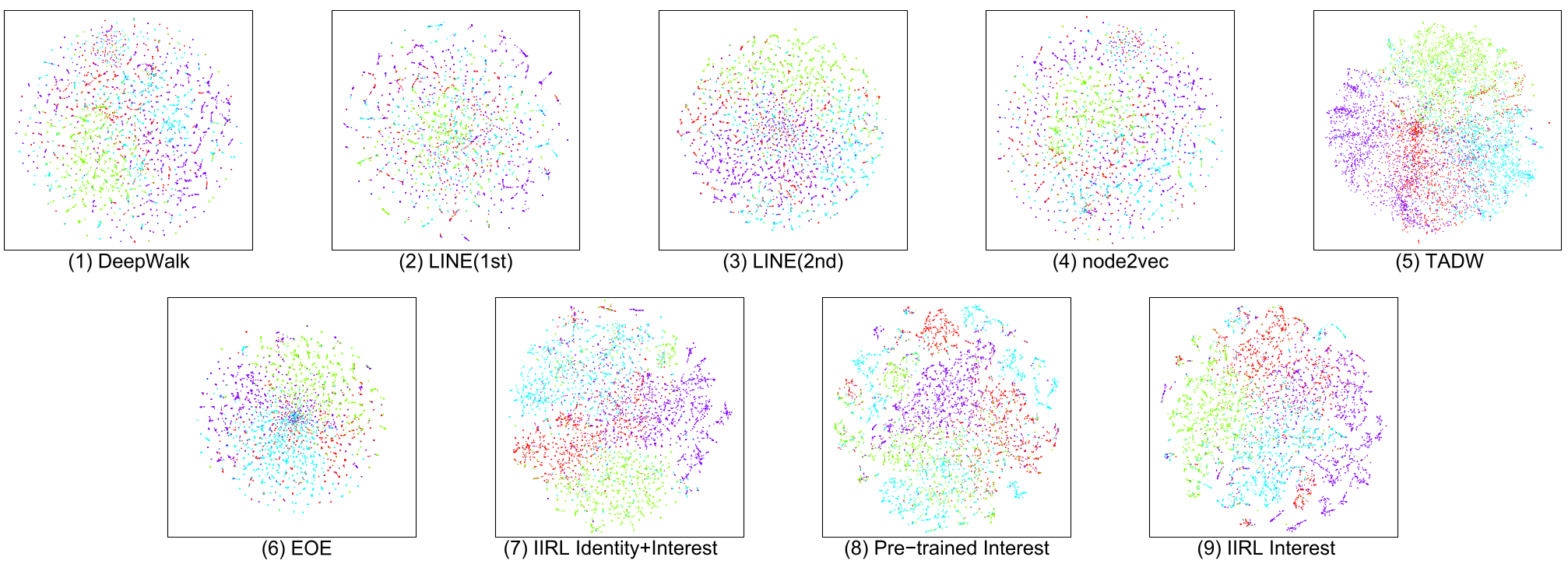 Figure 5: Visualization showing how IIRL maintains topical purity in the interest space.
Quantifiable Gains
- Link Prediction: On BlogCatalog, IIRL hit an AUC of 91.92, significantly higher than EOE (88.94) and DeepWalk (81.32).
- Classification: Micro-F1 scores improved across the board, proving that disentangled features are more linearly separable for classifiers like SVM.
Critical Analysis & Conclusion
Takeaway
IIRL proves that "Identity" and "Interest" are often orthogonal. In Twitter, for example, many users follow celebrities (Interest-only) without any structural overlap. By acknowledging this, the model avoids "over-smoothing" the graph.
Limitations & Future Work
- Coarse Category: The paper only looks at two broad categories. Future work could split "Interests" into sub-taxonomies (e.g., Sports vs. Politics).
- Scalability: While the authors claim scalability, alternating optimization on four variables () is more computationally expensive than single-pass stochastic gradient descent used in simpler models.
Ultimately, IIRL provides a robust blueprint for Interpretable Representation Learning in social graphs, moving us away from "Black Box" vectors toward semantically meaningful embeddings.