
Serendipitous Social Networks: Why Connecting with Strangers is the Future of Context-Aware Mobile Services
Exploring serendipitous social networks: sharing immediate situations among unacquainted individuals
This paper introduces the concept of "Serendipitous Social Networks," a framework that connects unacquainted individuals based on shared immediate situations rather than existing social ties. By deploying a prototype microblogging service, the authors demonstrate that context-aware networking fosters timely information exchange and emotional empathy among strangers.
TL;DR
Most social networks are "locked" by who you know. This paper breaks that barrier by proposing Serendipitous Social Networks, which connect you with people based on what you are doing right now. By leveraging immediate situations (like "shopping at the same mall" or "working late at the library"), the researchers found that strangers can provide more timely help and deeper emotional resonance than your actual friends.
The Problem: The "Friendship Trap" in Modern SNS
Current platforms like Facebook or X (Twitter) are built on acquaintanceship. This creates two distinct friction points:
- Relevance Anxiety: You might not post about your "unexciting" lunch because your followers won't care.
- Information Lag: If you need to know if a specific supermarket has frozen items right now, your friends across the city can't help you, but the stranger in the next aisle could.
Traditional SNSes are peer-centric; the authors argue we need a situation-centric approach.
Methodology: Mining the "Immediate Situation"
The core innovation lies in the Serendipitous Substrate. Connectivity is not static; it is ephemeral, dissolving as soon as the situation changes.
How it Works
The team built a prototype microblogging app (similar to a context-aware Twitter). Users provided two main inputs:
- Location: Where they are.
- Activity: What they are doing (e.g., Eating, Working, Partying).
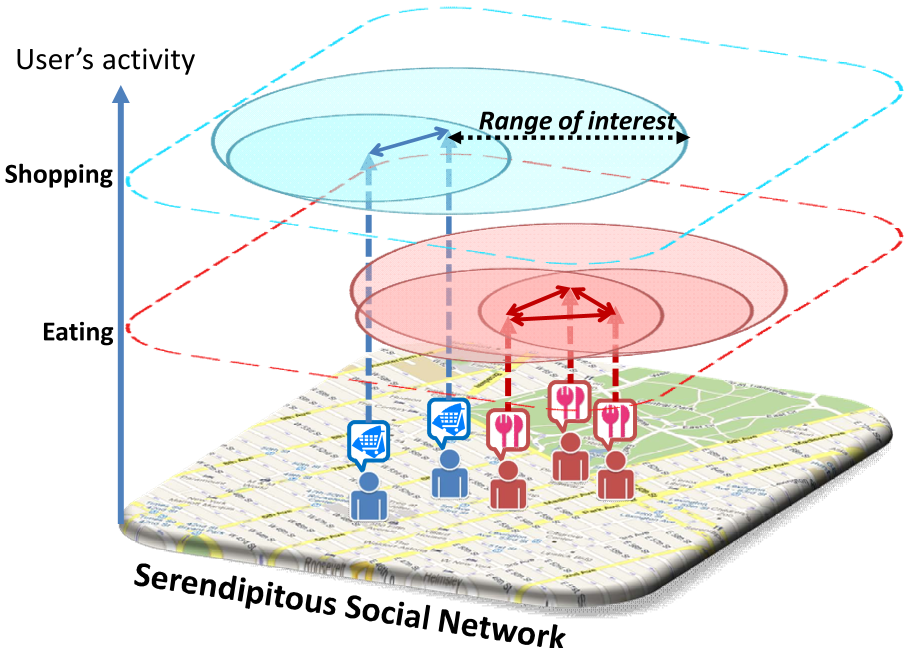 Figure 1: Serendipitous social networks based on users’ locations and activities.
By matching these two variables, the system creates a "pop-up" social network. You are instantly part of a community of "Workaholics" at 10 PM or "Foodies" at a specific restaurant cluster.
Key Insights from the Field
The study (n=16) lasted two weeks and produced several fascinating observations:
1. The Low Barrier to Entry
Unlike traditional apps where you start with zero followers and zero value, a serendipitous network provides instant value. As one participant noted, joining late didn't matter because the network was built around the now, not your history.
2. The "Kindness of Strangers" is Quantifiable
Participants used the app for "Immediate Crowd-sourcing." For example, a user at a supermarket asked about a specific product, knowing that the "situation-aware" audience was physically positioned to provide the answer. This is a level of utility that a global friend-list cannot match.
3. Emotional Resonance & Shared Reality
Surprisingly, the lack of an existing bond made people feel more free. There was a sense of "Mutual Sympathy." Seeing someone else "Working" late at night created an immediate bond of shared struggle, leading to higher engagement than typical social scrolling.
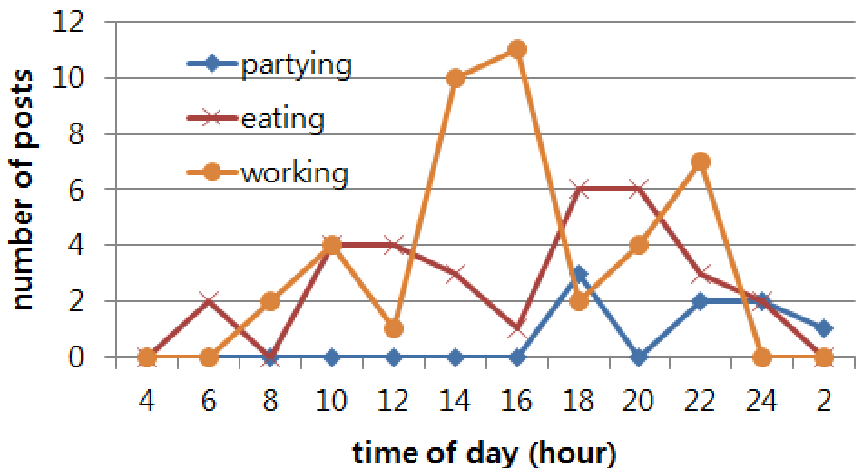 Figure 2: Analysis of posting density showing how users integrated the service into their daily life rhythms (Eating, Working, Partying).
Critical Analysis & Future Outlook
While the study was small-scale, it highlights a massive shift in how we view digital companionship.
The Privacy Trade-off: Interestingly, participants were less worried about privacy than expected, treating the service like a "public square." However, the authors admit that as context-detection becomes more autonomous (using GPS and sensors without manual input), the "creepiness factor" might rise, necessitating anonymous posting features.
Future Potential:
- Social Commerce: Imagine getting a group discount at a museum by instantly "grouping" with the 10 strangers standing in the same queue.
- Recommendation Engines: Instead of "people who bought this also bought...", we get "people who visit this specific niche park also enjoy this coffee shop."
Conclusion
The move from Who you know to Where you are and what you do represents the next frontier of mobile social interaction. Serendipitous Social Networks prove that sometimes, a stranger who understands your current situation is more valuable than a friend who doesn't.
Takeaway: Design for the moment, not the history. Utility in the mobile era is defined by situational context, not just the social graph.