
#mytweet via Instagram: Decoding the Cross-Platform Social DNA
#mytweet via Instagram: Exploring User Behaviour across Multiple Social Networks
This paper presents a user-centric study of cross-platform behavior across six major Online Social Networks (OSNs): Flickr, Google+, Instagram, Tumblr, Twitter, and YouTube. By analyzing over 15,000 users linked via About.me, the authors identify distinct temporal, topical, and "source-sink" patterns that define how individuals navigate the social media ecosystem.
TL;DR
Why do we use Instagram for photos but Twitter for thoughts? This study analyzes 15,000+ users across six major social networks to prove that our digital identities are fragmented by design. It introduces the concept of "Source" vs. "Sink" networks, revealing that visual platforms (Instagram/YouTube) act as the birthplaces of content, while text platforms (Twitter) serve as the ultimate destination for broadcasting.
Background: The Myth of the Unified Digital Identity
Most academic research stays within the "walled gardens" of a single platform like Twitter or Facebook. However, the average user manages over five accounts. This paper asks a fundamental question: Is our behavior on one network a mirror of our behavior on another? The answer is a resounding "No." By using About.me as a Rosetta Stone to link accounts, the researchers uncovered a complex ecology where each app fills a specific psychological and professional niche.
Problem & Motivation: The Limitation of Single-Platform Studies
If you only study a user's Twitter feed, you see an aggregator of links and short bursts of text. You miss the original creative process happening on Flickr or the professional networking occurring on Google+. The authors argue that Macroscopic analyses (graphs/networks) fail to capture the Micro-level (individual) nuances of how content flows through the modern web.
Methodology: Mapping the Flow
The researchers analyzed three dimensions of user behavior:
- Temporal Signatures: Using Kullback-Leibler (KL) divergence to measure how posting schedules differ.
- Topical Personas: Using Latent Dirichlet Allocation (LDA) with "author-time pooling" to overcome the brevity of social media posts.
- Cross-Sharing Topology: Explicitly tracking posts that move from one network to another (e.g., an Instagram photo appearing on Twitter).
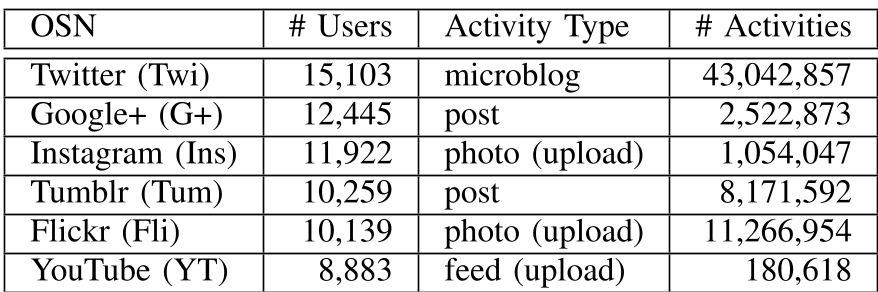
Key Insights: Sources and Sinks
The most striking discovery is the Source-Sink Duality. The paper characterizes networks based on where content starts and where it ends up:
- The Sources (The Creators): Instagram and YouTube. These platforms leverage mobile-first capture (cameras) and "Share" buttons to push content outward. Over 90% of Instagram users in the study cross-shared to other networks.
- The Sinks (The Aggregators): Twitter. It acts as the "lowest common denominator," a central hub where links from all other services converge. 54% of all cross-platform traffic ends up here.
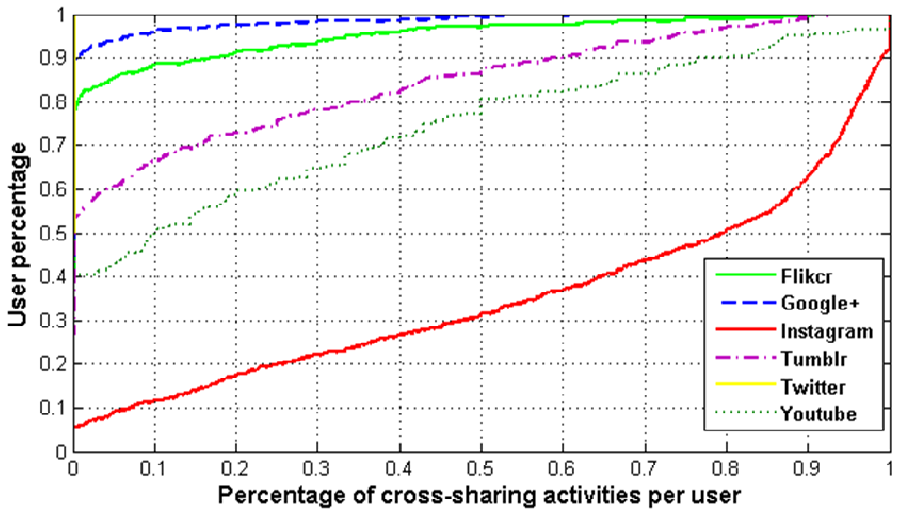
The Work-Life Split
The data reveals a clear temporal divide. Google+ was found to be a "workday" network, with activity peaking during 9-to-5 hours. Conversely, Instagram is a "leisure" network, with activity spiking on weekends and after-school/work hours. This is reflected in user profiles: only 3% of users use the same bio across all platforms; most customize their identity (e.g., "Software Developer" on Twitter vs. "Mountain Climber" on Tumblr).
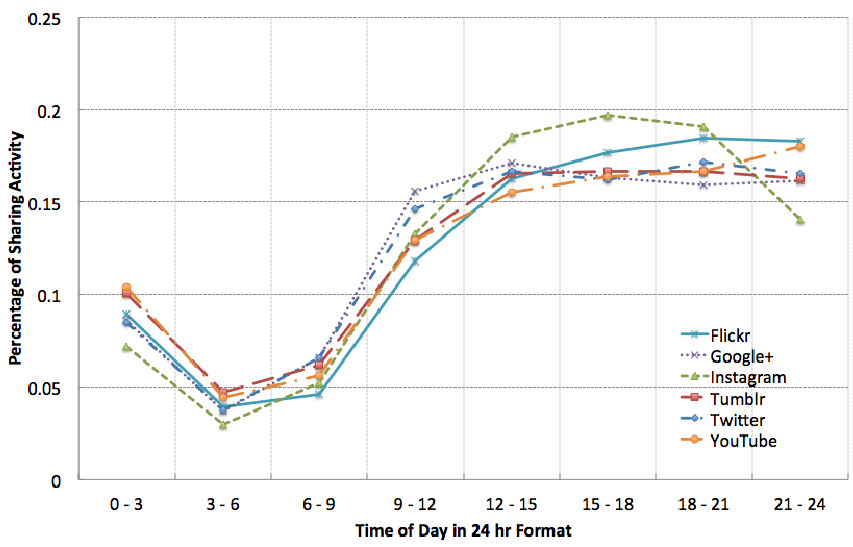
Critical Analysis & Future Outlook
This work provides a vital framework for understanding Information Flow. It suggests that a platform's success isn't just about its internal features, but its connective tissue to the rest of the web.
Limitations: The study relies on "About.me" users, who are often professionals or creatives (early adopters). Their behavior might be more "cross-link heavy" than a casual user. Furthermore, the dataset predates the massive shift toward vertical video (TikTok/Reels), which has likely altered the source-sink dynamics again.
Conclusion: To understand the modern user, we must look beyond the individual app. We are not one person online; we are a distributed collection of personas, optimized for the medium we are currently using.