
Beyond MCMC: Scaling ERGMs via the Geometry of Graph Limits
Estimation of exponential random graph models for large social networks via graph limits
This paper introduces a novel computational framework for the Maximum Likelihood Estimation (MLE) of Exponential Random Graph Models (ERGM) tailored for large-scale social networks. By leveraging graph limits theory and two-dimensional simple function approximation, the authors overcome the intractable normalizing constant problem, achieving SOTA performance in scalability and estimation accuracy compared to traditional MCMC-based methods.
TL;DR
Estimating parameters for Exponential Random Graph Models (ERGMs) has long been a "computational nightmare" for large networks. This paper introduces GLMLE (Graph Limit Maximum Likelihood Estimation), a method that bypasses the need for expensive MCMC sampling by approximating the network's normalizing constant through the lens of graph limits (graphons).
The "Normalizing Constant" Wall
ERGMs are powerful because they allow us to model complex dependencies like transitivity (triangles) and popularity (stars). However, their probability density function includes a term called the normalizing constant (). To calculate it exactly, one would need to sum over all possible graphs—a number that grows exponentially with the square of the number of nodes .
For a network with just 100 nodes, this is impossible. While MCMC methods attempt to approximate this via sampling, they often fall into "model degeneracy," where the simulation gets stuck in extreme states (e.g., producing only empty or complete graphs), making inference for large-scale real-world data like Facebook or Twitter snapshots effectively impossible.
The Intuition: Viewing Graphs as Functions
The authors turn to Graph Limit Theory. The core insight is that as a graph grows to infinity, its structure can be represented by a continuous function on a unit square , known as a graphon.
Methodology: Simple Function Approximation
The authors propose representing the graphon using two-dimensional simple functions. By dividing the unit square into an grid, they approximate the complex graphon as a piecewise constant function. This reduces the infinite-dimensional search for the likelihood's maximum into a finite optimization problem with parameters.
 Figure 1: The transition from discrete graph structures to a continuous limit representation.
The algorithm proceeds iteratively:
- Graphon Update: Find the simple function that maximizes the difference between the graph features and the rate function (Entropy).
- Parameter Update: Adjust the ERGM parameters to maximize the approximated log-likelihood based on the current graphon.
Experimental Breakthroughs
The researchers tested their method against the standard ergm package in R.
1. Robustness at Scale
In simulations with up to 4,000 nodes, the GLMLE demonstrated significantly lower bias than MCMC. Interestingly, for small (around 100), MCMC still holds an edge because graph limit theory is inherently asymptotic. However, as increases, GLMLE's advantage becomes dominant.
2. Real-World Social Networks
The method was applied to the Slashdot social network (over 82,000 nodes). While traditional MCMC methods crashed due to memory and convergence issues, the GLMLE successfully estimated parameters in a matter of minutes (under 600 seconds total).
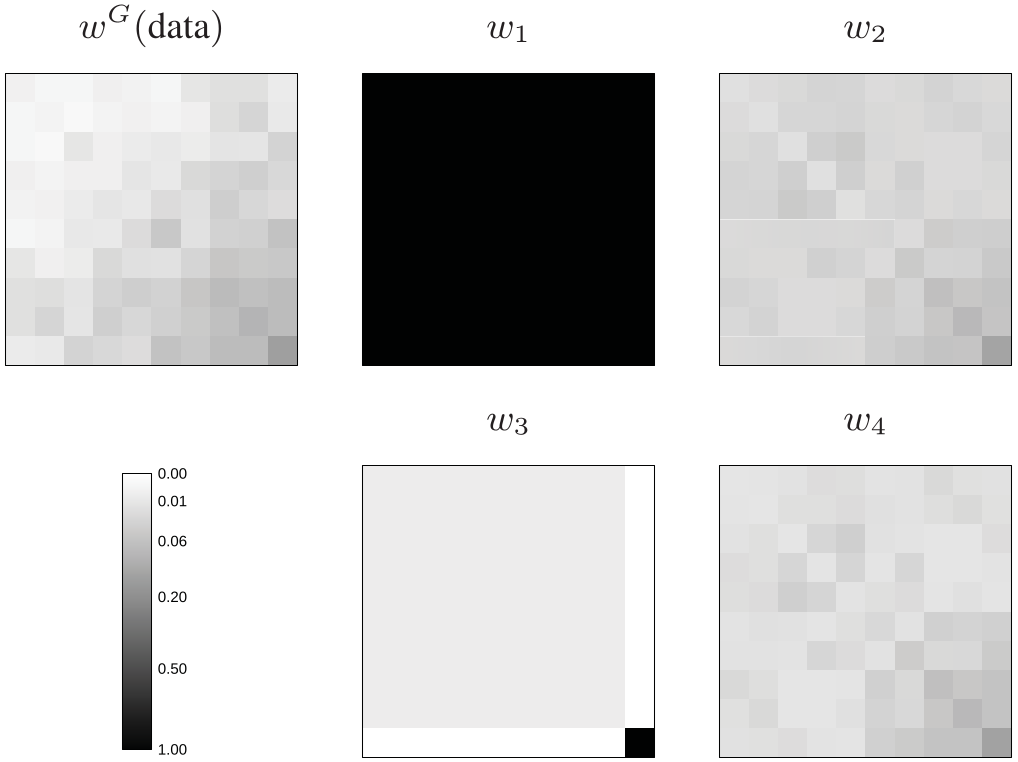 Figure 2: Visualizing the graph limits. The GLMLE estimated graphons (w2, w4) align much closer to the actual data (wG) than the degenerate MCMC results (w1).
Critical Analysis & Takeaways
The brilliance of this work lies in its computational efficiency. The complexity of the algorithm is largely independent of (after an initial pass), making it truly "Big Data" ready for social network analysis.
Limitations:
- Density Assumption: Graph limit theory currently works best for "dense" graphs (where the number of edges scales as ). Most real-world social networks are sparse, meaning the theoretical bounds might be looser in practice.
- Grid Sensitivity: The accuracy depends on the grid size . While worked well here, complex structures might require finer resolutions, increasing optimization time.
Future Outlook
This paper paves the way for a new generation of statistical tools. By treating large networks as continuous objects, we can apply the full toolkit of variational calculus and non-linear optimization to problems that were once considered computationally intractable. This is a vital step toward understanding the "macro" behavior of massive digital societies.
Editor's Note: For practitioners working with large graphs, this method offers a path out of the MCMC convergence trap, provided the network is sufficiently large for asymptotic properties to kick in.