
NAO as a Classmate: How "Small Talk" Triggers Empathy for AI in Elementary Students
Expressing the Personality of a Humanoid Robot as a Talking Partner in an Elementary School Classroom
This study explores using the humanoid robot NAO as a "talking partner" in an elementary classroom to foster empathy for AI. It introduces a dialogue classification system—Query (functional) vs. Phatic (emotional/social)—and validates how humorous, non-functional interactions significantly increase student engagement and perception of robot subjectivity.
Executive Summary
TL;DR: Researchers from Tokyo Gakugei University introduced a NAO humanoid robot into a 5th-grade classroom to shift the student perspective of AI from "machine" to "partner." By prioritizing Phatic Dialogue (casual, humorous interactions) over pure information delivery, they achieved an 82% laughter rate, successfully nudging students to attribute "subjectivity" and "consciousness" to the machine.
Positioning: This work sits at the intersection of Human-Robot Interaction (HRI) and Educational Technology. It moves beyond the "What is AI?" curriculum to address the "How do we live with AI?" social-emotional challenge.
Motivation: Moving Beyond the "Algorithm"
When children learn about AI, they often see it as a black box of data and logic. While they understand its utility, they often lack a "network of meanings" to connect with it emotionally. The authors argue that if we want students to navigate a future "Society 5.0" where AI is ubiquitous, they must first develop empathy—the ability to see things from the "other" (even a mechanical "other").
The central insight of this paper is that humor and personality are the bridges to this empathy. Instead of a perfect machine, the researchers presented a robot that could joke, make mistakes, and engage in "pointless" but social small talk.
Methodology: Query vs. Phatic Dialogue
The study defined two distinct interaction models for the NAO robot:
- Query Type: Traditional Q&A. The robot provides knowledge when prompted with specific, formulated questions.
- Phatic Type: "Heart movements." This includes expression of feelings, muttering, nodding, and small talk. Interestingly, the researchers dialed the speech recognition threshold to 55%, allowing the robot to "misinterpret" background noise as a cue for a phatic response, creating an illusion of spontaneous personality.
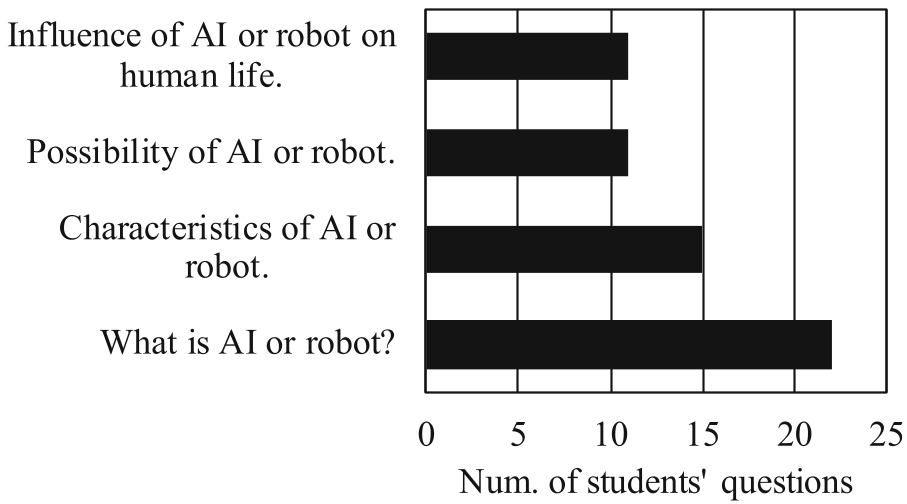 Prior to the session, students mostly asked technical/functional questions about AI.
The Power of Laughter: Results from the Classroom
The results were striking. While the robot was a source of information, its social presence was what captured the students.
- Laughter Response: Students burst into laughter during 82% of phatic dialogues, compared to only 44% during knowledge-based queries.
- Subjectivity Projection: In post-session surveys, students were asked what they would say to a robot that "dreams at night." Instead of asking for data, 53% of responses were directed at the robot's "inner side"—asking about its feelings, its own dreams, or how it views humans.
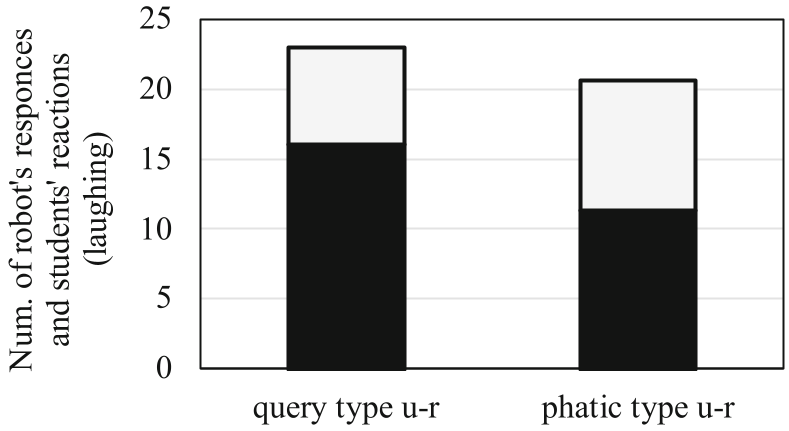 Comparison of student laughter between Query and Phatic dialogue types.
Critical Insight: The Value of "Mechanical Subjectivity"
The most profound takeaway is how the robot's perceived "personality" changed the students' outlook on their own futures. After the session, students were more likely to describe a future where they worked alongside AI as partners, rather than just being replaced by them.
By giving the robot Phatic capabilities, the researchers essentially "humanized" the algorithm. This suggests that for AI to be successfully integrated into social spaces (like schools or hospitals), designers should focus less on factual accuracy and more on the social nuances that signal consciousness.
Conclusion & Limitations
The study demonstrates that a humorous, talking-partner robot can effectively stimulate empathy in children. However, there are inherent limitations:
- The Novelty Effect: Would the laughter and empathy persist after months of interaction, or is it a short-term reaction to the robot's novelty?
- Anthropomorphic Bias: While empathy is beneficial, it risks misleading children about the actual current capabilities of AI (as no current AI "dreams" in a biological sense).
Ultimately, this research provides a blueprint for the next generation of educational AI: don't just teach the code; design the personality.