
Expressive Participation: Why Your Tech-Savviness and Sex Dictate Your Digital Activism
Expressive participation in Internet social movements: Testing the moderating effect of technology readiness and sex on student SNS use
This study investigates university students' use of Social Networking Sites (SNS) for expressive participation in Internet Social Movements (ISMs) by applying the Unified Theory of Acceptance and Use of Technology (UTAUT). It identifies Social Influence, Performance Expectancy, and Effort Expectancy as primary drivers of civic engagement intention, ultimately predicting actual SNS usage.
TL;DR
Is social media a true catalyst for social change or just a low-effort "slacktivism" hub? This study deep-dives into the Spanish university student population to show that the answer depends on who you are. By combining the UTAUT framework with Technology Readiness (TR), the researchers prove that while "Performance Expectancy" (the belief that SNS is useful for causes) motivates everyone, the barriers to entry—social pressure vs. technical ease—vary wildly between sexes and tech-comfort levels.
The Problem: The Mystery of the "Hyper-User"
We know that movements like the Arab Spring or Spain’s indignados relied on Facebook. However, academic literature has long suffered from a "generalization gap." Most studies treat SNS users as a monolithic block. They fail to explain why two students in the same dorm might have vastly different motivations for posting about a social cause.
The authors argue that we must look beyond "What" is being used and focus on the Inductive Bias of the user—their inherent readiness to embrace technology and their socialized gender roles.
Methodology: The UTAUT-TR Integration
The study utilizes the Unified Theory of Acceptance and Use of Technology (UTAUT), focusing on four pillars:
- Performance Expectancy: "Will this help the cause?"
- Effort Expectancy: "Is this hard to use?"
- Social Influence: "Do my friends expect me to post?"
- Facilitating Conditions: "Do I have the tools/data to do this?"
By overlaying these with Technology Readiness (TR) (Optimism, Innovativeness, Discomfort, Insecurity), the authors segments users into Explorers, Pioneers, Sceptics, and Laggards.
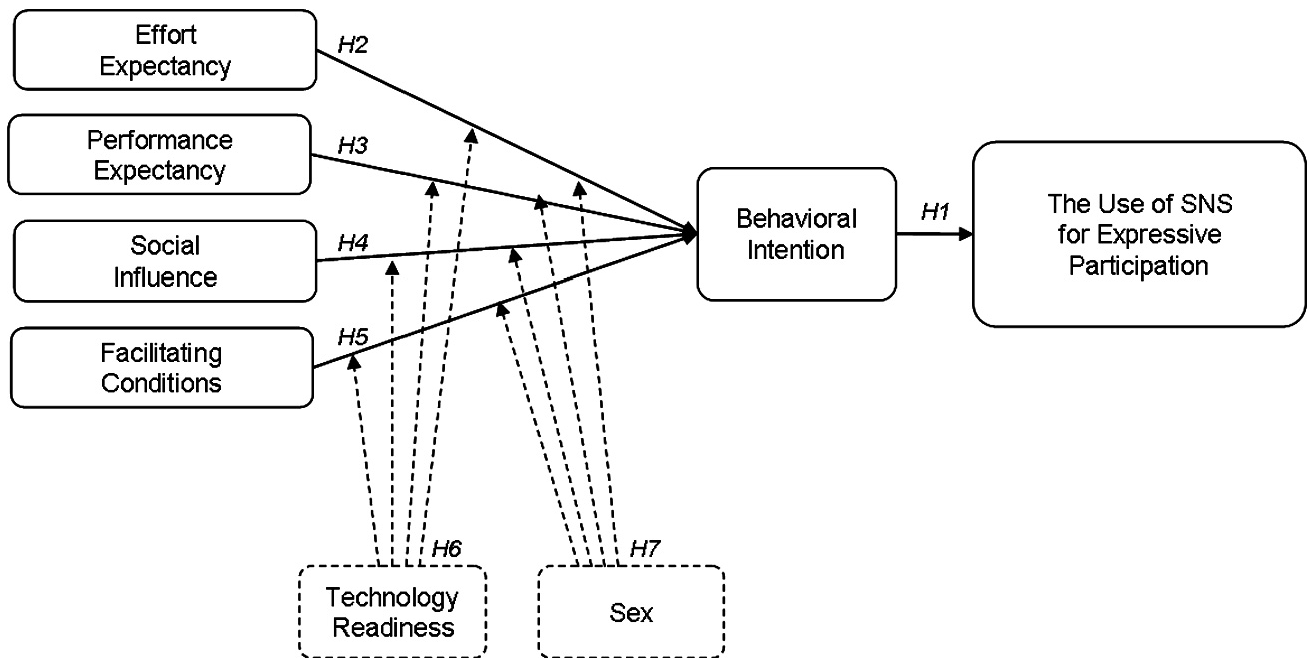 The proposed framework: Testing how Sex and TR moderate the path from beliefs to actual ISM participation.
Key Insights: Social Pressure vs. User Experience
The results from the 214-participant survey in Spain reveal a fascinating dichotomy in the digital "activist" psyche:
1. The "Social" Male vs. The "Practical" Female
For male students, the intention to use SNS for activism was heavily dictated by Social Influence (). If their inner circle believed in the cause, they engaged. Conversely, for female students, the driving factor was Effort Expectancy (). If the platform made it easy to comment, share, and organize, they were significantly more likely to participate.
2. The TR Paradox
- High-TR (Explorers/Pioneers): These users aren't worried about how to use the site; they are moved by the network effect. Social influence is their primary trigger ().
- Low-TR (Laggards): For this group (88% of whom were female in this sample), technical friction is a deal-breaker. They only engage when the interface is invisible and the effort is minimal.
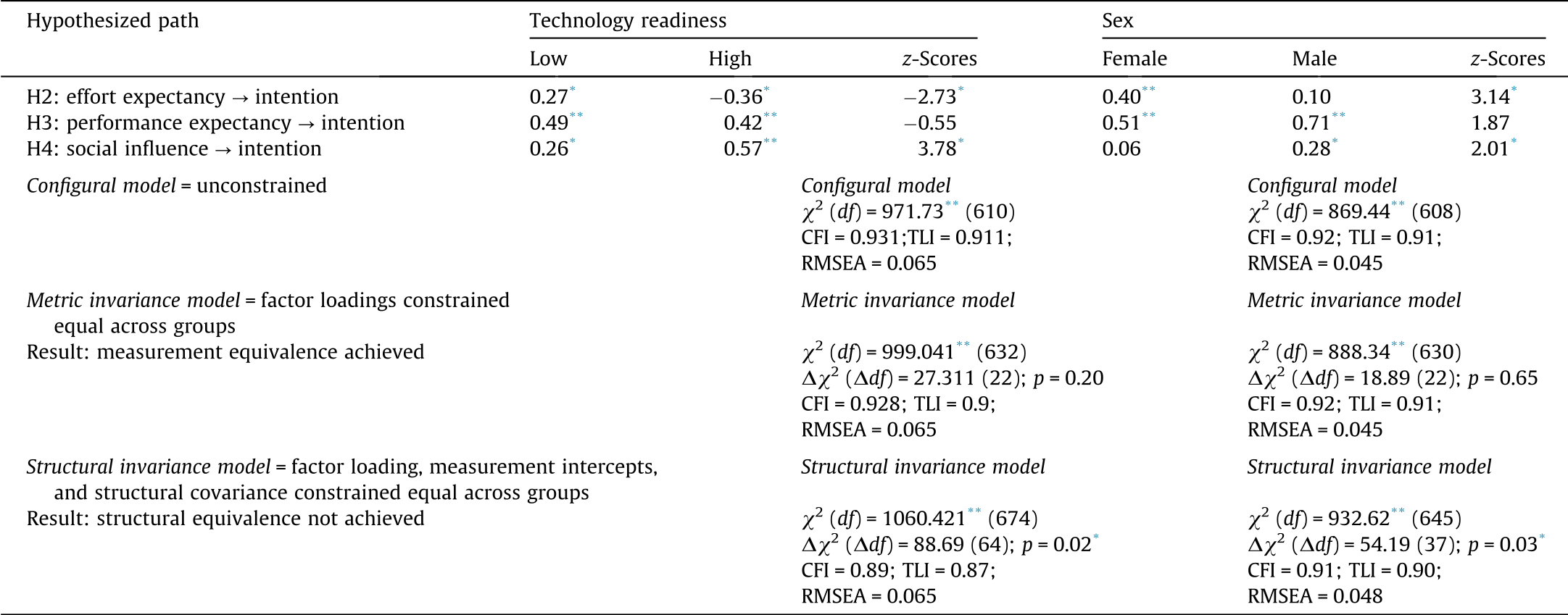 Comparative statistics showing the divergence in path significance between High/Low TR and Male/Female groups.
Critical Analysis: Beyond the Interface
The most striking takeaway is the "Weak-Tie" phenomenon. As the authors note, referencing Gladwell, SNS activism succeeds not by motivating high-risk sacrifice, but by massively lowering the cost of participation.
Limitations:
- Demographic Slicing: The sample is limited to Spain and a younger age bracket (18-25). Would the "Effort Expectancy" gap close in countries with higher baseline female STEM participation?
- Platform Specificity: The study predates the "algorithmic feed" era (TikTok/Reels), where social influence is often replaced by content-based discovery.
Conclusion: A Tool for Organizers
If you are an organizer for an Internet Social Movement (ISM):
- To attract male and tech-savvy users: Build community features, emphasize "who else is here," and leverage peer pressure.
- To attract female and tech-hesitant users: Focus on UX. Make "one-click" signing, simple commenting, and clear, understandable interfaces your priority.
In the end, technology is just the stage; our psychological readiness determines how we perform on it.