
ExSIOCA: Extending Ontologies to Solve the Privacy Paradox in Social Networks
ExSIOCA: an Extension of the SIOCA ontology
The paper introduces ExSIOCA, a semantic ontology extension of the SIOCA (SIOC Access) model designed to enhance privacy and security in Online Social Networks (OSNs). By leveraging Role-Based Access Control (RBAC), it standardizes visibility levels and permissions to allow automated reasoning for user authorization across heterogeneous social platforms.
TL;DR
As Online Social Networks (OSNs) grow exponentially, the risk of data leakage and privacy invasion increases. ExSIOCA is a technical extension of the SIOCA ontology that uses the Semantic Web and Role-Based Access Control (RBAC) to provide a standardized, machine-readable way to manage who can see and do what across different social platforms. It moves privacy from "click-box" settings to "logical reasoning."
The Problem: Siloed Privacy and Semantic Blindness
Most current social networks are "walled gardens." Your privacy settings on Facebook don't talk to your settings on Twitter or LinkedIn. This creates several pain points:
- Syntactic Matching Limitations: Search engines only see keywords, not the semantic relationships between users and their data.
- Static Access Control: Most models (like the original SIOC) focus on what is shared but lack a robust way to define who is allowed to interact with it in a hierarchical manner.
- Inconsistency: There is no common "vocabulary" for privacy, making it nearly impossible to maintain consistent protection across the "Social Semantic Web."
The Solution: ExSIOCA’s Hierarchical RBAC
The authors propose ExSIOCA (Extension of the SIOCA ontology) to solve these issues. The core insight is that privacy is not just a binary (Public/Private), but a result of Roles and Permissions that should inherit qualities from one another.
1. The Role Hierarchy
ExSIOCA specializes the Role class into a hierarchy where:
Owner > Administrator > Moderator > Member > Subscriber > Guest.
In this model, if you are an Administrator, you automatically inherit the permissions of a Subscriber. This reduces the complexity of defining individual rules.
2. Permission Inheritance
Similarly, permissions are nested. Having the DeleteContent privilege implies you also have ModifyContent, CommentContent, and ViewContent.
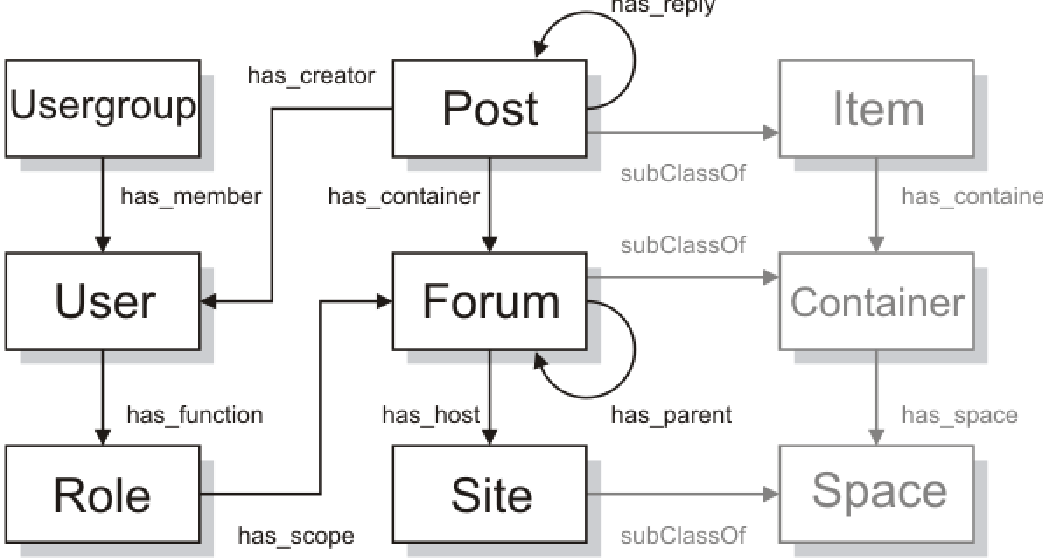 Figure: The foundational SIOC ontology structure which ExSIOCA builds upon.
Inference Rules: Let the Machine Decide
The real power of ExSIOCA lies in its Inference Rules. Because the ontology is formal, an OWL (Web Ontology Language) reasoner can automatically determine access based on logic:
- Priority: Direct roles assigned to a user have higher priority than roles inherited through group membership.
- Conflicts: If a user has multiple roles on the same object, the role with the highest priority is used. If priorities are equal, the more limited permission is applied (Privacy by Default).
- Contextual Status: An item's status (Draft, Private, Public) takes precedence over the status of the "Container" (the page or group) it lives in.
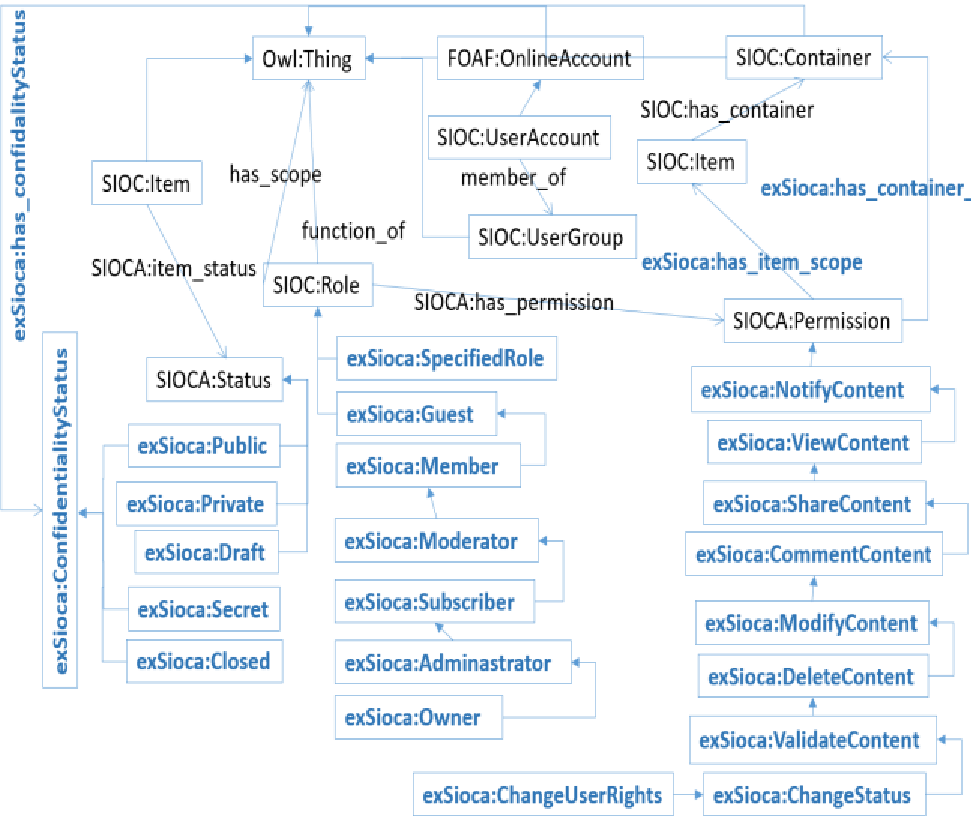 Figure: The ExSIOCA module showing the specialization of Roles, Permissions, and Statuses.
Validation Scenarios
The paper validates the ontology through several real-world cases:
- Selective Invisibility: Bob can make a picture invisible to his Manager even if they are "friends" by assigning the Manager a specific role on that specific object with "No Permission."
- Group Management: Differentiating between "Members" who can view content and "Moderators" who can validate shared content before it goes public.
Critical Perspective: Is it Enough?
Takeaway: ExSIOCA is a significant step toward a standardized "Security Layer" for the social web. By aligning with the SIOC standard, it ensures that privacy isn't lost when data is interlinked.
Limitations:
- Complexity: Implementing OWL reasoning in real-time for millions of social media interactions is computationally expensive.
- Deducible Threats: As the authors note, things like "Spam" and "Pirated Accounts" are deducible but not declarable. Future work needs to merge this logic-based access control with behavioral analytics to catch malicious actors that technically hold legitimate "Roles."
Final Summary
ExSIOCA provides the necessary "vocabulary" for privacy in the semantic age. It transitions us from a world where we manually toggle switches to a world where our data "knows" who is allowed to access it based on logical relationships.