
Beyond Heuristics: Meta-Learning the Language of Ontology Mapping
An Extendable Meta-learning Algorithm for Ontology Mapping
The paper introduces an extendable meta-learning framework for ontology mapping by reformulating the alignment task as a supervised classification problem. It utilizes the Average One Dependence Estimators (AODE) algorithm to achieve state-of-the-art results while automating weight and threshold selection.
TL;DR
Ontology mapping—the process of identifying equivalent concepts across different taxonomies—has long been plagued by the "threshold bottleneck." This paper presents a meta-learning approach using Average One Dependence Estimators (AODE) to transform mapping into a classification problem. By doing so, it eliminates manual tuning and provides a robust, extendable framework that remains accurate even when fed noisy or "diluted" similarity data.
The "Threshold Bottleneck" in Semantic Integration
The Semantic Web relies on ontologies to make data machine-understandable. However, because ontologies are developed independently, they often use different terms for the same concept (e.g., "Lecturer" vs. "Assistant Professor").
The traditional research intuition has been to develop various similarity measures:
- Syntactic: How similar are the strings?
- Structural: Do they share the same parents or children in the graph?
- Extrinsic: Do they share the same instances (individuals)?
The problem? Weighting these measures is an art, not a science. Researchers usually manually adjust thresholds based on precision-recall curves, which makes the systems brittle and domain-specific.
Methodology: The AODE Paradigm
The authors argue that we should stop "hard-coding" the logic of how similarity measures interact. Instead, they propose using a Generative Classifier.
Why AODE?
In many mapping tasks, training data is scarce and classes are highly unbalanced (most pairs of concepts are not matches). While Naive Bayes is efficient, its "independence assumption" is too strong for ontology features (e.g., a name match is often correlated with a structural match).
AODE (Average One Dependence Estimators) offers a middle ground:
- It allows each attribute to depend on the class and one other attribute.
- It averages the predictions of all qualified one-dependence classifiers.
- It avoids the high computational cost of model selection associated with algorithms like SP-TAN.
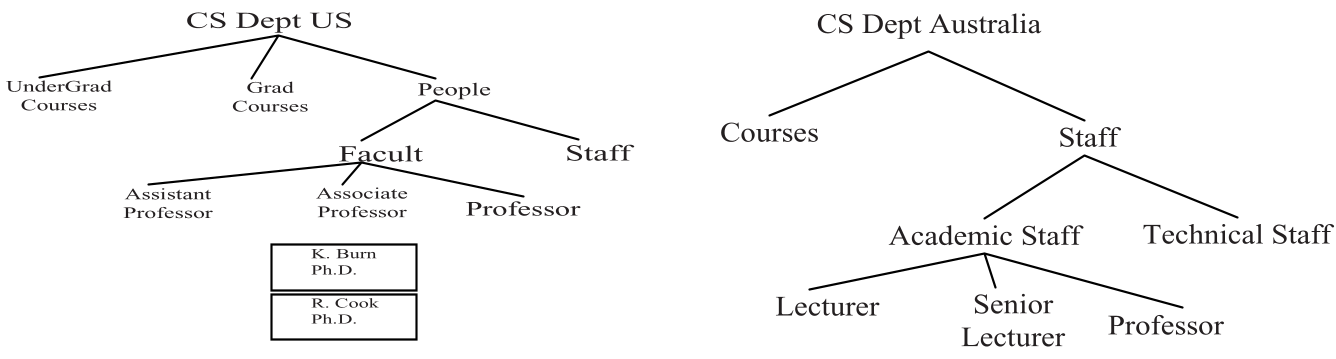 Figure 1: Comparison of two Computer Science department ontologies with different taxonomies.
Measuring Similarity
The framework is "pluggable." For their experiments, they used:
- Name Similarity: Jaro-Winkler distance for string matching.
- Path Similarity: Comparing the "lineage" of a concept from the root to the node.
- Content Similarity: Using the Jaccard Coefficient to compare sets of individuals belonging to each class.
Experimental Insights
The researchers tested their approach on two real-world bibliographic ontologies (OntoWeb vs. Bibliographic).
Robustness Against "Dilution"
A key highlight of this paper is the dilution test. They added random, uninformative variables to the input to see if the classifier would "choke."
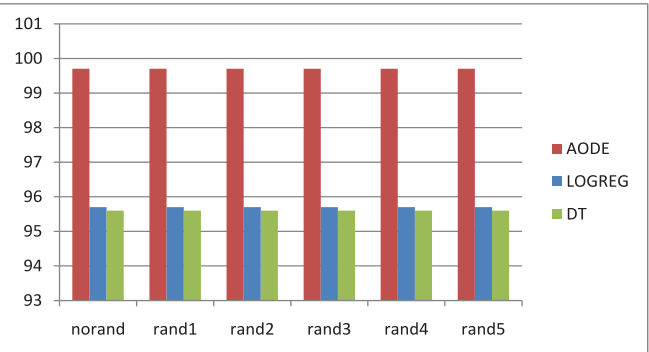 Figure 2: Area Under the Precision-Recall Curve (AUPRC) results showing AODE's resilience compared to Logistic Regression and Decision Trees.
Key Findings:
- AODE consistently outperformed C4.5 and Logistic Regression.
- Handling Unbalanced Classes: In ontology mapping, the "False" class (non-matches) vastly outnumbers the "True" class. AODE maintained higher recall and precision in these skewed environments.
- Incremental Learning: Because it's a Bayesian approach, the model can be updated easily as new user-verified mappings become available, making it ideal for collaborative "crowdsourced" alignment.
Critical Analysis & Conclusion
This work significantly advances ontology integration by moving the "intelligence" of the system away from hand-crafted heuristics and into the learning algorithm.
Takeaways:
- Automation: No more staring at PR curves to decide if a threshold should be 0.7 or 0.8.
- Extendability: New similarity measures (like modern vector embeddings) can be "plugged in" without rewriting the core logic.
Limitations: While the classifier determines if a match exists, it still requires a tie-breaking or optimization strategy (like relaxation labeling) to ensure a globally consistent 1-to-1 mapping if the domain requires it.
Future Outlook: The logic of AODE suggests that as we develop more sophisticated semantic measures (e.g., Large Language Model-based embeddings), this meta-learning framework will naturally become even more powerful without needing structural changes.