
DFT-L: Bridging Cognitive Psychology and Social Networks to Decode Collective Decisions
Extended decision field theory with social-learning for long-term decision-making processes in social networks
This paper proposes Decision Field Theory with social-Learning (DFT-L), a novel framework combining the cognitive Decision Field Theory (DFT) with the DeGroot learning model. It achieves a high-fidelity representation of long-term human decision-making in social networks by integrating previous experience, current evaluations, and neighbors' preferences into a Markovian preference evolution process.
TL;DR
Deciding which car to buy or whether to invest in a hedge fund isn't just a personal calculation—it's a social process. This paper introduces Decision Field Theory with social-Learning (DFT-L), a mathematical framework that merges individual cognitive dynamics with social network theory. By combining the DFT model (internal deliberation) with the DeGroot model (social influence), the authors provide a rigorous way to predict how opinions evolve and reach equilibrium in complex societies.
Motivation: Why Utility Functions Aren't Enough
For decades, researchers relied on Utility Theory to model human behavior. The assumption was simple: humans are rational optimizers. However, real-world data tells a different story. Humans are prone to:
- Preference Fluctuations: Our choices change over time based on deliberation.
- Irrationality: We often ignore clear evidence in favor of "Information Cascades" (following the crowd).
- Social Context: Our "forgetting" processes and current evaluations are heavily influenced by the "likes" and "retweets" of our peers.
Existing Decision Field Theory (DFT) addressed the cognitive side but ignored the network. The authors saw this gap and asked: How can we mathematically represent an individual's preference when it is constantly being reshaped by a social network?
Methodology: The DFT-L Framework
The core of the methodology lies in the evolution of a preference vector . In the original DFT, your preference at the next step is a function of your current preference and your evaluation of an object's attributes.
The authors transform this into the DFT-L equation:
Deciphering the Components:
- : The Forgetting/Stability Matrix. It represents how much of your previous preference you retain.
- : The Social Interaction Matrix (DeGroot). This is the "secret sauce." It weights your neighbors' preferences based on their influence or network degree.
- : The Valence Vector, representing the immediate evaluation of alternatives based on attributes (e.g., cost vs. quality).
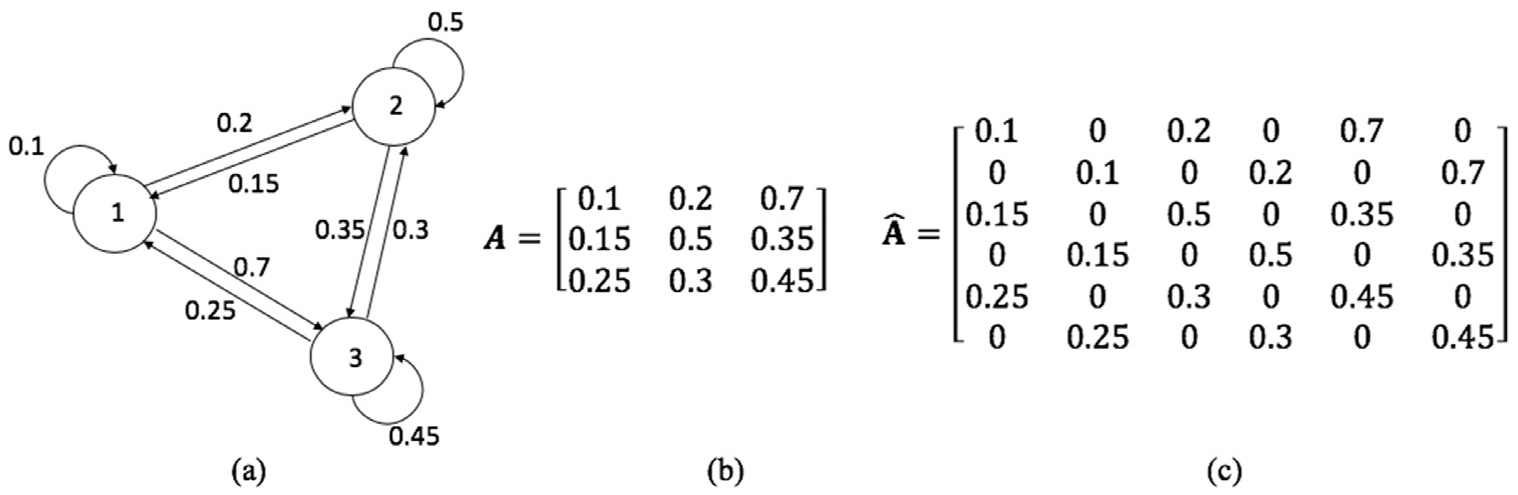 Fig 1. The construction of the matrix, showing how individual preferences are coupled through social connections.
Proving Stability: The Asymptotic Equilibrium
One of the paper's strongest contributions is the mathematical proof of Asymptotic Stability. By applying linear systems theory, the authors derived that as long as the 2-norm of the matrix product is less than 1, the network will reach a predictable equilibrium state.
This means we can calculate the "final" opinion of a society without running a simulation for millions of steps, provided we know the network structure and the individuals' initial weights.
Experimental Insights: Ring Lattices vs. Random Networks
The authors validated DFT-L using Agent-Based Simulation (ABS) across three network topologies:
- Ring Lattice: Low complexity, slow diffusion.
- Small World: Intermediate complexity.
- Random Network: High complexity, lightning-fast diffusion.
The "Bandwagon Effect"
In a "Progressive" society (rich with risk-takers), the DFT-L model showed a significantly higher adoption rate for risky investments compared to a standard DFT model. Why? Because the social interaction term () intensifies the existing cultural bias. In the DFT-L simulation, if your neighbors are risk-takers, your own preference for the risky option is amplified beyond your personal evaluation.
 Fig 2. The classic S-curve of innovation adoption, validated here within the DFT-L framework across different network complexities.
Critical Analysis & Real-World Application
The authors further validated the model using real-world datasets: Zachary’s Karate Club and American College Football networks. The results confirmed that the model generalizes well to real social structures.
Limitations:
- Static Networks: The current model assumes the network structure (who follows whom) is fixed during the deliberation. In reality, people break ties when opinions differ too much (homophily/fission).
- Homogeneous Processes: It assumes everyone follows the same "forgetting" rule.
Future Work: The authors suggest incorporating Community Detection to model group-level interactions more accurately and exploring Multi-layer Networks where one might have different influencers for financial vs. political decisions.
Conclusion
DFT-L is a significant step forward for computational social science. By moving away from "Rational Man" and toward "Socially-Influenced Cognitive Man," this framework provides a robust toolkit for marketers, economists, and policy-makers to understand the "Why" behind information cascades and the "How" of social consensus.