
Collective Evolution: Gamifying the Facility Location Problem with COIN MOEAs
Extending Collective Intelligence Evolutionary Algorithms: A Facility Location Problem Application
This paper introduces an extension to Multi-Objective Evolutionary Algorithms (MOEAs) by integrating Collective Intelligence (COIN) via a novel variation operator. Applied to a real-world Facility Location Problem (FLP) in the petroleum industry, the proposed CI-NSGA-II leverages gamified human input to outperform SOTA reference-point-based methods like R-NSGA-II.
Executive Summary
TL;DR: This research bridges the gap between stochastic optimization and human intuition. By transforming the complex Multi-Objective Optimization Problem (MOP) of petroleum facility placement into a shared game, the authors allow a "collective" to act as a dynamic mutation/variation operator. The result is a specialized MOEA that converges faster and more accurately on preferred solutions than standard benchmarks.
Positioning: This work is an architectural extension of classical MOEAs (NSGA-II, SPEA2, SMS-EMOA), introducing "Collective Intelligence" (COIN) as an online, interactive mechanism rather than a static pre-configuration.
The "Expert" Bottleneck: Why Standard MOEAs Fail
In the petroleum industry, placing offshore platforms isn't just about minimizing distance or maximizing production; it involves avoiding obstacles, managing shared resources, and balancing stakeholder trade-offs.
Traditional MOEAs generate a broad "Pareto Front" of trade-offs, but a single Decision Maker (DM) often lacks the bandwidth or insight to pick the right one. Furthermore, most algorithms treat "preferences" as fixed mathematical points. In reality, preferences are subjective, collective, and evolving.
Methodology: Gaming the Search Space
The authors propose a dual-layer COIN approach integrated into algorithms like CI-NSGA-II:
- Collective Selection: Users perform pairwise comparisons between scenarios, identifying which trade-offs look "better" based on human perception.
- Collective Variation (The "Fix" Operator): This is the core innovation. Candidate solutions are presented as a game board where players can manually move facility icons and redraw connections. These "human-processed" individuals are then fed back into the Evolving population.
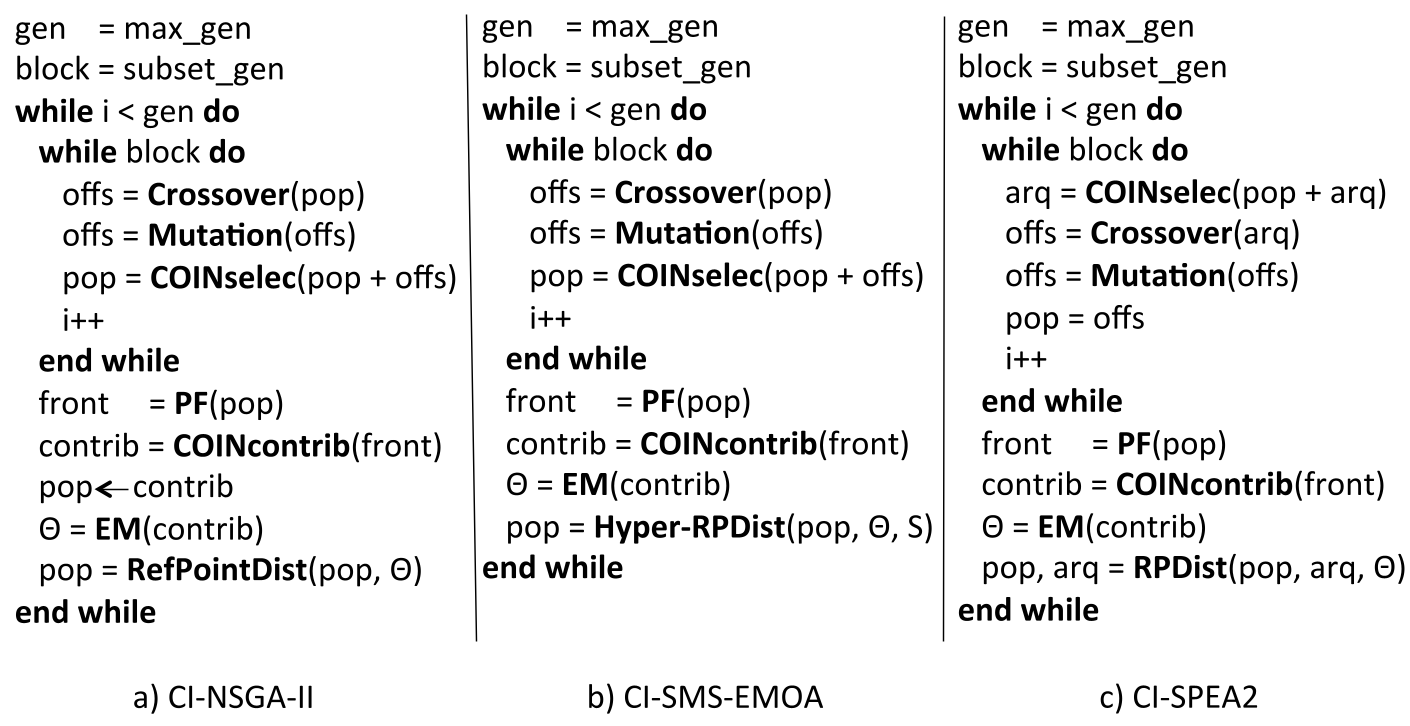
The algorithm uses Gaussian Mixture Models (GMM) to cluster these human inputs, effectively creating a "heat map" of where the search should focus (Collective Reference Points).
Experimental Results: Complexity is the Catalyst
The study compared various versions of CI-NSGA-II against the standard NSGA-II and the reference-point-based R-NSGA-II across several difficulty levels.
Key Insights:
- Simple Scenarios: In "Easy" tasks, human intervention is actually a hindrance. The computational overhead of waiting for human input makes standard algorithms faster.
- Complex Scenarios: In the "Hard Obstacles" scenario—which mimics real-world oil fields with 3D pathfinding—the CI-NSGA-II Fix crushed the competition. It achieved the required proximity to the Pareto Front 3x faster than the nearest rival.
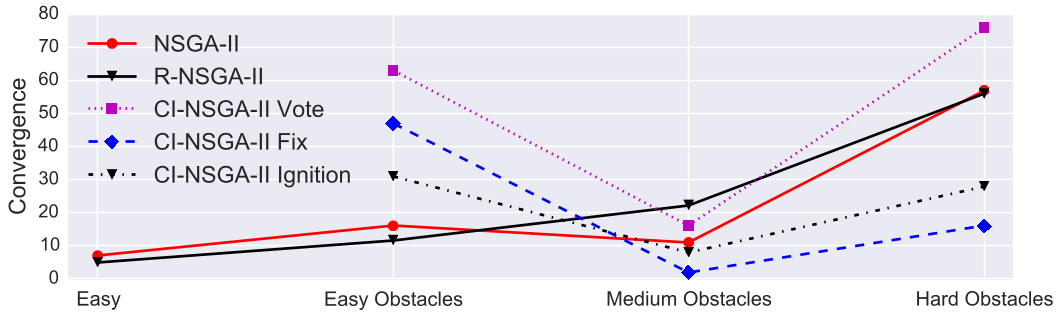
Visual evidence (Figure 3 in paper) demonstrates that as complexity increases, the gap between Collective-AI and traditional AI widens, favoring the COIN-based approach.
Efficiency Gains
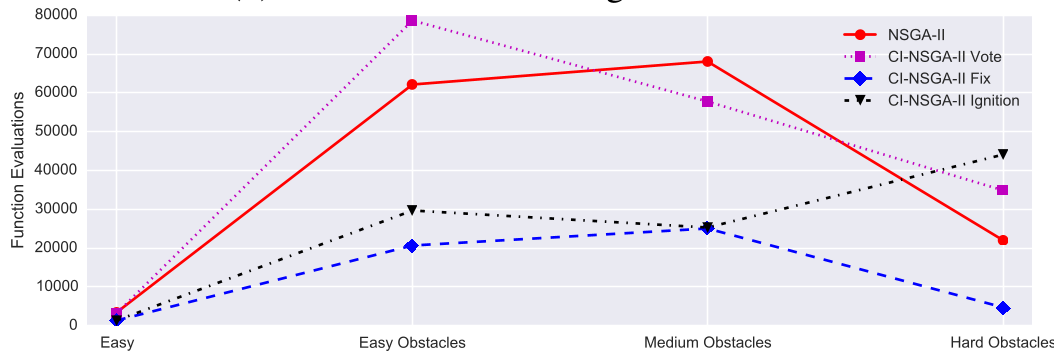
By focusing the search on "areas of practical interest" defined by the crowd, the algorithm reduces the number of function evaluations needed, saving significant computational resources.
Critical Analysis & Conclusion
Takeaway: The "wisdom of the crowd" isn't just for labeling data; it can be an active driver in the optimization loop. By gamiying the Facility Location Problem, the authors tapped into human spatial reasoning (3D obstacle avoidance) which is notoriously difficult for pure algorithms to navigate efficiently.
Limitations:
- Synchronicity: The algorithm must wait for human clicks (30-60 seconds), creating a potential bottleneck in high-throughput environments.
- Scalability: Maintaining a "crowd" of active players/users requires sustained engagement and gamification incentives.
Future Outlook: We are likely to see this approach applied to "Many-Objective" problems (10+ objectives) where mathematical visualization for a single human becomes impossible, but the statistical aggregation of a crowd's "gut feeling" remains accurate.