
Enhancing the "Phygital" Social Graph: An Extensible System for Conference Networking
9090_An Extensible System for Enhancing Social Conference Experience.
The paper presents an extensible on-site system to enhance social networking at conferences by combining Auto-ID (RFID) and Web 2.0 technologies. The system, deployed at events like ESWC 2010, enables participant authentication via RFID badges to access interactive services such as VCard exchange and research impact evaluation through touchscreen kiosks.
TL;DR
Attending a conference is as much about the "hallway track" as it is about the sessions. This paper introduces an extensible system that bridges physical interaction and the Social Web using RFID-enabled kiosks. By allowing participants to "check-in" and interact with customized services like contact exchanges and research impact comparisons, the authors demonstrate how simple Auto-ID tech can turn a static badge into a gateway for professional networking.
Motivation: The Icebreaker Problem
Conference networking is inherently difficult. Despite the shared interests, participants often face a "white noise" of results when looking up peers, or struggle with the friction of manual contact exchange. Previous attempts at tech-enabled networking either used expensive, privacy-invasive active tracking or were too static to provide real-time value. The authors saw an opportunity to use Passive RFID—a cheap, ubiquitous technology—to create intentional, haptic interaction points (touchscreen kiosks) that provide immediate digital utility for physical social actions.
Methodology: A Flexible, Web-Centric Architecture
The system is built on an extensible framework using Google Web Toolkit (GWT), allowing for the rapid deployment of various "Showcase Services."
System Architecture
At its core, the system utilizes a Model-View-Controller (MVC) pattern. When a user wipes their RFID badge, an authentication token is sent to the server, which maps the unique ID to a profile in the STI International Community database.
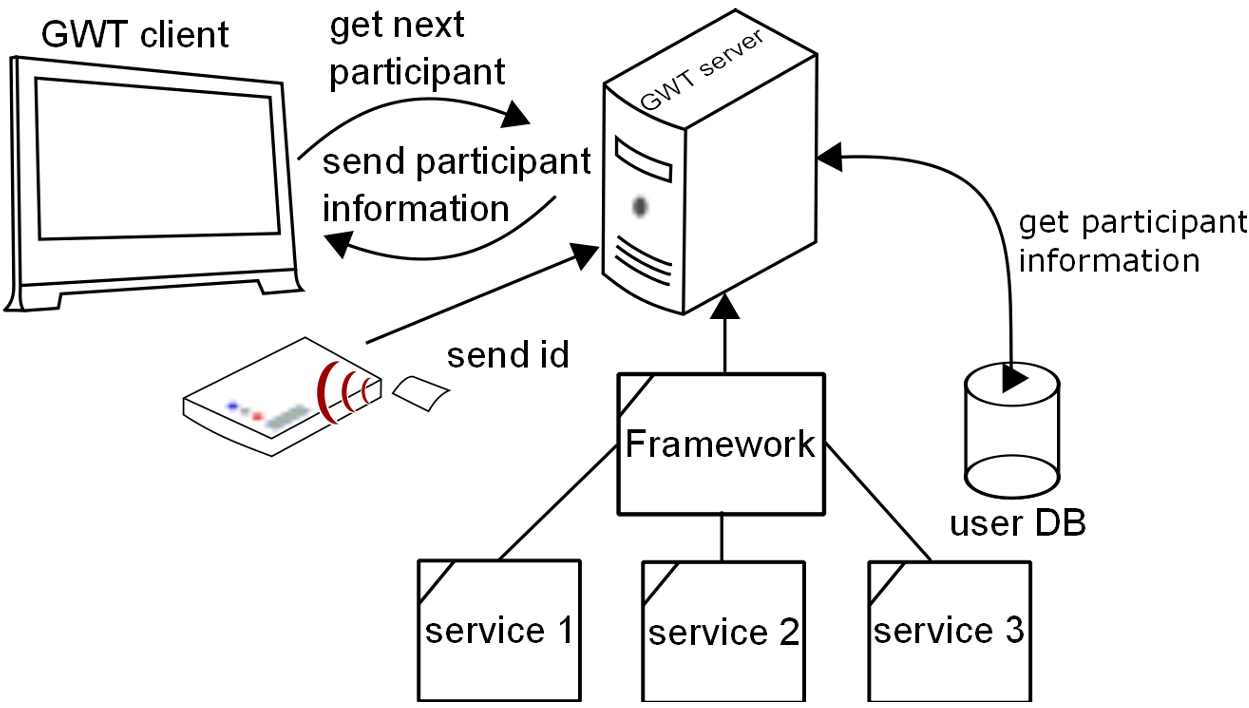
The services include:
- VCard Exchange: A digital alternative to business cards.
- Web Comparator: A "fun" service that pits participants against each other based on their web presence (Google results, images, etc.).
- Research Impact Evaluation: Leveraging the ResEval tool to fetch H-index and citation metrics from Google Scholar via RESTful services.
Experiments & Real-World Deployment
The system underwent four major iterations, with the most significant data coming from ESWC 2010.
User Acceptance and Usage Peaks
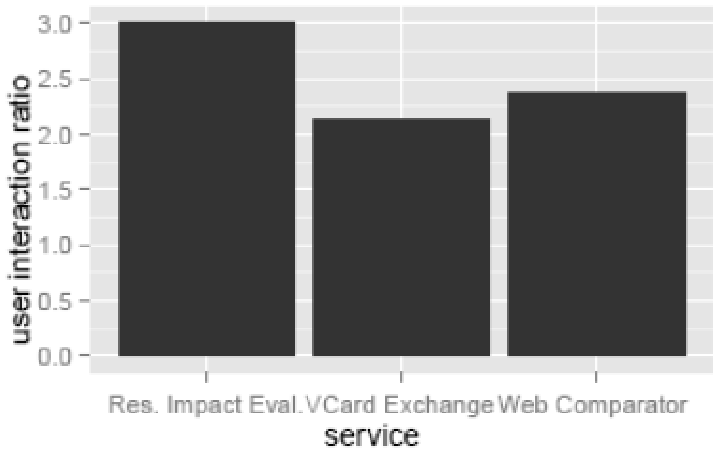
The authors found a classic "early peak" behavior. Usage surged on the second day as curiosity grew, then gradually declined. Interestingly, there was a gap between perceived utility and actual usage:
- Web Comparator was the most used service (over 200 interactions), likely due to its "gamified" nature.
- VCard Exchange was rated most "useful" in surveys but had lower interaction counts, possibly because the community was already tight-knit.
Learning from Failure
In early versions (ESWC 2009), the system used Active RFID to recognize people within 5 meters. This failed because it lacked "intentionality"—the system often authenticated multiple people nearby simultaneously, leading to confusion. Switching to Passive RFID (20cm range) required a deliberate "wipe" gesture, which vastly improved the user experience by making the interaction explicit and secure.
Critical Analysis & The Path to Mobile
While the kiosk model proved effective for 38% of conference attendees, the authors highlight a major bottleneck: spatial constraints. One or two kiosks in a large venue aren't enough.
The Future is Semantic and Mobile
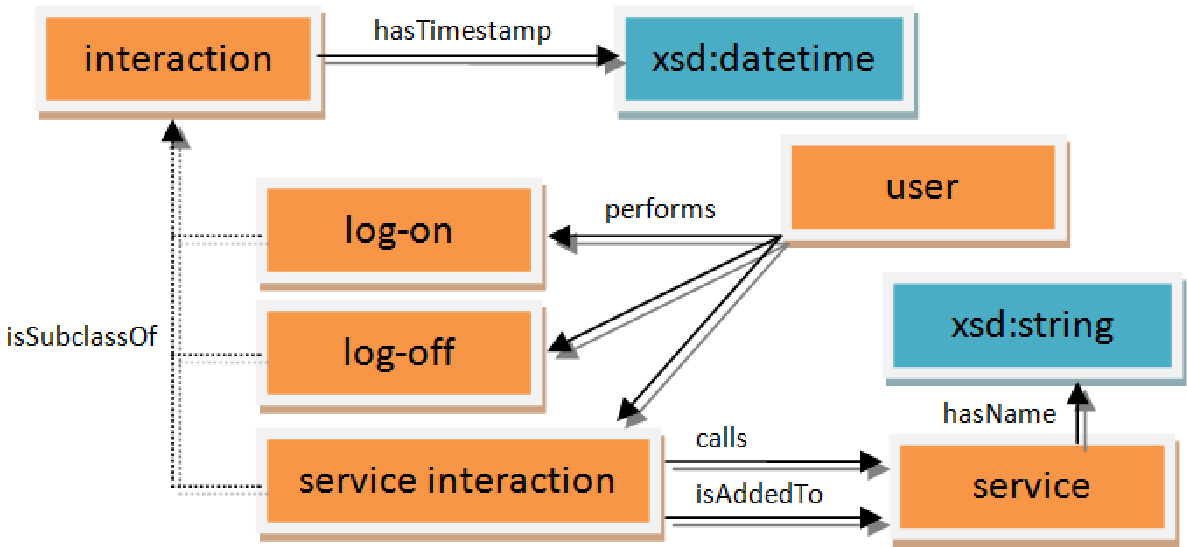
The paper concludes that the next logical step is shifting from stationary kiosks to mobile devices using NFC or QR Codes. Furthermore, by logging interactions into a Semantic Interaction Ontology (RDF), the system could eventually offer "People Recommendations" based on localized social graphs—essentially telling you who you should have talked to based on common proximity and research interests.
Final Takeaway
This work serves as a blueprint for "Phygital" experience design. It proves that technology shouldn't just exist in the background (tracking); it must be an active, haptic tool that users choose to engage with to solve a specific social pain point—be it exchanging a contact or validating their research impact.