
C-Value Evolution: Solving the Nesting Dilemma in Arabic Term Extraction
5534_Extension of Semantic Based Urdu Linguistic Resources Using Natural Language Processing.
This paper introduces an enhanced Arabic automatic term extraction method utilizing the C-Value statistical measure combined with linguistic patterns. The approach focuses on identifying Multi-Word Terms (MWTs) by integrating Part-of-Speech (POS) tagging and a domain-specific scoring system to improve the precision of terminology extraction in complex languages like Arabic.
TL;DR
Extracting technical terminology from Arabic text is notoriously difficult due to linguistic complexity and the "nested term" problem. This paper presents a hybrid framework that blends linguistic rules with the C-Value algorithm, a statistical power-tool designed to distinguish between standalone technical terms and mere fragments of longer phrases.
The "Nesting" Motivation
In technical writing, we often see terms inside other terms. For example, "Cloud Computing" is a valid term, but it is also a nested part of "Cloud Computing Service Platform."
Traditional frequency-based extraction would rank "Cloud Computing" extremely high simply because it appears every time the longer phrase does. However, if it only appears as part of that longer phrase, it shouldn't be extracted as an independent term. This is the Prior Work limitation: it lacks the "termhood" awareness to separate parts from the whole.
Methodology: The C-Value Core
The paper employs a two-step pipeline:
- Linguistic Filtering: Using POS (Part of Speech) tagging to find patterns like
JJNN(Adjective + Noun) orNNCCNN. - Statistical Ranking: Applying the C-Value formula to evaluate "Termhood."
The Formula Breakdown
The algorithm uses the following logic to rank candidates:
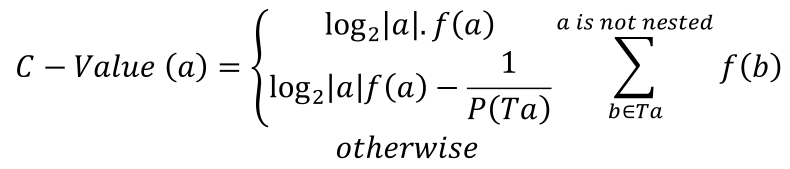
- : Weights the term by its length (longer terms are often more specific).
- : The raw frequency.
- Subtraction Component: This is the magic. It subtracts the frequency of the term when it appears as part of longer candidates (), ensuring that a sub-phrase is only rewarded if it also appears independently.
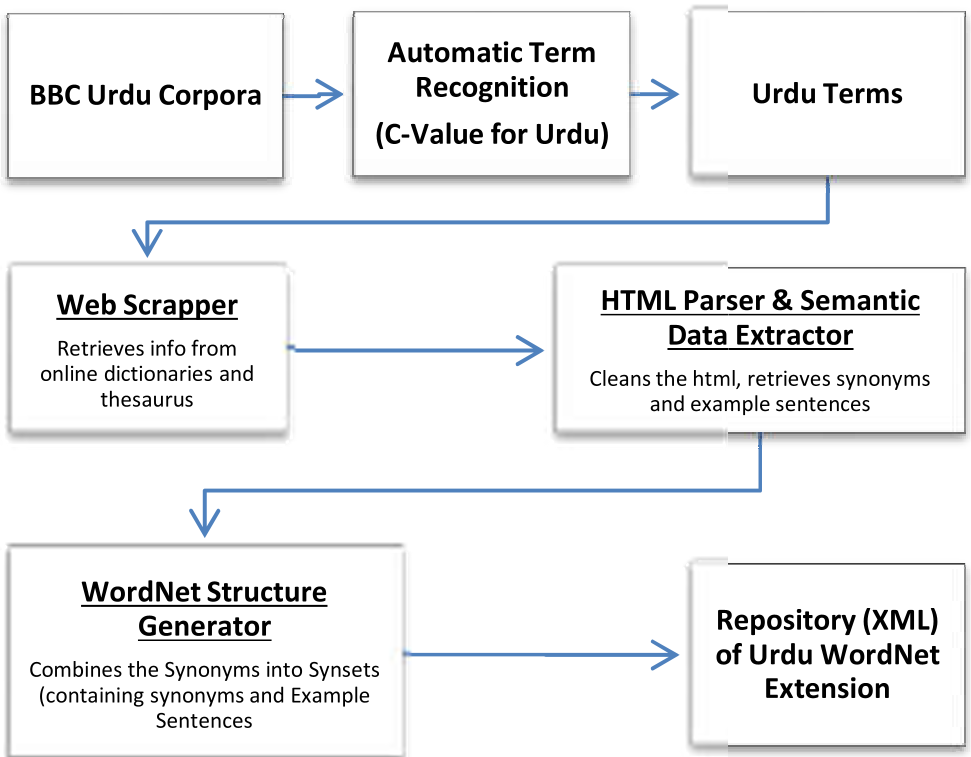
System Architecture
The workflow involves processing raw Arabic text through a series of filters before calculating the final scores:
Experimental Insights
The study categorized extracted Multi-Word Terms (MWTs) based on their linguistic structure. The JJNN (Adjective-Noun) pattern proved to be the most fertile ground for term discovery.
| Linguistic Rule | Count of MWTs |
|---|---|
| JJNN | 603 |
| NNCMNN | 109 |
| NNCCNN | 23 |
| Total | 735 |
This distribution highlights that in Arabic technical discourse, descriptive noun-adjective pairings are the primary vehicle for specific concepts.
Critical Analysis & Future Outlook
While the C-Value approach effectively handles the nesting problem, it remains a "shallow" method—it relies on surface-level statistics and POS tags rather than deep semantic understanding.
Takeaway: The integration of C-Value provides a statistically sound way to de-noise candidate lists. For future work, combining this structural "termhood" score with Contextual Embeddings (like AraBERT) could allow the system to recognize terms that are semantically identical but syntactically different, a common occurrence in the flexible Arabic language.
Conclusion
By moving beyond simple frequency and addressing the structural hierarchy of phrases, this work provides a robust framework for Arabic NLP tasks like ontology building and automated indexing.