
SmileWave: Quantifying the Ripple Effect of Digital Smiles
Poster: Extensive Evaluation of Emotional Contagion on Smiling Selfies over Social Network
This paper introduces "SmileWave," a specialized selfie-based social networking service designed to detect and analyze emotional contagion. By tracking user facial expressions in response to viewed content, the study confirms that smiling selfies can trigger similar emotional states in viewers across a social network.
TL;DR
Is happiness truly contagious through a smartphone screen? Researchers from Keio University developed SmileWave, a social network that senses your facial expressions in real-time as you view others' selfies. Their findings confirm that "smile-based emotional contagion" is real, measurable, and highly dependent on the intensity and order in which you see happy faces.
Background: The Science of "Catching" Feelings
Emotional contagion is the psychological phenomenon where we "catch" the emotions of those around us—a mechanism essential for human empathy and social bonding. While we know this happens in person, the digital world is a different beast. Does a static selfie have the same power as a living, breathing human? This paper tackles this by moving beyond self-reported surveys into objective, real-time sensing.
Methodology: The SmileWave System
The researchers built a custom social networking service (SNS) called SmileWave. Unlike Instagram or X (formerly Twitter), SmileWave’s primary function is to act as a scientific probe.
The Core Loop:
- Content Consumption: Users browse a feed of smiling selfies.
- Real-time Sensing: Using the front-facing camera, the app analyzes the viewer's "smile degree" using mobile vision algorithms.
- Feedback & Sequencing: The app tests different ways of showing content—specifically varying the "smile intensity" of the photos.
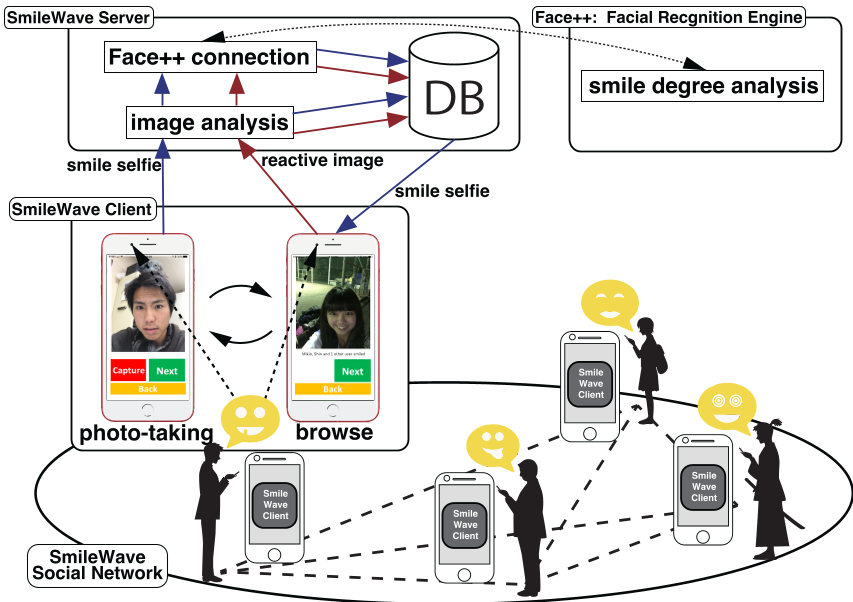
Key Insights from the "In-the-Wild" Study
The team conducted two separate studies involving 86 participants. Unlike laboratory experiments, these were "in-the-wild," meaning users used the app in their daily lives over several weeks.
1. The Power of "Progression"
One of the most fascinating findings was the impact of sequencing. The researchers discovered that showing smiles in an ascending order of intensity (moving from a slight grin to a broad laugh) created a much stronger contagion effect than showing them in a random or descending order. This suggests that "warming up" the viewer's emotional state leads to higher peak happiness.
2. Temporal Persistence
Contagion wasn't just a "flash in the pan." The study found that exposure to smiling selfies influenced the user's emotional baseline not just for a few seconds, but over a longer duration. This provides evidence that positive digital interactions can have a cumulative effect on mood.
Critical Analysis & Future Directions
While the study provides a robust proof-of-concept for emotional contagion in SNS, there are limitations to consider:
- Scale: With 86 participants, the study is extensive for a mobile sensing paper but small compared to global social networks.
- Smile vs. Happiness: The paper measures the "smile degree" (the physical act). While the two are correlated, future work needs to validate if this physical reaction translates directly into a sustained increase in internal "subjective well-being."
What this means for the future
SmileWave suggests a future where social media algorithms aren't just optimized for "engagement" (which often prioritizes outrage), but for "emotional well-being." Imagine an algorithmic feed designed to gradually lift your mood through a scientifically-sequenced set of social interactions.
Conclusion
The Keio University team has successfully demonstrated that our phones are not just mirrors of our social lives, but active participants in our emotional health. By simply viewing a sequence of smiling friends, we can tangibly shift our emotional state—a discovery that paves the way for a more empathetic and positive digital future.