
Optimizing Sentiment Classification: A Deep Dive into Feature Engineering for Social Media
Extensive Survey on Feature Extraction and Feature Selection Techniques for Sentiment Classification in Social Media
This paper provides an extensive survey and comparative analysis of feature extraction and selection techniques—such as N-grams, CHI-statistics, and Information Gain—specifically tailored for sentiment classification in social media. It evaluates various machine learning models, highlighting that Naïve Bayes consistently outperforms K-Nearest Neighbor (KNN) in sentiment accuracy.
TL;DR
This research provides a comprehensive roadmap for navigating the complexities of social media sentiment analysis. By evaluating the interplay between Feature Extraction (N-grams), Feature Selection (CHI, IG, OR), and Classification Algorithms, the paper demonstrates that strategic dimensionality reduction is more critical than model complexity. Experimental results prove that Naïve Bayes maintains a competitive edge over lazy learners like KNN in accuracy and efficiency.
Background & Positioning
In the era of Big Data, social media serves as a goldmine for consumer insights. However, the raw data is often "perplexing"—filled with slang, irony, and noise. This paper positions itself as a structural guide to Knowledge Discovery in Data (KDD), bridging the gap between raw mathematical algorithms and actionable business intelligence.
The Core Conflict: Why Sentiment Analysis is Hard
The primary challenge in mining Twitter or e-commerce reviews is the curse of dimensionality. A vast vocabulary leads to a sparse feature space where most attributes are redundant. Traditional classifiers fail because:
- Irrelevant Information: Useless words (stop words) dilute the signal.
- Computational Load: Wrapper methods for feature selection are often prohibitively expensive.
- Granularity: Moving from binary (Positive/Negative) to multi-class sentiment leads to a significant drop in accuracy (from ~81% to ~60%).
Methodology: The Feature Engineering Pipeline
The authors propose a rigorous multi-stage pipeline to refine raw text into high-value numerical vectors.
1. Data Preprocessing & Extraction
The process begins with Tokenization and Normalization to handle data redundancy. The core extraction relies on N-grams:
- Unigrams: Treating words as independent events.
- Bigrams/Trigrams: Capturing local context and word order, which is vital for detecting shifts in sentiment (e.g., "not good").
2. Feature Selection: Filter vs. Wrapper vs. Embedded
To reduce the input space, the paper details three primary strategies:
- Filter Methods: Using statistical scores (CHI-Square, Information Gain) independent of the classifier.
- Wrapper Methods: Evaluating feature subsets by actually training models, which yields higher accuracy but at a higher computational cost.
- SMO (Sequential Minimal Optimization): A critical inclusion for SVM training that breaks down large Quadratic Programming (QP) problems into smaller, analytically solvable pieces, speeding up training by up to 1000x.
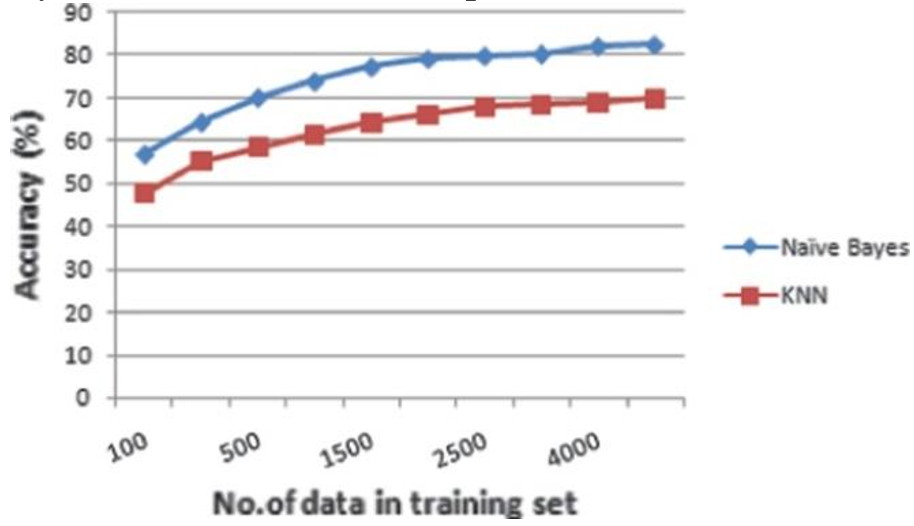 Fig 1. Performance delta between Naïve Bayes (Probabilistic) and KNN (Instance-based) learners.
Experimental Insights & Results
The study conducts a head-to-head comparison between Naïve Bayes (NB) and K-Nearest Neighbor (KNN).
- Naïve Bayes (56.78% accuracy) wins because its probabilistic inductive bias is better suited for the high-dimensional, categorical nature of text data.
- KNN (47.64% accuracy) suffers from the "lazy learning" approach where the lack of a generalized model makes it susceptible to noise in small-to-medium datasets.
The authors also highlight the effectiveness of Information Gain (IG) and Odds Ratio (OR) in filtering out features that do not contribute to class discriminability.
Critical Analysis & Conclusion
Takeaway
The paper confirms that for sentiment analysis, "less is more." A well-curated feature set using CHI-Square or IG coupled with a robust classifier like Naïve Bayes or SVM (via SMO) provides the most reliable results for real-world deployment.
Limitations
While the survey is extensive regarding traditional ML, it only briefly touches upon the transition to Deep Learning (RNN/LSTM/CNN). The accuracy of 56-60% for multi-class sentiment suggests that while feature selection helps, the semantic nuance of human emotion still presents a significant ceiling for non-transformer-based models.
Future Outlook
The next frontier lies in Meta-heuristic algorithms (like Cuckoo Search or PSO) for feature selection, which may offer a more optimized balance between the speed of Filter methods and the accuracy of Wrapper methods.