
Creators of Influence: How External Exposure Realigns Social Networks in Remote Communities
External exposure, boundary-spanning, and opinion leadership in remote communities: A network experiment
This study investigates the impact of external social exposure on internal social structures within 16 remote Indonesian farming communities using a network experiment. By combining Randomized Controlled Trials (RCT) with Exponential Random Graph Models (ERGMs), the authors demonstrate that providing external training to randomly selected individuals can effectively transform them into local opinion leaders (SOTA in network intervention strategy).
TL;DR
Can we "manufacture" opinion leaders? A groundbreaking study in Sumatra suggests yes. By taking randomly selected farmers out of their isolated villages for external training, researchers doubled their social influence (indegree) 18 months later. This research proves that opinion leadership isn't just an inherent trait—it's a structural position that can be engineered through external social exposure.
Contextualizing the Problem: The "Opinion Leader" Trap
For decades, social scientists and development agencies have relied on a top-down strategy: find the local "influencers" and convince them to adopt new practices. However, this approach has two major flaws:
- Stagnation: Existing leaders are often guardians of tradition and may resist changes that threaten local norms.
- Inequity: Targeting the already-powerful can reinforce existing social hierarchies, leaving marginalized members behind.
The authors of this study asked a provocative question: In peripheral, ethnically fragmented communities, is "boundary spanning" (connecting to the outside world) a source of prestige or a mark of a social pariah?
Methodology: A "Network-Aware" Randomized Controlled Trial
The researchers invited 117 farmers from 16 communities in Sumatra to a 3-day networking event outside their villages. This was a Randomized Controlled Trial (RCT)—the golden standard of causality.
To account for the complex physics of social ties, they didn't just count links; they applied Exponential Random Graph Models (ERGMs). This allowed them to control for:
- Reciprocity: "I ask you for advice because you ask me."
- Transitive Closure: "Friends of friends become friends."
- Popularity Scaling: The "rich-get-richer" effect in networks.
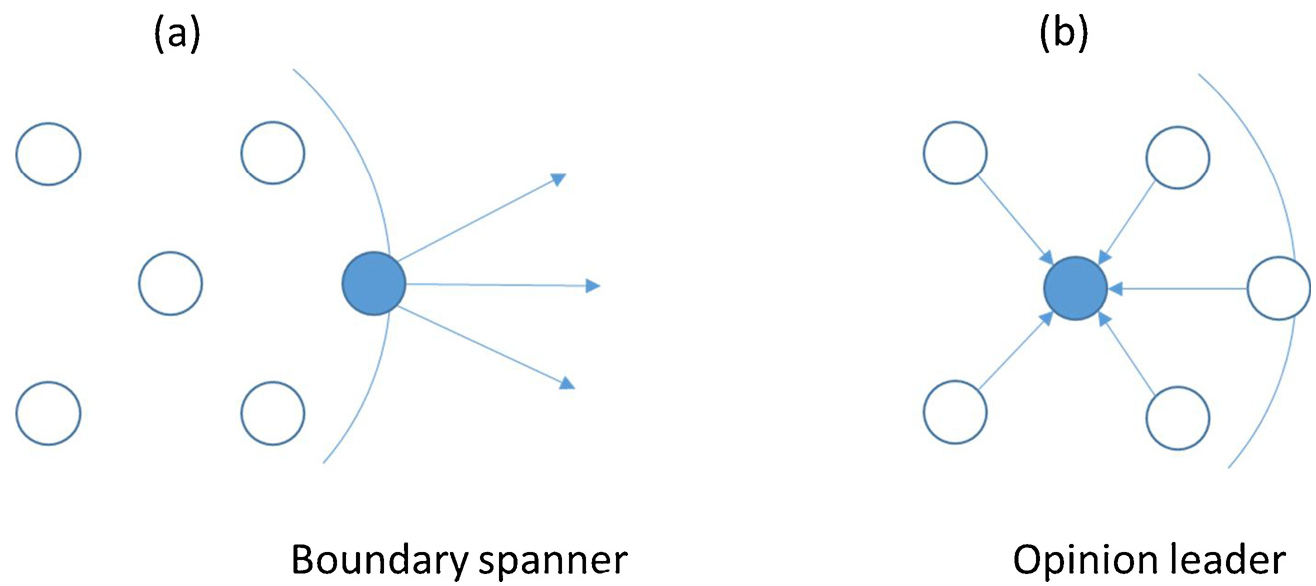 Figure 1: Boundary spanners bridge the gap to external knowledge, while opinion leaders are the internal hubs of information.
Key Insights: Why the Intervention Worked
The results, measured 18 months after the 3-day event, were striking.
1. The Popularity Double-Up
The intervention group had an average indegree of 2.8, compared to 1.4 for the control group. The ERGM analysis confirmed that this wasn't just a fluke of the participants being more "chatty" (the Sender effect was non-significant); it was the rest of the community actively seeking them out (a significant Receiver effect).
2. The Expert Logic vs. The Trust Logic
While some theories suggest that "cosmopolitans" are distrusted in traditional villages, this study found the opposite. In the non-competitive environment of Sumatran coffee/cocoa farming (where one farmer's high yield doesn't hurt another's), boundary spanners were viewed as valuable assets. They provide "second-hand social capital"—access to external secrets without having to leave the village yourself.
3. Structural Zeroes: A Methodological Innovation
The study utilized a clever "Structural Zero" approach in its ERGM to analyze 16 different networks of varying sizes simultaneously. This solved a common technical hurdle: how to generalize findings across multiple independent social groups without losing statistical power.
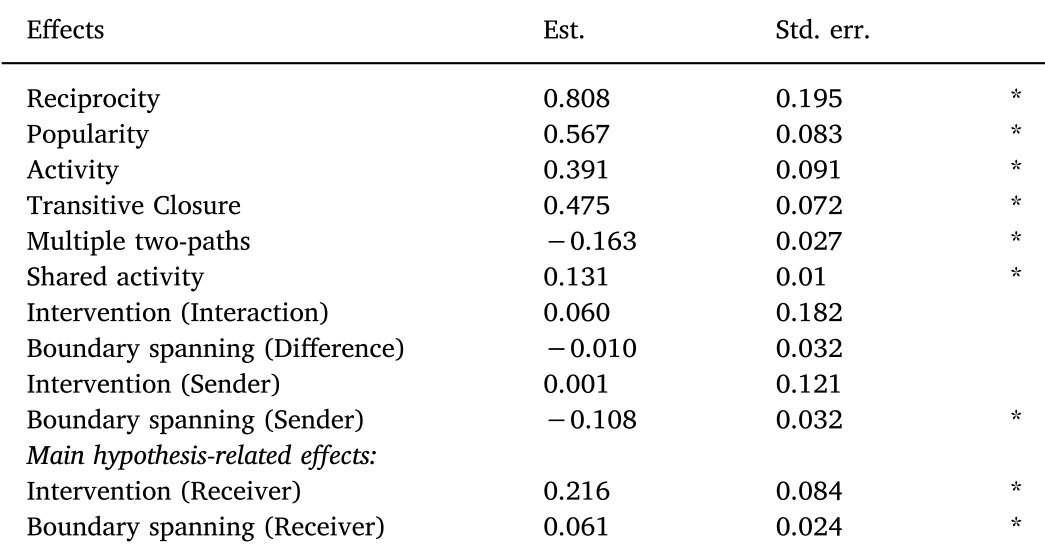 Figure 2: The table highlights the significant 'Intervention (Receiver)' and 'Boundary Spanning (Receiver)' effects, confirming the main hypothesis.
Critical Perspective: Limits of the "Edge"
The authors are careful to note that "people in the center are the people on the edge." This works in cooperative environments. However, in competitive settings (like the Hawaiian fisheries cited in the paper), boundary spanners might be viewed as traitors who leak "group secrets."
Furthermore, while the research showed that we can create leaders, it also noted that social networks naturally tend toward "cliquishness" (transitive closure). This means that while we can boost someone's status, natural network forces will always try to pull the structure back into local, closed clusters.
Conclusion: Designing the Future of Communities
This study offers a powerful tool for social design. If we want to diversify the distribution of power and knowledge in marginalized groups, we shouldn't just look for leaders—we should build them by bridging them to the world.
Takeaway for Practitioners: When selecting participants for training or pilot programs, prioritize those who are motivated but currently "peripheral." Their newly acquired external links may be the exact catalyst needed to transform them into the next generation of community opinion leaders.