
Unmasking Anonymity: How External Web Knowledge Bridges the Gap in Social Media De-anonymization
Effects of External Information on Anonymity and Role of Transparency with Example of Social Network De-anonymisation
The paper presents a novel de-anonymization system that identifies anonymous social network users by correlating their posts with external "real-named" data such as résumés. It introduces the Hidden Term Frequency (HTF-IDF) method, which leverages web search engine results to uncover indirect semantic links, achieving high identification precision for Twitter accounts.
TL;DR
Researchers have developed a system capable of identifying anonymous Twitter users by matching their posts against their professional résumés. By utilizing a new metric called Hidden Term Frequency (HTF), which draws on external web search data, the system can "read between the lines" to link indirect references (like local landmarks) to specific identities with over 90% accuracy.
The Illusion of Privacy in the Open World
Users often believe they are safe if they omit their name, employer, or specific location from social media. This paper highlights a critical "blind spot" in this logic: External Information Context. While you might not mention your university, mentioning a coffee shop "5 minutes from the lab" creates a footprint that, when combined with a search engine's knowledge of that shop’s location, points directly to your institution.
The core motivation of the authors was to prove that traditional privacy metrics like k-anonymity or perturbation are insufficient because they treat datasets as isolated islands, ignoring the vast "semantic bridge" of the internet.
Methodology: Beyond Simple Keyword Matching
The technical heart of this work is the shift from TF-IDF (Term Frequency-Inverse Document Frequency) to HTF-IDF.
1. The Failure of Standard TF-IDF
Standard models look for direct overlap. If your résumé says "Cybersecurity Researcher" and your tweets say "Analyzing zero-days," a standard model might miss the connection because the literal words don't match.
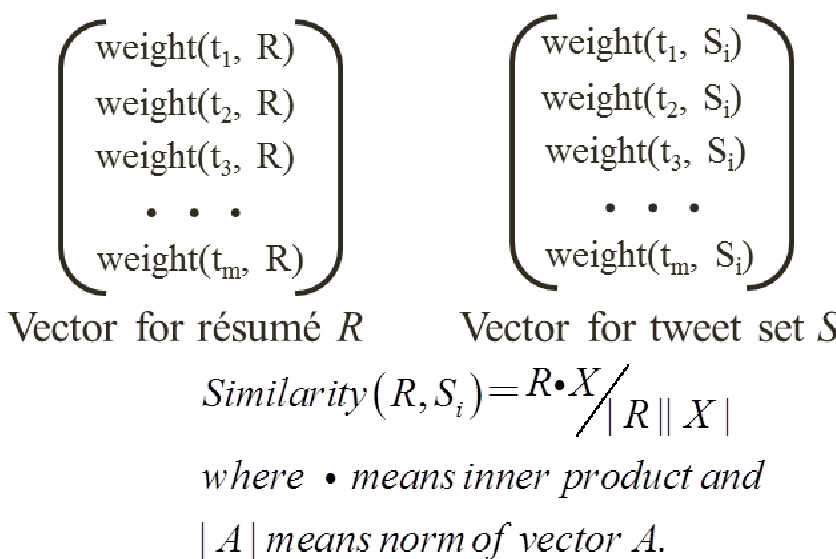 Figure: The graph shows that direct keyword overlap between résumés and tweets is nearly zero, rendering standard matching useless.
2. The HTF Algorithm
The HTF algorithm acts as a "reasoning engine." It takes terms from a tweet, queries a search engine, and analyzes the top results. If the search results for a tweet's phrases frequently contain terms from the target's résumé (like a specific university name), the "Hidden Term Frequency" increases.
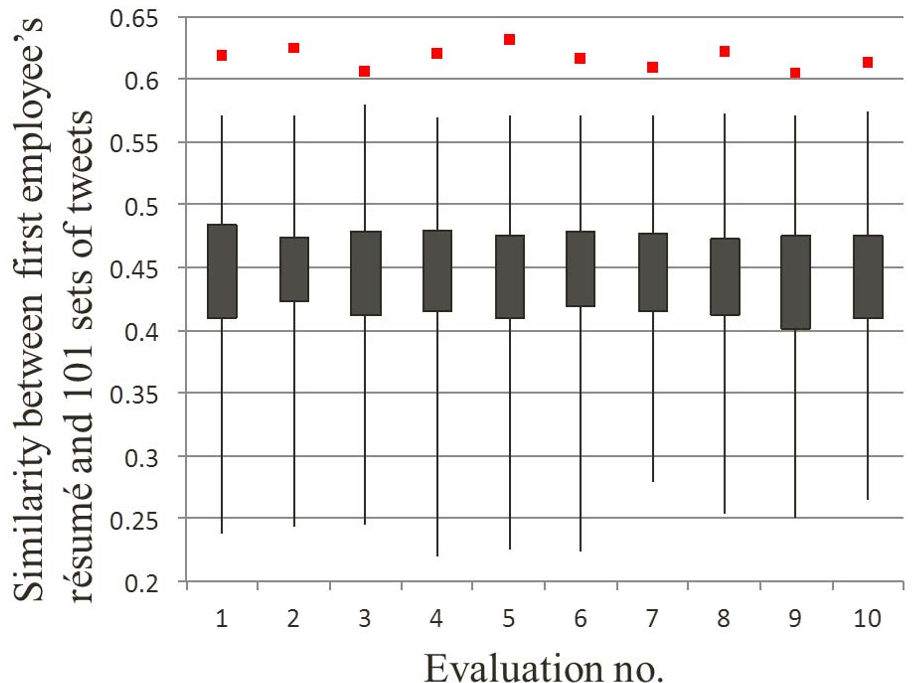 Figure: Once HTF is applied, the "Hidden" similarity is revealed, allowing the correct account to stand out from the noise.
Experimental Results: Precision through Persistence
The study tested the model on professional employees and university students.
- For Professionals: With just 100 tweets, the system achieved a True Positive Rate of 0.941.
- For Students: Student data was noisier (colloquialisms, lack of job history). However, by increasing the sample size to 1,000 tweets, the system successfully identified the majority of targets.
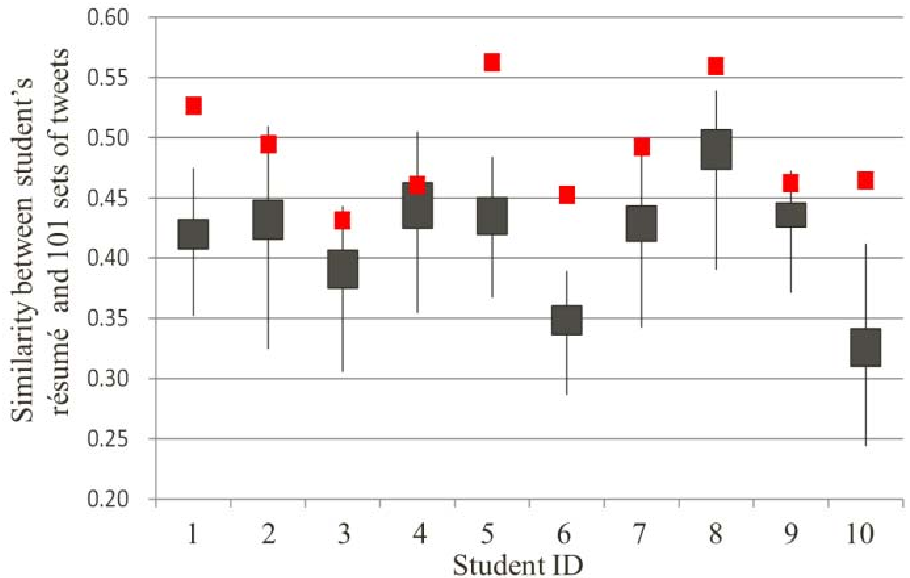 Figure: Distribution of similarity values showing the "Employee" tweet set consistently scoring higher than the 100 control sets.
Critical Analysis: The Role of Transparency
The authors conclude that technical anonymization is a losing battle. If an attacker has access to a search engine and a "real-named" source (like a résumé), they can almost always bridge the gap.
Key Takeaways:
- The Limitation of Obfuscation: You cannot anticipate which future web pages or data sources will "leak" your identity by providing context to your current anonymous posts.
- Transparency as Protection: Since we cannot stop the math of de-anonymization, we must regulate the action. The authors argue for high "Transparency"—legal frameworks that prevent employers or organizations from ever attempting to link real-named databases with anonymous social streams.
- The Right to be Forgotten: This research provides a strong technical justification for the "Right to be Forgotten," as erasing old "contextual" data is the only way to prevent it from being matched with new real-named data in the future.
Conclusion
This paper serves as a wake-up call for the privacy-preserving data publishing (PPDP) community. It demonstrates that as the web grows "smarter" through better search and indexing, our "anonymized" footprints become increasingly unique and identifiable.