
IFHN: Reimagining Social Recommendation via Implicit Friend Extraction
Extracting Implicit Friends from Heterogeneous Information Network for Social Recommendation
The paper proposes IFHN (Implicit Friends Extraction from Heterogeneous Information Network), a recommendation framework that identifies high-quality implicit friends using meta-path-guided network embeddings. By integrating these implicit relations into a Matrix Factorization (MF) model, it significantly improves rating prediction performance and addresses the sparsity of explicit social data.
Executive Summary
TL;DR: Most social recommendation systems fail because explicit "friend" buttons don't capture the full picture of human preference. IFHN bypasses this by building a Heterogeneous Information Network (HIN) and using meta-path-guided embeddings to discover "implicit friends"—people you aren't connected to, but whose tastes perfectly mirror yours.
Within the academic landscape, this work moves beyond simple graph regularization and enters the realm of Deep Semantic Graph Mining, proving that structural patterns in heterogeneous data are far more predictive than explicit social signals.
The Problem: The "Sparse and Noisy" Trap
Explicit social relations (trust/friendship) in datasets like Epinions or Douban are notoriously sparse (often < 0.1% density). Furthermore, these links are "noisy": you might follow a friend for their political insights but completely disagree with their movie tastes. Relying solely on these "Explicit Friends" leads to a bottleneck in recommendation accuracy.
The authors' core Insight is that the user-item interaction space, combined with auxiliary item metadata and existing social links, contains a latent "Implicit" friendship network that is much denser and more aligned with actual consumption habits.
Methodology: The Architecture of IFHN
The IFHN pipeline consists of four sophisticated stages:
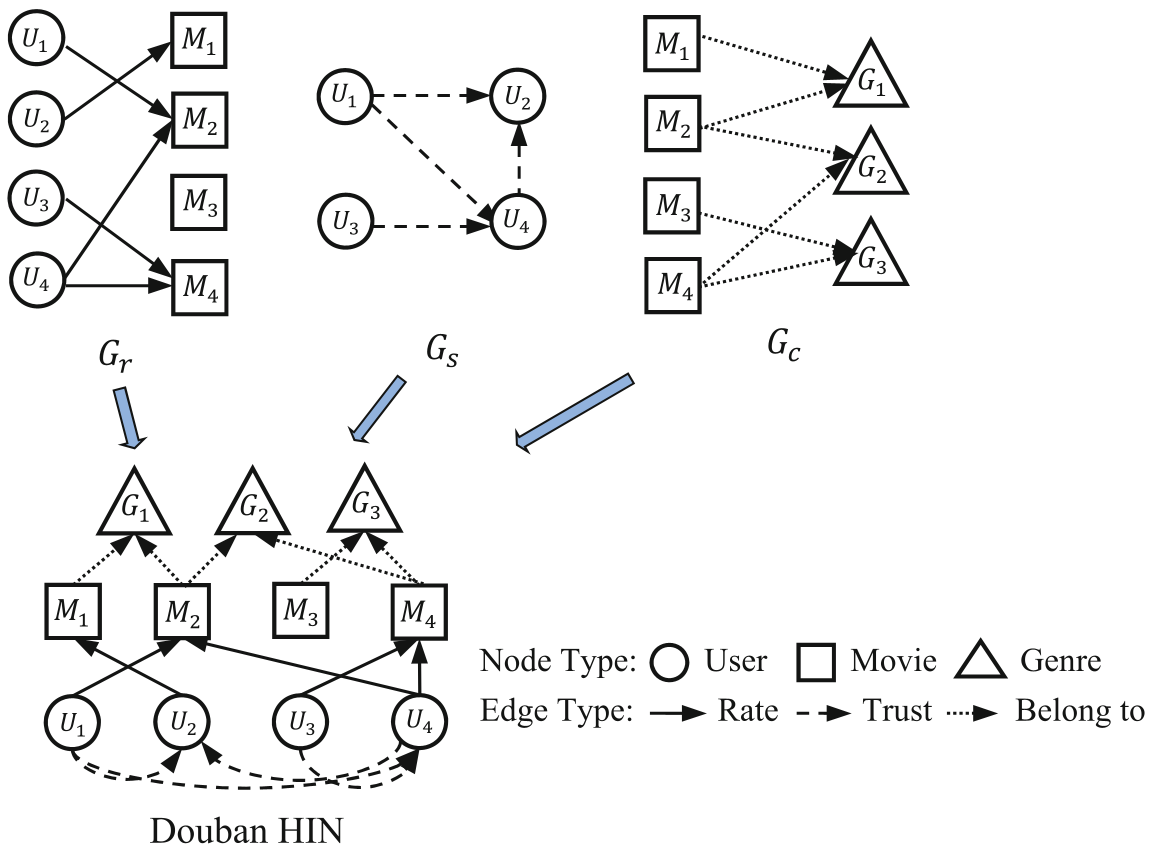
1. Constructing the HIN
The system doesn't just look at a user-item matrix. It merges:
- User-Item Bipartite Network (Ratings)
- User-User Social Network (Explicit Trust)
- Item-Category Bipartite Network (Genre/Metadata)
2. Meta-path Guided Random Walks
To extract semantics, the authors define specific "Meta-paths" (e.g., ). This path finds users who like movies of the same genre. Unlike standard random walks, these are biased; for trust relations, the walk favors users with more mutual friends.
3. Heterogeneous Embedding (metapath2vec)
By feeding these walks into a Heterogeneous Skip-Gram model, each user is mapped to a latent vector . The distance between these vectors represents their "Implicit Friendship" strength.
4. Social Regularization in MF
Finally, the top-k implicit friends are used to regularize the Matrix Factorization objective function: This forces the latent preference of a user to stay close to their implicit friends .
Experimental Breakthroughs
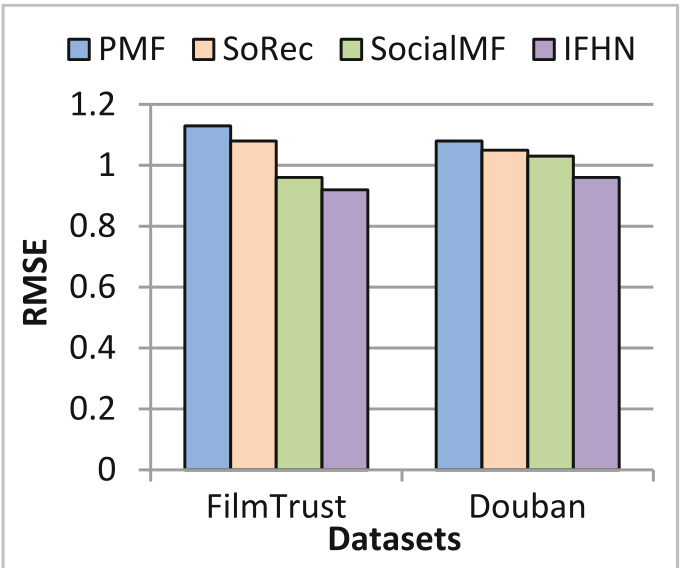
The results on the Douban and FilmTrust datasets validate the superiority of implicit connections.
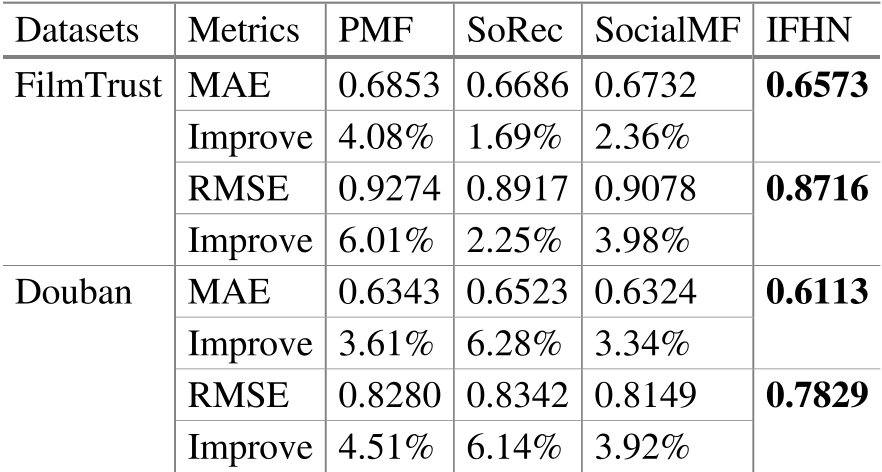
- Baseline Superiority: IFHN consistently outperformed SoRec and SocialMF.
- Solving Cold-Start: For users with fewer than 10 ratings, IFHN showed a massive 18.6% improvement. This is because even if a user has few ratings, their sparse patterns can still link them to a dense cluster of implicit friends via the HIN.
Critical Insight & Conclusion
The true value of this paper lies in its treatment of Social Information as a Latent Variable rather than a fixed input. By allowing the model to "curate" its own social graph through HIN embeddings, it filters out the noise of real-world friendships and focuses on "Taste Homophily."
Limitations: The reliance on pre-defined meta-paths requires domain expertise. A natural evolution would be to use Graph Neural Networks (GNNs) with automated path discovery (e.g., Attention-based HGT) to eliminate manual path engineering.
Takeaway: If your recommendation engine is struggling with data sparsity, stop looking for more data—start looking for the implicit connections already hidden in your heterogeneous graph.