
Beyond the Z-Score: Empirical Validation of Data Mining for Corporate Bankruptcy
Extracting Predictors of Corporate Bankruptcy: Empirical Study on Data Mining Metliods
This study evaluates various AI-based data mining techniques and statistical methods for selecting financial predictors of corporate bankruptcy in Japan. Comparing C4.5, SIBILE, CART, Logit analysis, and Stepwise selection, the researchers identify Logit analysis as the superior method for variable selection, achieving a peak classification accuracy of over 87%.
TL;DR
Predicting corporate failure is a high-stakes challenge where the choice of "which financial ratios matter" is as critical as the model itself. This study benchmarks five variable selection methods—ranging from AI-driven decision trees to classical Logit analysis—on a massive dataset of Japanese firms. The verdict? Logit analysis remains the accuracy king at 87%+, but AI-based methods like C4.5 and CART prove to be more "perceptive," capturing vital indicators that classical stepwise methods overlook.
The Generalization Gap: Why Most Bankruptcy Models Fail
Historically, bankruptcy prediction models suffered from a "small-data" bias. Most studies utilized samples of only 50 to 100 firms, making their findings localized and fragile. Furthermore, researchers often struggle with the "curse of dimensionality"—having 60+ financial ratios but not knowing which ones truly signal a firm's death spiral.
The authors of this paper address this by leveraging a significantly larger dataset (986 firms) from the Teikoku Data Bank, ensuring the results carry statistical weight that previous literature lacked.
Methodology: AI Intuition vs. Statistical Rigor
The study treats "variable selection" as the primary experimental lever. They compare three AI techniques with two statistical staples:
- AI Techniques: C4.5 (Decision Trees), CART (Classification and Regression Trees), and SIBILE (Interactive Genetic Algorithms).
- Statistical Techniques: Logit Analysis and Stepwise Selection.
A unique contribution of this research is the "Accounting Ethics" cleaning phase. The authors manually removed variables that showed trends contrary to traditional financial wisdom (univariate analysis), preventing the models from learning "noise" that might lead to mathematically correct but logically unsound predictions.
Key Findings: The Power of Logit and the Insight of AI
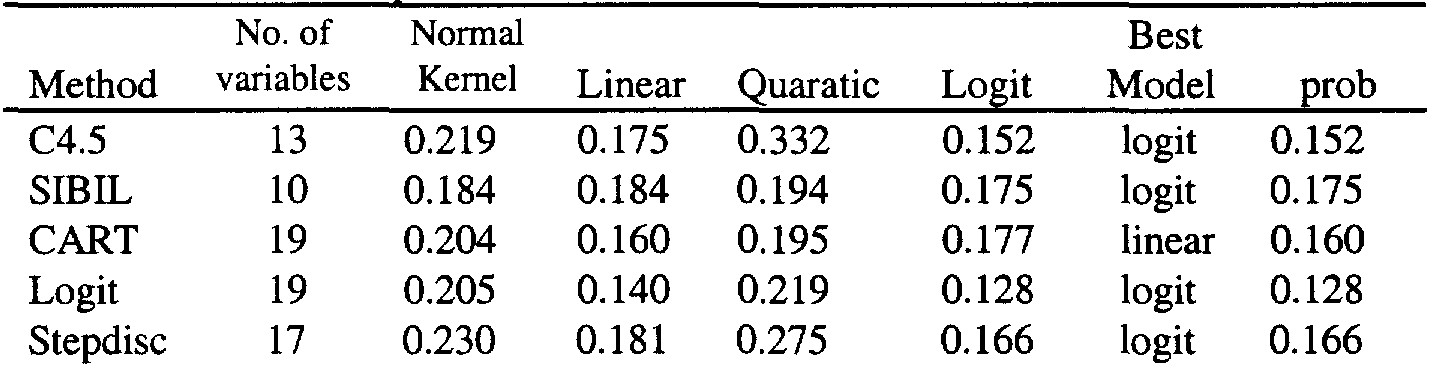
The experimental results (summarized in the table above) reveal several critical insights:
- The Accuracy Champion: The Logit method for variable selection, when paired with a Logit Discriminant model, yielded the lowest error rate (0.128, or ~87.2% accuracy).
- AI's Hidden Advantage: While AI methods like C4.5 and CART were slightly less accurate (~85%), they were the only ones to select X2 (Retained Earnings / Total Assets) as a top predictor. This is significant because Altman’s seminal Z-score research identifies X2 as perhaps the most critical indicator of corporate health. Conventional statistical "stepwise" methods missed this entirely.
- Linearity Rules: In all cases, Linear and Logit models outperformed Quadratic and Normal-Kernel (non-parametric) models, suggesting that the boundary between "bankrupt" and "solvent" in financial ratio space is relatively linear.
Critical Analysis & Takeaways
The study concludes that while Logit analysis provides the best "fit" for Japanese corporate data, AI-based data mining is not just a commercial buzzword—it is a robust tool for feature engineering.
The Takeaway: If you need the absolute highest precision for a specific dataset, stick with Logit selection. However, if you want a model that respects financial theory and finds "hidden" drivers like Retained Earnings, AI-based decision trees offer a more stable and theoretically grounded feature set.
Limitations: The study primarily focuses on quantitative financial ratios. While it touched on qualitative factors (Size/Industry), these did not significantly improve the models. Future work might benefit from incorporating "Soft Info" such as management sentiment or macroeconomic indicators to break the 90% accuracy barrier.
References
- Altman, E. (1977). ZETA Analysis: A new model to identify bankruptcy risk.
- Quinlan, J.R. (1986). Induction of Decision Trees.
- Breiman, L. et al. (1984). Classification and Regression Trees.