
GSDM: Balancing Social Tightness and Diversity for Optimal Team Extraction
On Extracting Social-Aware Diversity-Optimized Groups in Social Networks
This paper introduces the Social-aware Diversity-optimized Group Extraction (SDGE) problem, which aims to select a group of individuals from a social network such that group diversity is maximized under constraints of social tightness and minimum group size. The authors propose GSDM (Group Shrinking for Diversity Maximization), a 3-approximation algorithm that balances the trade-off between attribute heterogeneity and communication efficiency.
TL;DR
Building a team isn't just about finding specialists; it's about finding a diverse group that can actually talk to each other. This paper presents SDGE, a framework to extract socially tight groups with maximized diversity. The proposed GSDM algorithm provides a 3-approximation guarantee, ensuring high-quality, diverse team assembly at scale (millions of users) in seconds.
Context: Why "Expertise" Isn't Enough
In Management Science, it is well-established that diversity in functional and educational backgrounds leads to more innovative problem-solving. However, in the field of Computer Science, most "Team Formation" algorithms focus on Skill Coverage. They try to find the minimum number of people to finish a checklist. This often results in "Echo Chambers"—groups where everyone thinks alike, killing innovation.
The challenge lies in the Social-Diversity Paradox:
- High Diversity: Often means pulling people from different departments or social circles (High communication cost).
- Social Tightness: Often means picking friends or close colleagues (Low diversity).
Methodology: The Art of Shrinking
The authors propose the Social-aware Diversity-optimized Group Extraction (SDGE) problem. Instead of looking for a "minimum cost," they look for "maximum average diversity" under a social hop constraint .
1. The Metric: Average Diversity
Unlike total diversity (which just encourages picking everyone), Average Diversity () normalizes the dissimilarity between all pairs by the group size. This forces the algorithm to pick members who are truly "different" from the existing pack.
2. The GSDM Algorithm
Instead of building a team from scratch (which is combinatorial and slow), GSDM starts with a candidate pool of everyone within hops of the leader. It then performs an iterative "Shrinking" process:
- Identify the vertex that contributes the least marginal diversity to the current set.
- Remove that vertex.
- Repeat until the group size constraint is met.
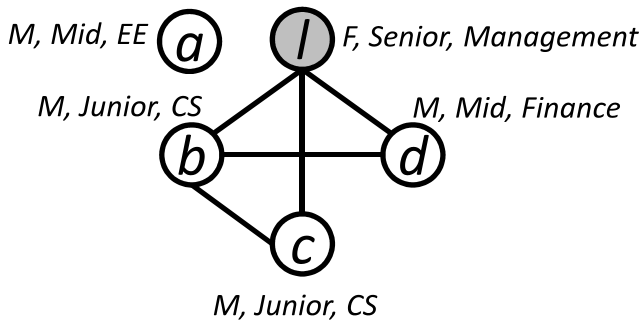 In the figure above, G3={l, b, d} is chosen because it balances the distance to the leader with a high variety of attributes (Gender, Major, Seniority).
3. Early Termination: The Efficiency Secret
To prevent unnecessary iterations on massive graphs like Pokec, the authors derived a mathematical bound (). If the maximum possible contribution of any remaining node is less than twice the best diversity found so far, the algorithm stops. This is why it can handle 1.6 million nodes in around 100 seconds.
Experimental Validation
The authors tested GSDM against SSGQ (which only cares about social tightness) and Random selection.
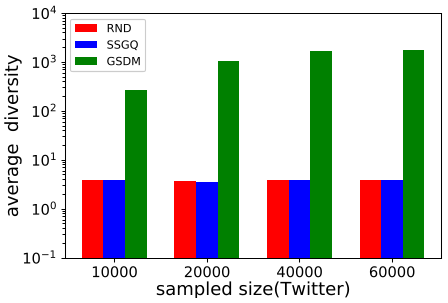 (a) Shows that GSDM maintains significantly higher diversity than social-only methods.
Key Findings:
- Accuracy: GSDM achieves results nearly identical to Brute-Force (BF) methods but at a fraction of the cost.
- Scalability: The time complexity is , but with the Early Termination strategy, it effectively performs much faster on real-world power-law graphs.
- Feasibility: Unlike random selection, GSDM guarantees that every member is within the allowed "hops" from the leader, ensuring the team can actually collaborate.
Critical Insight & Conclusion
The genius of this work lies in the shift from additive optimization to iterative shrinking. By treating the problem as a diversification of a social neighborhood, the authors turned an NP-Hard problem into a manageable task with a 3-approximation guarantee.
Takeaway for the Industry: As companies move toward remote and cross-functional work, tools using SDGE could automate the assembly of "Innovation Task Forces" by scanning internal social graphs (like Slack or LinkedIn) to find members who are socially connected but intellectually diverse.
Limitations: The model assumes "friendship" (edges) equals "effective communication." Future work might need to weigh edges by actual interaction frequency to better reflect social reality.