
Beyond Human Bias: Decoding Bengali Literature via Game Theory and Graph Mining
Extracting Social Network and Character Categorization From Bengali Literature
This paper introduces a computational framework for Extracting Social Networks and Character Categorization from Bengali literature, specifically focusing on Rabindranath Tagore's dramas. It employs a weighted graph-based methodology using a novel Edge Contribution Factor and a Game Theory-based community detection algorithm to identify protagonists and antagonists with high accuracy.
TL;DR
Researchers have developed a rigorous computational framework to extract social networks from Bengali plays and automatically categorize characters. By moving beyond simple frequency counts and employing Game Theory and Edge Contribution Factors, the study achieves a mathematical definition for the "Protagonist" and "Antagonist" that aligns with literary benchmarks but remains entirely unbiased.
Background: The Limits of Human Perception
Literature analysis—the study of "who matters and why"—has historically been the domain of subjective human sensitivity. While a reader "feels" who the hero is, computational social network analysis (SNA) seeks to replace intuition with evidence. However, prior SNA methods often failed because they treated all interactions equally. A character who speaks to everyone might just be a messenger (high degree), not a protagonist. This paper addresses this by analyzing the quality and diversity of a character's social sphere.
Methodology: The Math of Social Influence
The core innovation lies in treating the literature network as a directed, weighted graph where edges represent the volume and frequency of dialogue.
1. Weighted Edge Contribution Factor (WECF)
Instead of looking only at the node itself, the authors look at the "power" of the neighbors. If your friends are influential, you are likely a central figure. The WECF calculates the ratio of the combined weight of a node and its neighbors' contributions relative to the entire graph.
2. The Diversity Metric
A protagonist is often a bridge between disparate groups. The paper introduces a Diversity Metric (D). High diversity indicates a character interacts with members of various independent communities, while low diversity suggests their influence is siloed.
Lemma 1: High diverse nodes show low clustering coefficients. In literary terms, the hero's friends shouldn't all know each other; they come from different parts of the hero's world.
3. Game Theory-Based Community Detection
The authors treat community assignment as a Non-cooperative Game. Each character (player) chooses a community (strategy) to maximize their "Utility Function"—a measure of the internal strength of their connections. The system iterates until it reaches a Nash Equilibrium, where no character can improve their social utility by switching groups.
 Eq 6: The formula for Weighted Edge Contribution Factor (WECF).
Experiments: Validating Tagore’s Classics
The study analyzed two iconic plays by Rabindranath Tagore: Raktakarabi (Red Oleanders) and Muktodhara (The Waterfall).
Case Study: Muktodhara
In Muktodhara, human scholars often debate whether the prince Abhijit or the singer Dhananjay is the true protagonist.
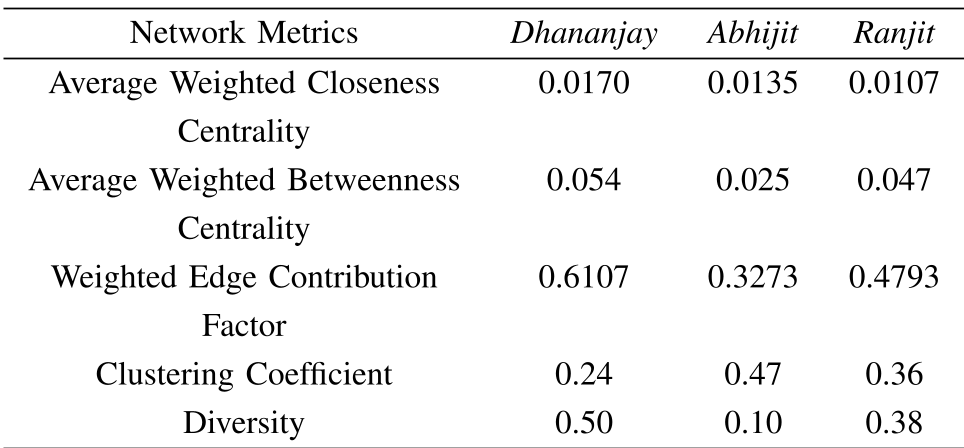
- The Data says: Dhananjay possesses a higher average weighted closeness, betweenness, and WECF compared to Abhijit.
- Categorization: While both are central, Dhananjay’s influence is more distributed across the social fabric (High Diversity), mathematically confirming his role as the overarching spirit of the play.
Results & Performance
The proposed game-theoretic method was tested against standard datasets like "Les Misérables" and "Facebook wall posts."
- Modularity: The method consistently produced higher modularity scores than baseline algorithms like "Greedy" or "NASHCoDe," meaning the identified communities are more distinct and logically sound.
- Character Accuracy: In both plays, the algorithm correctly identified the antagonist (e.g., King Ranjit or Sardar) by detecting high clustering among their associates—meaning antagonists tend to operate in closed, tight-knit "evil" circles.
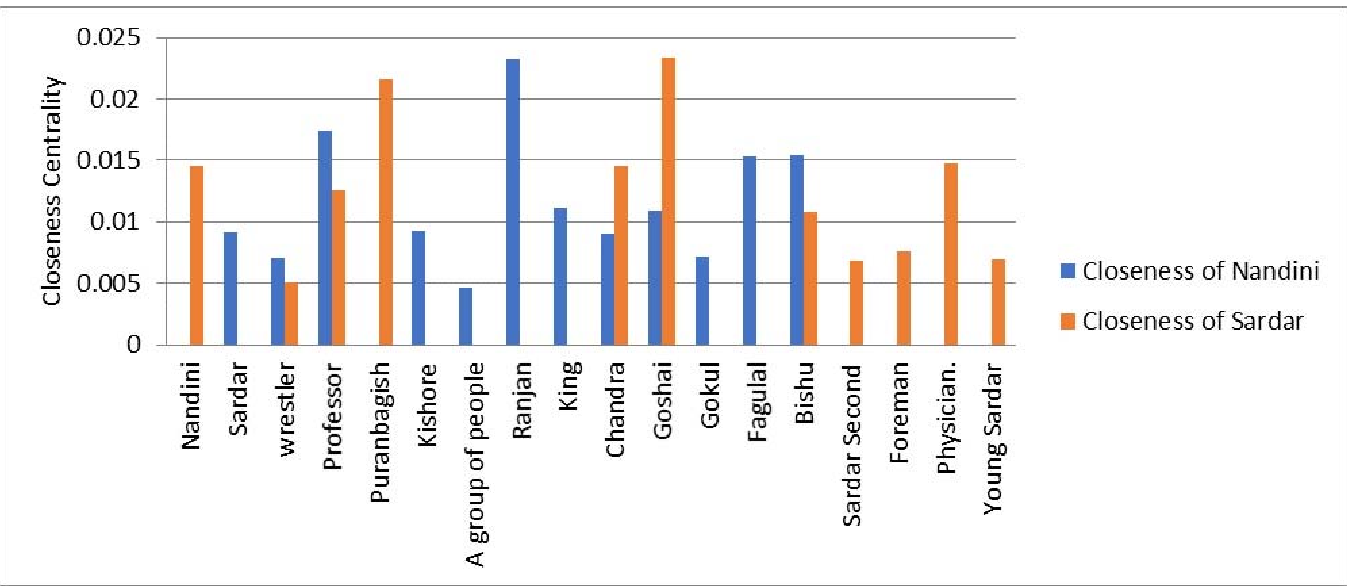 Graph: Comparison of Closeness Centrality between Protagonists and Antagonists.
Critical Insight & Conclusion
The significance of this work extends beyond Bengali literature. By defining the "Protagonist" as a node of High Diversity and Low Clustering, and the "Antagonist" as a node of High Connectivity but Low Diversity, the authors have provided a universal mathematical template for narratology.
Limitations: The current model ignores "narrative time." Characters evolve; a friend may become an enemy. Future work integrating Temporal Centrality will likely be the next frontier in Digital Humanities, capturing how social influence shifts as the curtain rises and falls.