
Beyond the "Reply" Button: Enriching Social Networks with Textual Insights
Extracting Social Networks Enriched by Using Text
This paper introduces a formal framework for extracting multi-relational social networks from online forums by combining structural metadata with textual content analysis. The authors propose three types of edges: structural replies, name quotations, and text quotations, achieving a more realistic mapping of user interactions in French and English discussions.
TL;DR
Researchers Mathilde Forestier and her team at the University of Lyon 2 have developed a method to move beyond simple structural links in online forums. By analyzing who quotes whom and who repeats whose words, they've built a multi-relational social network model that captures the nuances of human interaction that traditional "Reply-to" graphs miss.
Background Positioning
In the landscape of Social Network Analysis (SNA), most researchers focus on explicit signals (like "Following" or "Replying"). This paper belongs to the niche of Implicit Relation Extraction, arguing that the true "social fabric" of a community is woven into the text itself, not just the metadata.
Problem: The "Linguistic Chaos" of Web Forums
Why haven't we always done this? Because forum users are linguistically rebellious. The authors identify three major hurdles:
- Structural Incompleteness: Many users reply to multiple people in one post, but the system only records one "Reply-to" link.
- Pseudonym Volatility: People use diminutives (e.g., "Pierrr-rot" for "Pierrrre") or nicknames.
- Typographical Mess: Improper use of quotation marks makes it nearly impossible for standard parsers to tell where a quote begins and ends.
Methodology: The Multi-Relational Approach
The authors define a multi-graph where:
- = Authors.
- : The explicit "Reply-to" link provided by the forum software.
- : Mentioning another user's pseudonym in the text.
- : Directly quoting a string of text from a previous post.
The Technical Engine
To handle the "messy" data, the system uses Levenshtein Distance to allow for character-level errors in names. To avoid false positives (e.g., mistaking the word "Stone" for a user named "Stone"), they check words against a dictionary via TreeTagger. If a word isn't in the dictionary, it's more likely to be a pseudonym.
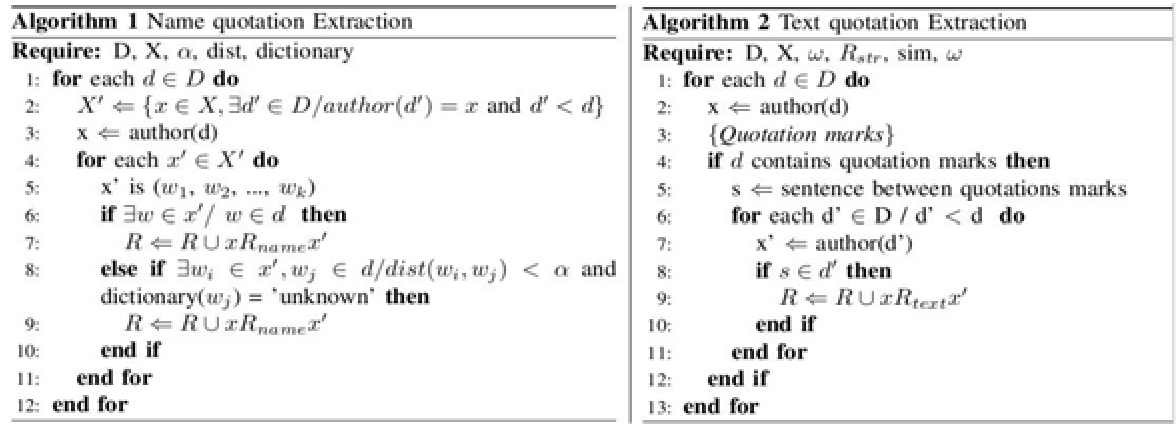 Figure 1: Algorithms for extracting Name and Text Quotations.
Experiments & Results
The team tested their system on French ("Sarkozy", "Roma") and English ("Diabetes", "Quiet") forums.
The Language Contrast
A fascinating finding was the disparity between languages. French users appeared more disciplined with quotation marks, leading to an F-measure of 0.84 for text quotation. In contrast, the English "Diabetes" forum was a "Wild West" of punctuation, dropping the recall to a staggering 0.143.
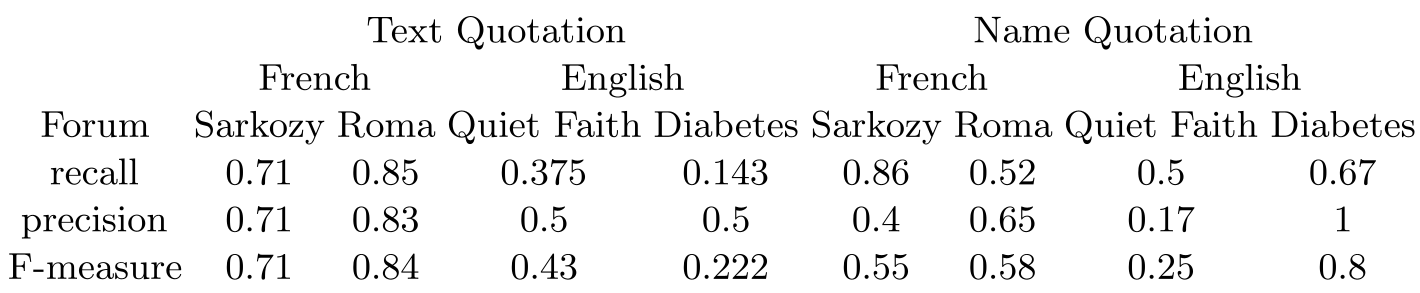 Table 1: Performance metrics across different forum types and languages.
The Precision/Recall Tradeoff
In name extraction, the system often faced a choice between being too strict (missing diminutives) or too loose (hallucinating connections). On the "Sarkozy" forum, they achieved a high recall (0.86) but low precision (0.4), meaning the system was "over-eager" to find mentions.
Critical Insight & Future Outlook
This work highlights that text is a reinforcement of structure. While the "Reply-to" button provides the skeleton, the text provides the nerves and muscles of a social network.
Limitations: The reliance on Levenshtein distance is a "brute force" approach that struggles with semantic synonyms (e.g., calling a user "the.clam" a "gastropod").
Future Work: The next leap in this field will likely involve LLMs (Large Language Models) that can understand intent and sarcasm, allowing us to not just see who is talking to whom, but the emotional valence of the relationship—turning a simple graph into a living map of human sentiment.