
Beyond the Screen: How Mobile Forensics & Web Mining Reconstruct Secret Social Networks
Extracting social networks from seized smartphones and web data
The paper introduces a forensic profiling framework that reconstructs an individual's social network by integrating private data from seized smartphones with public data mined from the Web. It employs the SESORR algorithm for relationship retrieval and spectral clustering to identify real-world social groups (cliques), achieving a "clearer" profile than single-source analysis.
TL;DR
In modern digital forensics, a smartphone is a goldmine, but its data is often fragmented. This paper presents a framework that bridges the gap between private device data (calls/SMS) and public web data (search engine hits). By applying the SESORR algorithm and Spectral Clustering, the researchers can reconstruct not just a list of contacts, but an organized map of "real-life" social cliques—from work colleagues to secret hobbyist groups.
Background: The Identity Gap
The central challenge in digital profiling is the Identity Gap. Information on the Web represents a persona that is often too broad or fake, while information on a phone is too narrow (often limited to nicknames or recent logs). The authors posit that the truth lies at the intersection: a person who appears in both your SMS logs and frequently appears alongside you in Google search results is a "high-weight" link in your actual social fabric.
Methodology: The Three Pillars of Profiling
1. Smartphone Data Analysis (SDA)
The process begins by extracting the "Profile Graph."
- Nodes: The owner and their contacts.
- Edges: Established via calls, SMS, and MMS.
- Weighting: The "strength" of a relationship is initially calculated by the volume of interaction, pulling frequent contacts closer to the center of the graph.
2. Web Data Analysis (WDA) & SESORR
To add depth, the system uses the SESORR (Search Engine SOcial Relationships-Retrieving) algorithm. It submits query pairs—like ("Name A" "Surname A") AND ("Name B" "Surname B")—to Google or Yahoo.
- Semantic Vision: It counts "hits" and extracts keywords from snippets to characterize the relationship (e.g., spotting terms like "research," "concert," or "legal").
- Distance Metrics: It uses the Jaccard Index and Normalized Google Distance (NGD) to mathematically quantify how closely two people are linked on the global web.
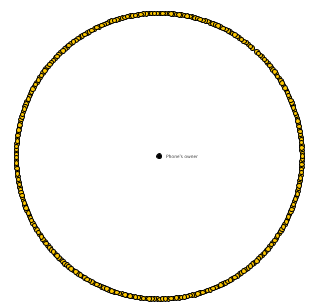 Figure 1: Conceptual transition from a raw contact list (a) to a weighted, multi-source social graph (b & c).
3. Clustering Analysis (CA)
The final piece of the puzzle is breaking this massive graph into meaningful sub-groups. The authors utilize Spectral Clustering (based on Singular Value Decomposition). This allows the tool to find "locally dense" subgraphs—cliques where everyone knows everyone—indicating a cohesive social unit like a family or a sports team.
Experimental Insights: Finding the "Rock Band"
In a real-world test case involving 218 contacts, the algorithm revealed fascinating structures that manual browsing would never find:
- The Muscle of Metadata: By analyzing a "musician friends" cluster, the tool found a complete subgraph of five people. It turned out these five were members of a rock band, even though the phone owner only directly communicated with one of them frequently.
- Filtering Noise: The system successfully flagged "Mom" and "Dad" as entries needing manual correction (since searching for "Mom" on Google is useless) while automatically identifying professional colleagues through shared domain URLs.
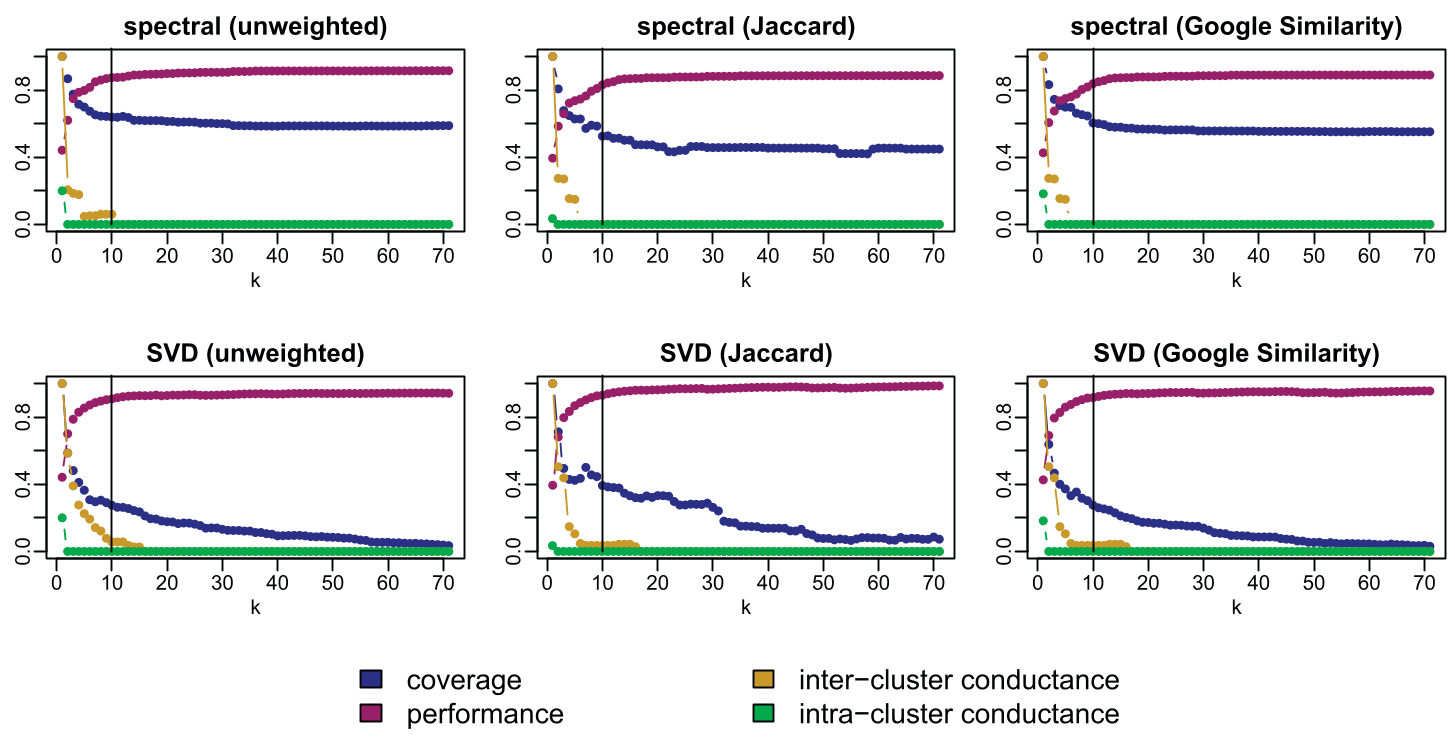 Figure 2: Analysis of clustering quality (k-selection) to ensure the social groups found are statistically significant.
Critical Insight & Limitations
The beauty of this approach is its inductive bias: it assumes that human relationships are naturally modular. However, the authors admit a significant bottleneck: The Naming Problem. If a user saves a contact as "Johnny" without a surname, the Web mining phase fails. For high-stakes forensic scenarios, this requires an operator to "repair" identities using carrier data or address book triangulation.
Conclusion
This paper shifts the focus of mobile forensics from "what did this person say?" to "who is this person?" By leveraging the global index of the Web to validate the local logs of a smartphone, the researchers have created a powerful lens for social network reconstruction.
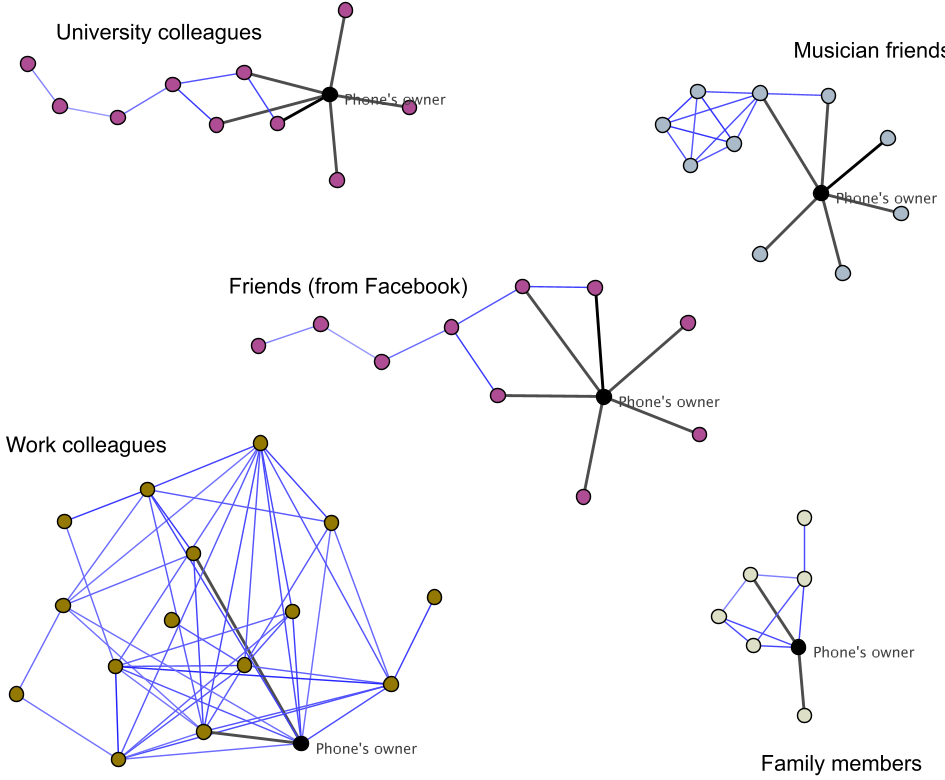 Figure 3: The final result—a clearly partitioned social map where the black node (owner) is connected to distinct, task-oriented social groups.