
Unveiling Hidden Echoes: Extracting Social Structures from Conversational Proximity
Extracting Social Structures from Conversations in Twitter: A Case Study on Health-Related Posts
This paper presents a framework for reconstructing social structures from unstructured Twitter conversational data related to the top leading causes of death in the US. By employing a sliding "time window" mechanism to link users who mention the same health topics, the authors demonstrate that these reconstructed networks exhibit non-trivial properties typical of small-world social networks.
TL;DR
Is a "follow" or a "reply" the only way to define a social connection? This research suggests otherwise. By analyzing a massive dataset of 12.5 million tweets related to the leading causes of death in the US, the authors demonstrate that simply talking about the same thing at the same time is enough to reconstruct complex social networks. Using a Time Window approach, these implicit networks reveal "small-world" characteristics similar to traditional social graphs.
Context & Positioning
In the landscape of Social Network Analysis (SNA), we usually look for explicit signals: friendships, retweets, or @mentions. However, this study operates in the "latent" space. It argues that conversations on Twitter are often partitioned into topical "spheres." By positioning this work at the intersection of Temporal Informatics and Public Health, the researchers provide a blueprint for identifying support groups and information hubs that are otherwise invisible to standard scrapers.
The "Time Window" Insight: From Sequence to Structure
The core challenge: how do you prevent a topical network from becoming a "clique" (where everyone is connected to everyone)? Without a temporal constraint, every person tweeting about "diabetes" would eventually be linked to every other person.
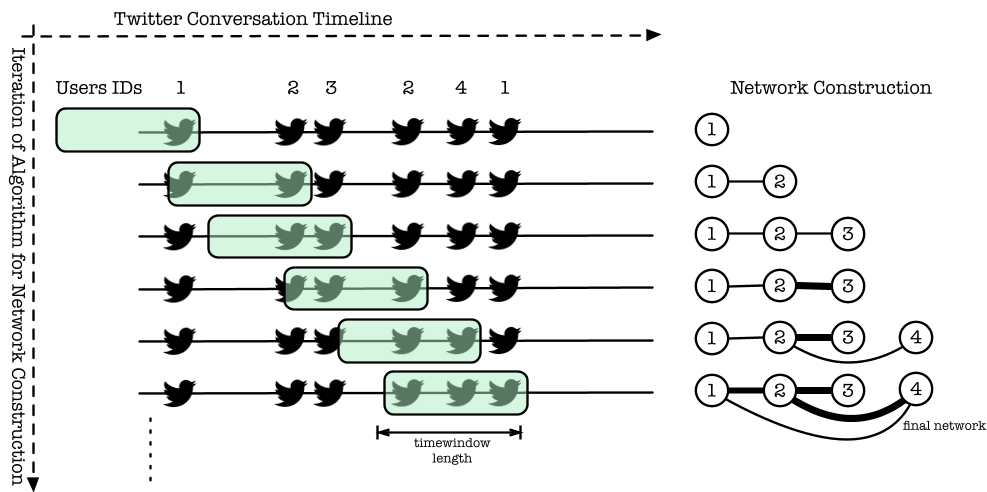
The authors solve this using a Moving Time Window:
- Temporal Trigger: A connection is formed only if two users mention the same keyword within a specific duration (1 to 12 hours).
- Weighted Reinforcement: If users remain within each other's windows over multiple iterations, the edge weight increases.
This mimics a "social gathering" intuition: if two people discuss a topic in a crowded room within minutes of each other, they are likely part of the same context, even if they aren't looking at each other.
Experimental Deep-Dive
The researchers analyzed the top causes of death (Heart Disease, Cancer, Diabetes, etc.) across 60 days.
1. The Scaling Myth
Surprisingly, most of these conversational networks are not strictly scale-free. Only 1% of the 7,344 generated networks followed a perfect Power-Law distribution (). This suggests that "hubs" (super-influencers) are less dominant in these spontaneous topical conversations compared to the global Twitter follower graph.
2. The Small-World Reality
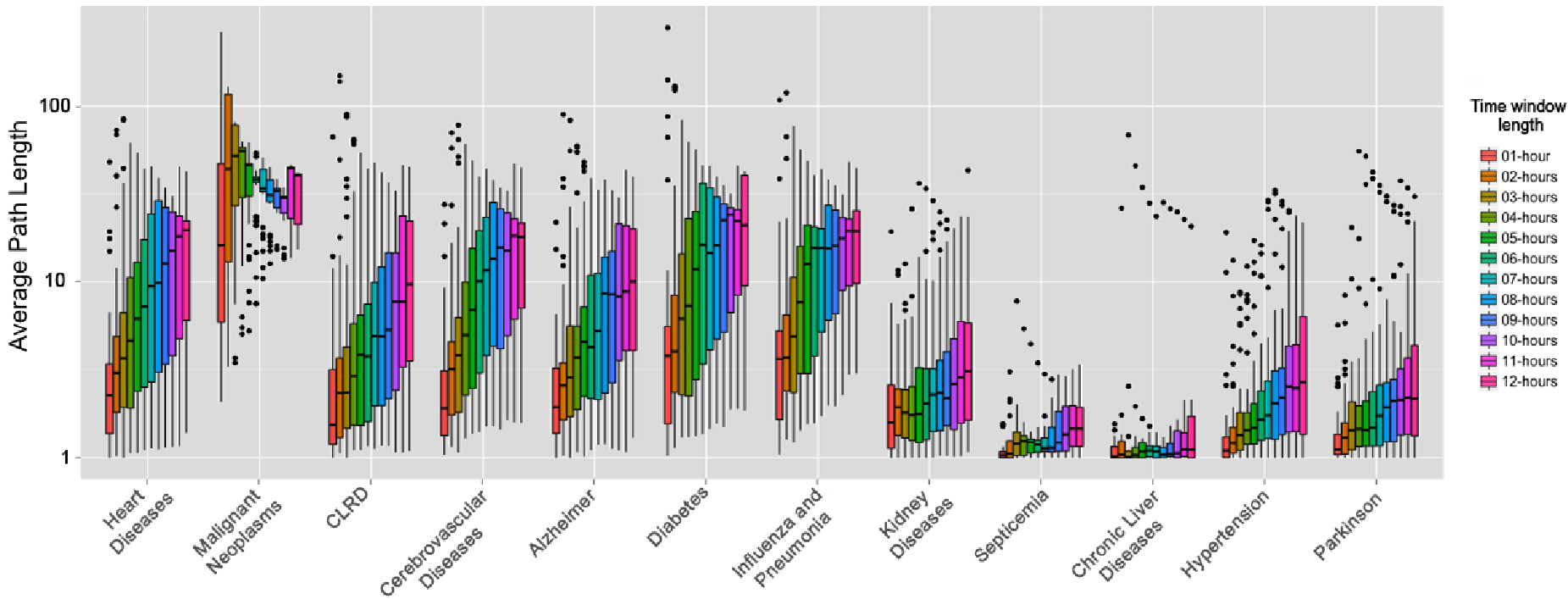
Despite the lack of scale-free behavior, the networks displayed high Clustering Coefficients and low Average Path Lengths.
- Clustering: Even without knowing each other, users form tight-knit clusters around specific diseases.
- Path Length: For a 1-hour window, the average path length was at its lowest, meaning information can jump across these implicit groups with minimal steps.
Critical Analysis & Takeaways
The most striking finding is that disease awareness does not correlate with clustering. One might assume that a high-profile disease like Cancer would lead to more tightly-packed support networks than something like Nephritis. The data says no: the tendency to cluster is a fundamental property of how we talk about health, regardless of the condition's prevalence in the media.
Limitations:
- Geospatial Bias: While 76% of tweets were geocoded, many users omit location data, potentially skewing regional results.
- Simple Motion: The time window moves tweet-by-tweet. A more sophisticated "event-driven" jump might filter out noise better.
Conclusion: This work provides a powerful tool for public health officials. By extracting these "invisible" social structures, we can identify where information flows and who might benefit most from targeted health awareness programs, even if those users never officially "follow" a doctor or a hospital.