
Deciphering the Rhythm of Retweets: Extracting User Behavior via Temporal Word Patterns
Extracting user behavior-related words and phrases using temporal patterns of sequential pattern evaluation indices
The paper proposes a novel method for extracting user behavior-related feature words and phrases from Twitter by analyzing the temporal patterns of sequential pattern evaluation indices. It targets the prediction of "retweeting" behavior by linking the content of users' historical tweets to their future social engagement with specific enterprise accounts like Amazon and Rakuten.
Executive Summary
TL;DR: This paper introduces a method to predict and understand "retweeting" behavior by analyzing the history of a user's tweets through a temporal lens. Instead of looking at what words are said in isolation, the study focuses on how the statistical properties of those words (importance and sequential patterns) evolve over time.
Context: This work sits at the intersection of Temporal Text Mining and User Behavior Analytics. It moves beyond static keyword extraction to a dynamic model where words are treated as time-series data points, allowing for a deeper understanding of shifting consumer interests in the social media ecosystem.
The Problem: Why Static Analysis Fails
Traditional social media mining often falls into two traps:
- The Dictionary Dependency: Some methods require pre-built, expensive dictionaries to categorize words (e.g., emotional analysis), which fail when new slang or specific domain terms emerge.
- Ignoring the Dimension of Time: Most models look at frequency counts but ignore when a surge in interest happened. A user interested in "Spring Sales" has a temporal window of relevance that a static model misses.
The author argues that user behavior is a reflection of historical speech patterns. To predict if a follower will retweet a post from a retailer like Amazon, we must analyze the statistical "fingerprint" of their previous tweets over a sequence of time.
Methodology: From Words to Temporal Clusters
The proposed framework follows a sophisticated three-step process:
1. Feature Extraction (FLR Score)
The system first identifies candidate phrases using the FLR (Functional Local Ranking) score. This algorithm measures the "meaningfulness" of a compound noun based on its surrounding context in a network-like structure, similar to how HITS or PageRank identifies authority nodes.
2. Multi-Index Evaluation
Each extracted phrase is evaluated using 19 different indices. These are split into:
- Importance Indices: Standard metrics like TFIDF, Support, and Document Frequency.
- Sequential Pattern Indices: These look at the order of words (e.g., "Reservation" followed by "Accepting") using metrics like Head Confidence and Max Confidence.
3. Temporal Clustering
This is the core innovation. For every phrase, the system tracks its evaluation index values over a 14-day window. It then applies k-means clustering to these time-series.
- The Result: Phrases aren't just grouped by meaning, but by their behavioral trend. For example, phrases used for a sudden smartphone game promotion appear in a cluster with a specific "spike" shape.
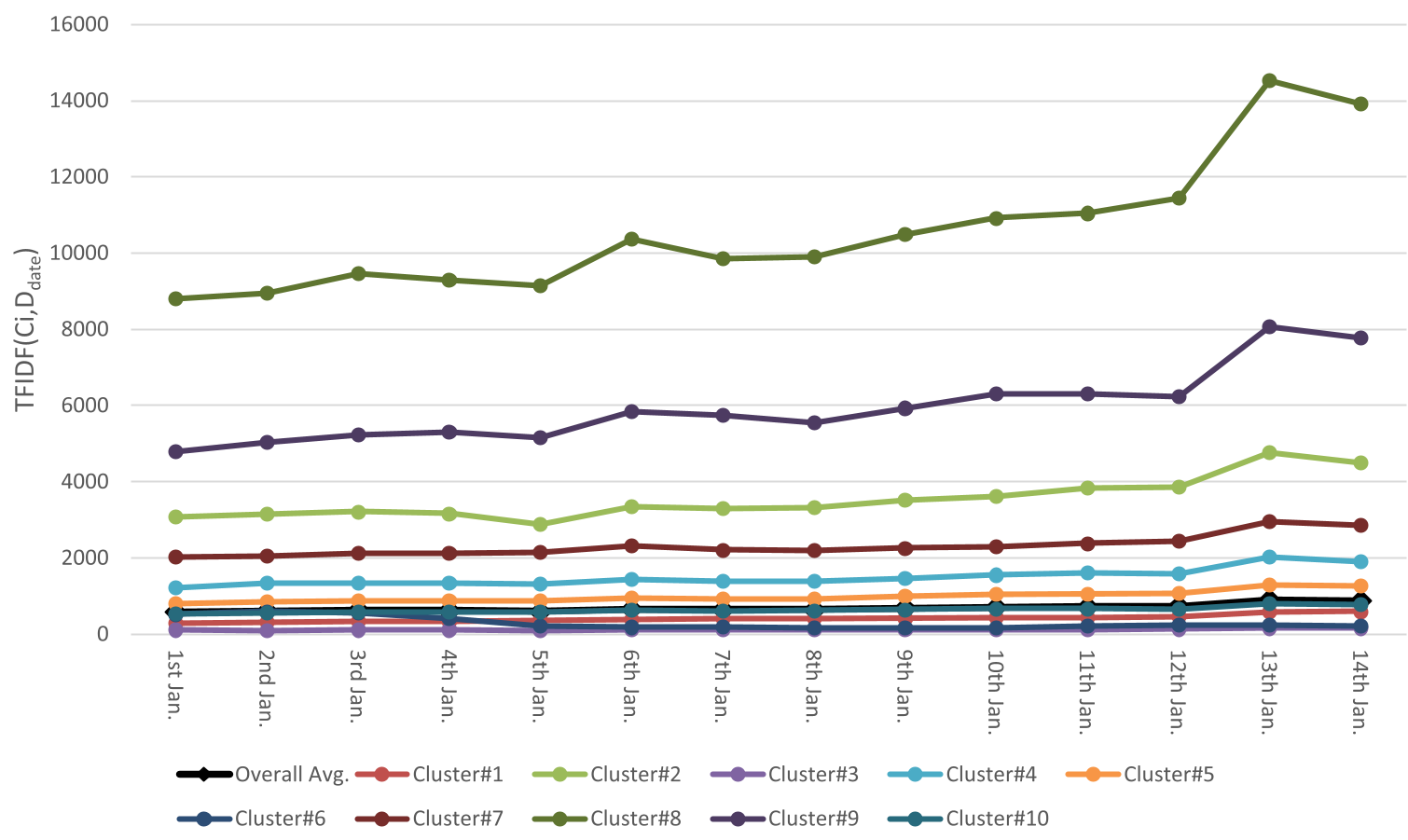 Figure 1: (a) Temporal Cluster Centroids from TFIDF Dataset; (b) Centroids from MaxConf Dataset showing distinct behavioral "shapes".
Experimental Insights: Amazon vs. 7 Net Shopping
The author tested the method on Japanese Twitter data from 2015 and 2016. The findings were revealing:
- 7 Net Shopping: Most followers focused on specific promotions like smartphones and games. The MaxConf (DF) index revealed clusters that surged after January 5th, specifically around Android game promotions.
- Amazon.co.jp: Followers showed a distinct pattern of using emoticons and "face marks" to make tweets friendlier, often appearing in the final days before a retweeting action.
The Variance Ratio (F-Test)
To prove that the shape of the trend matters more than the average, the author used an F-test. If the variance ratio is high, it means the temporal movement of the word counts is a significant feature that simple averages would lose.
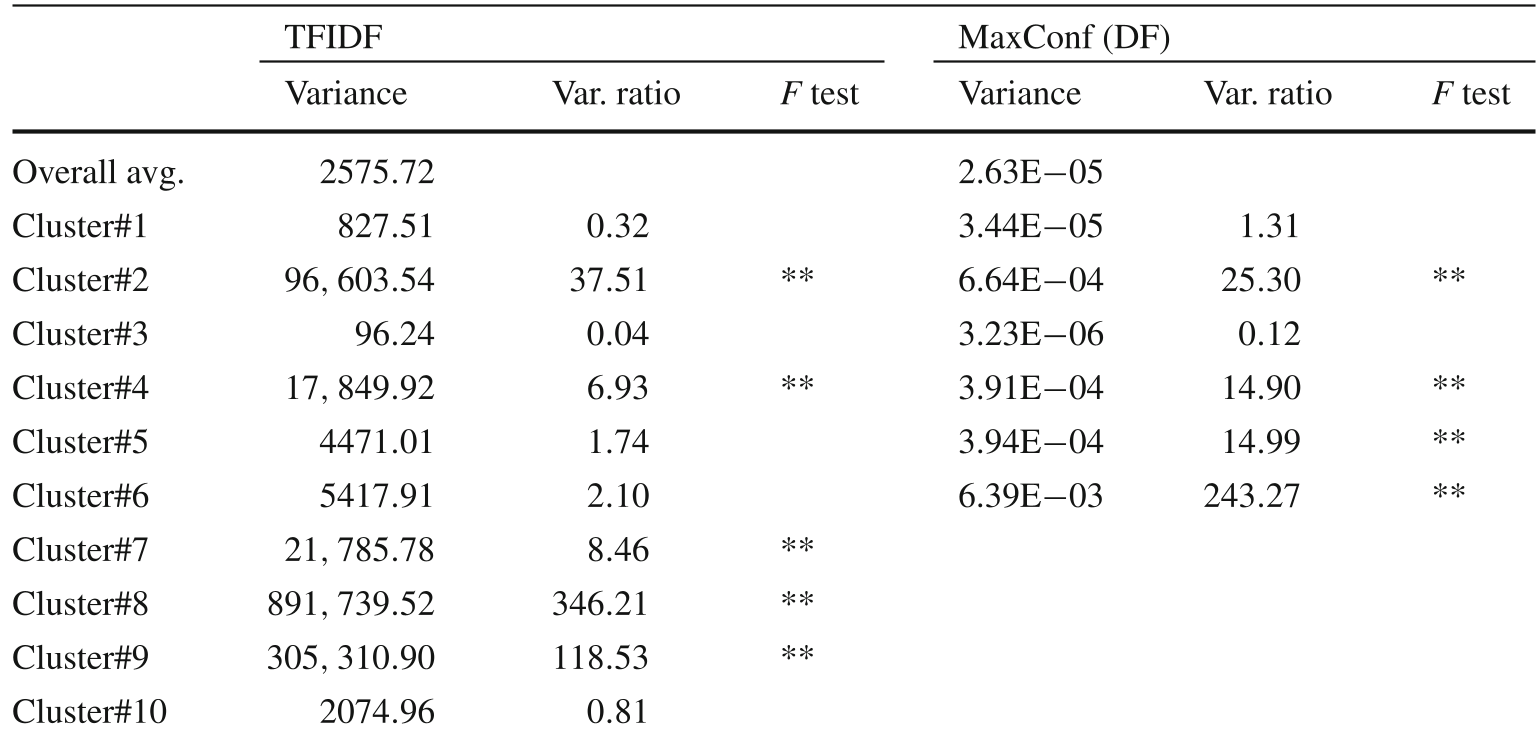 Table: F-test results showing which clusters provide statistically significant temporal information.
Critical Analysis & Future Outlook
Takeaways:
- The method successfully anonymizes the "surface form" of words into statistical patterns. This is powerful for detecting bots or spam because bots often have rigid, mechanical temporal patterns regardless of the specific words they use.
- The use of Sequential Pattern Evaluation Indices allows the model to capture the "logic" of short-text sequences (like Japanese compound nouns) better than standard bag-of-words models.
Limitations: While the method is robust locally, the computation of 19 indices for 1,000+ terms daily is computationally intensive. The dependence on k-means also requires the researcher to manually inspect clusters to assign "meaning."
Future Work: The next logical step is integrating these temporal clusters as explanatory variables in a machine learning model (like a Random Forest or LSTM) to automate the actual prediction of retweets with a high degree of accuracy.
Conclusion
This paper shifts the focus of social media mining from "what is being said" to "how the importance of words fluctuates." By capturing the rhythm of user speech, enterprise users can better identify truly interested followers and filter out the noise of mechanical bots.